In the fall of 2011 at Jefferson Patterson Park and Museum archaeologists discovered an
iron door latch bar during excavations at the Smith's St. Leonard site (18CV91). When
the object was cleaned of dirt and corrosion it revealed a surface decoration that is
rare for iron but found quite often on tin and pewter ware (Smith 1987). This design
is called bold punch work decoration. Punching was a term given to a method of
decorating softer metals such as tin. A blunt tool or "punch" was struck with a
hammer to produce an indentation on the surface of the metal (Arbor 1994). The
Smith's St. Leonard latch bar was found in a brick-capped cellar in front of the
kitchen hearth. The cellar, which dates to the mid-eighteenth century, was
probably filled in quickly during building renovations (Glass, 2013: pers.
comm.).
The latch bar, found in two pieces, has a triangular shaped pivot end with a nail hole
in the center (Fig. 1). The length of the object is eight and three quarter inches.
Halfway down on the exterior side is a slightly raised square containing one solitary
punch decorated circle. Further down the latch is a group of five punched circles
and below them a group of four punched circles divided by the incised lines of
an X. The very end of the latch bar has a vertical incised line and five shorter
horizontal incised lines.
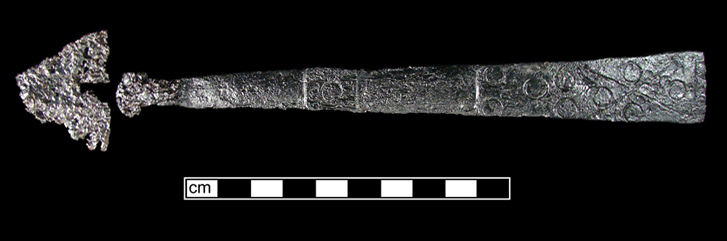 Figure 1. Punched Decorated Latch Bar from the Smith’s St. Leonard Site
found in a brick capped cellar in the kitchen area in front of the hearth.
Figure 1. Punched Decorated Latch Bar from the Smith’s St. Leonard Site
found in a brick capped cellar in the kitchen area in front of the hearth.
This latch bar belongs to a type of early eighteenth-century door hardware referred to
as "Suffolk" latches (Fig. 2), which were made of five pieces. In an early
nineteenth-century treatise, English Metalwork, William Twopenny (1797-1893) coined
the names "Suffolk" and "Norfolk" to describe the two most common styles of thumb
latches. The Suffolk style has no back plate (Kraumanis 2005). Each part of the
Suffolk latch was hand wrought and hand crafted. The five pieces of this
particular door latch are the latch bar, the thumb latch, the keeper, the stapler
or retainer and the curved grasp, which had flattened ends or "cusps" in many
forms, including heart, spade and diamond shaped. These were all hammered out by
the blacksmith (Cotton 1987).
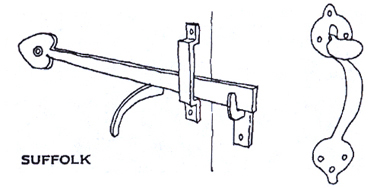 Figure 2. Illustrated example of a Suffolk latch, by Randall Cotton.
The latch bar is attached horizontally across the door at its hinge or pivot end.
About two-thirds of the way across, a staple or retainer holds the latch bar against
the door, while its end rests in a keeper beyond the face of the door. On the
other side of the door is attached the grasp, which has an upper and lower cusp
that were often symmetrical and triangular or heart shaped, and the thumb latch
which protrudes through the door. When the thumb latch is depressed on the grasp
end, the curved bar extending through the door lifts the latch bar above the keeper
and thus the door opens (Cotton 1987).
Certainly it was a blacksmith who forged and shaped the iron latch, but it was another
skilled metal worker, called the "whitesmith," who added the finishing touches and
punch work (Fig. 3). The whitesmiths worked primarily with the lighter colored metals
such as tin and pewter, producing surface designs along with filing and polishing.
Early whitesmith products that exhibit punch work in iron are difficult to find
today, partly because they were never common in the first place (Smith 1987).
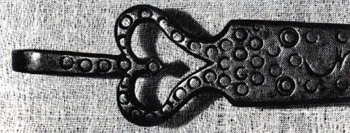 Figure 3. Example of a punched-decorated iron piece that has similar punch patterns
as the latch found at the Smith St. Leonard Site. (Early Iron Ware)
Figure 3. Example of a punched-decorated iron piece that has similar punch patterns
as the latch found at the Smith St. Leonard Site. (Early Iron Ware)
References
Arbor, Marilyn
1994 Tool and Trades of America's Past.
The Mercer Museum Collection.
Cotton, J. Randall
1987 Knobs and Latches. Old House Journal.
Glass, Alex
2013 Personal communication – Maryland
Archaeological Conservation Laboratory.
Kraumanis, Sven
2005 Three Centuries of Door Hardware.
Legacy Vintage Building Materials and Antiques.
Smith, Elmer L.
1987 Early Iron Ware. Applied Arts
Publishers.