The names Spec, Four-eyes and Poindexter all conjure up the image of a person wearing
thick glasses with tape wrapped around the bridge. While these names may bring up
childhood fears for people who wore glasses, at one time having glasses was a symbol of
wealth.
 Painting of Hugh of Saint-Cher by Tomas da Modena in 1352, first known
painting of eyeglasses (Frugonia and McCuaig 2001)
Painting of Hugh of Saint-Cher by Tomas da Modena in 1352, first known
painting of eyeglasses (Frugonia and McCuaig 2001)
The earliest form of today's eyeglasses was seen in first century AD, when a tutor for
Nero used a "globe or glass filled with water" to enlarge and read letters more clearly
(Kriss and Kriss 1998). A form of glasses then appeared in Alhazen's Book of Optics,
which, when translated into Latin, brought Alhazen's findings to Europe and helped bring
about the invention of glasses there in the 13th century (Kriss and Kriss 1998).
In 1907, a German professor claimed that eyeglasses were invented much earlier in India
(Agarwal 1971). According, however, to a sermon given by Friar Giordano da Pisa in 1306,
the first eyeglasses were created in 1286 in Italy (Ilardi 2007). These eyeglasses were
able to correct farsightedness and presbyopia. Later advancement to eyeglasses would come
with Benjamin Franklin's invention of the bifocal (College of Optometrists 2013).
Previously, glasses had been worn in many ways, such as tying the frames with ribbon
around the face, by holding up the glasses by hand or a handle (also called a
lorgnette) or by the bridge of the glasses pinching the nose (called a pince-nez).
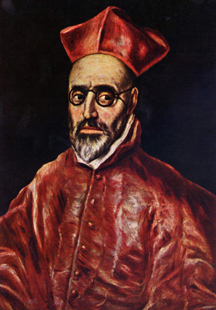 Portrait of Cardinal Fernando Niño de Guevara by El Greco (Greco).
The exact year of the creation of the "modern" way of wearing glasses, with the temple
arms over the ears, is unknown; however, it has been suggested that it started in the
18th century. Today, eyeglasses are worn for protection from the sun and workplace
hazards, for corrective vision and even for style.
A number of eyeglass lenses were found in a privy dating from the 1850s to the 1870s on
the Federal Reserve site in Baltimore (McCarthy and Basalik 1980). During the excavation
of the privy, archaeologists found only the lens of the glasses. The absence of the
surrounding frames could be due to the fact that only 50 percent of the privy was dug
or, more likely, because the frames were made from a cheap metal like copper or
iron that had disintegrated by the time the excavation had begun.
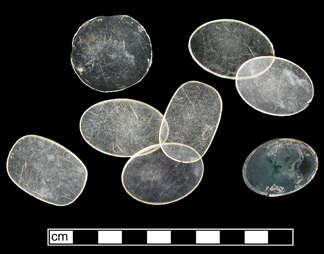 Number of eyeglass lenses found in a privy dating from the 1850s to the 1870s on the Federal
Reserve site in Baltimore
Number of eyeglass lenses found in a privy dating from the 1850s to the 1870s on the Federal
Reserve site in Baltimore
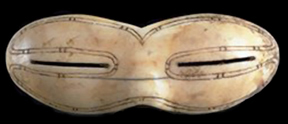 Prehistoric Inuit Snow-Goggles, circa 1200 (Prehistoric, 1997).
In this feature there was also a lens from a pair of sunglasses. The earliest known
sunglasses were made from animal bone by the Inuit people to protect themselves from
the bright northern sun (Acton et al. 2006). Sunglasses were also found in China as
early as the 12th century. The glasses from the Federal Reserve privy were most
likely a form of James Ayscough's tinted lenses. Ayscough started working with
tinted lenses in the middle of the 18th century; however, these green or blue
lenses were used for vision impairments and not for protection against the sun.
The "modern" idea of sunglasses didn’t come about until the early 20th century.
References
Acton, Johnny, Tania Adams, and Matt Packer
2006 Origin of Everyday Things. Sterling, New York.
Agarwal, R.K.
1971 Origin of Spectacles in India. British Journal of
Ophthalmology, 55(2): 128-29.
Canadian Museum of Civilization
1997 Prehistoric Inuit Snow-Goggles, circa 1200.
Canadian Museum of Civilization.
College of Optometrists
2013 The Inventor of Bifocals? The College of
Optometrists. Website. http://www.college-optometrists.org, accessed 2 Aug. 2013.
Frugonia, Chiara, and William McCuaig
2001 Books, Banks, Buttons and Other Inventions from
the Middle Ages. Columbia University Press, New York.
Greco, El
1600 Portrait of a Cardinal. 1600. Oil on canvas.
Metropolitan Museum of Art.
Ilardi, Vincent
2007 Renaissance Vision from Spectacles to Telescopes
Kriss, Timothy C., and Vesna Martich Kriss
1998 History of the Operating Microscope: From Magnifying
Glass to Microneurosurgery. Neurosurgery 42(4): 899–907.
McCarthy, John P. and Kenneth J. Basalik
1980 1980 Summary Report of Archaeological Investigations;
Federal Reserve Bank Site. Mid-Atlantic Archaeological Research, Inc., Newark.