Nothing will ever quite equal that moment of total hilarity that filled my whole body at the moment of
take-off… It was not mere delight. It was a sort of physical rapture… I'm finished with Earth. From
now on our place is in the sky! —Dr Jacques Charles, 1783 (Holmes 2013:17)
For as long as people have looked towards the sky, we have dreamed of flight. While the earliest flying
apparatuses — capes, wings, kites — were less than successful, the late 18th century saw the
first use of hot air and hydrogen-filled balloons, inventions that opened up the skies and captured
the world's imagination.
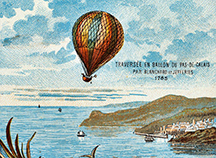 Crossing of the Strait of Dover by Blanchard and Jeffries, 1785 collecting card
printed c. 1890-1900.
Crossing of the Strait of Dover by Blanchard and Jeffries, 1785 collecting card
printed c. 1890-1900.
The first successful balloon launchings took place in Paris in 1783 by Joseph-Michel and
Jacques-Étienne Montgolfier. Although they did not fully understand how hot air worked to lift the
balloons, they were able to demonstrate that they could float at great heights, travel through the
air, and were safe for passengers — the first of which were a sheep, a duck, and a
rooster!
The discovery of hydrogen around the same time allowed for additional experimentation, and shortly
after the Montgolfier brothers' demonstrations, Jacques Charles launched an unmanned hydrogen-filled
balloon. In the following months, a number of aviation firsts were achieved — the first tethered
human flight, the first free flight with human passengers, and in January of 1785, the first
balloon crossing of the English Channel. This daring feat was carried out by Jean-Pierre Blanchard,
an inventor and fame-seeking "aeronaut," and John Jeffries, an American doctor who financed the
operation in exchange for accompanying Blanchard on the flight. Despite a rocky partnership and
difficulties during the voyage, their flight was a great achievement (Bristow 2010:23-25).
Blanchard's success led to a career as a professional balloonist in which he demonstrated balloon
flight for crowds of onlookers. He capped off his international career with the first flight in
the United States in January 1793 with President Washington in attendence (Holmes 2013:20). A
newspaper article describing the event reads, "The celebrated aeronaut made his 45th voyage in
a magnificent balloon from... the city of Philadelphia… amidst the acclamations of an immense concourse
of spectators. His ascension was majestick; he saluted his terrestrial gazers with his
flag…" (Columbian Centinel 1793:2).
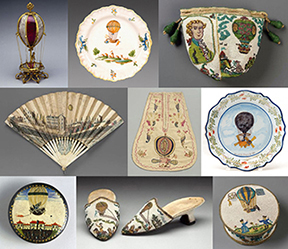 'Ballooniana' objects c. late 18th century A) Scent bottle holder, B) French Faience plate, C)
French beaded bag, D) English fan, E) English embroidered pocket, F) French Faience plate, G)
Snuff box, H) French womens’ shoes, I) French beaded box. From the collections of the
Science Museum (UK), Smithsonian Air & Space Museum, and the Museum of Fine Arts, Boston.
'Ballooniana' objects c. late 18th century A) Scent bottle holder, B) French Faience plate, C)
French beaded bag, D) English fan, E) English embroidered pocket, F) French Faience plate, G)
Snuff box, H) French womens’ shoes, I) French beaded box. From the collections of the
Science Museum (UK), Smithsonian Air & Space Museum, and the Museum of Fine Arts, Boston.
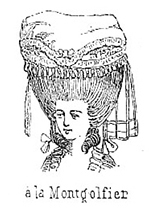 18th century French hairstyle fashioned after the shape of a hot air balloon.
The public was fascinated by balloon flight, and a craze for all things balloon was firmly established.
One resident of Paris wrote, "all one hears is talk of experiments, atmospheric air, inflammable
gas, flying cars, journeys in the sky" (Heppenheimer 2001:9). The rage inspired clothing, jewelry,
and just about every conceivable form of adornment for home or person. Parisian women even
wore their hair "à la Montgolfier" (Lacroix 1876)!
An artifact recently excavated by the Maryland State Highway Administration at Camp Stanton
(18CH305) in Benedict, Maryland appears to be one such "ballooniana" object. This cuff link
features a hydrogen-style balloon with two flags, possibly flying over a seascape. It has
been suggested that this type of motif was commemorative of Blanchard and Jeffries'
crossing of the English Channel (Parker 2013). A nearly identical sleeve link was
recovered from the Halsewell (Carter n.d.), a trade ship that was wrecked off the coast
of England in 1786, just one year after the Channel crossing. Although the ballooning experiments
occurred mainly in Europe, the craze quickly took hold in the newly formed United States as
well. As Crouch (n.d.) explains, "If human beings could break the age-old chains of gravity,
what other restraints might they cast off? The invention of the balloon seemed perfectly
calculated to celebrate the birth of a new nation dedicated… to the very idea of freedom for
the individual."
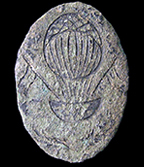 Balloon cuff link from 18CH305.
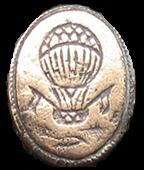 Balloon cuff link from Halsewell shipwreck, c.1786.
However, there is one piece of the puzzle that does not quite fit; the Camp Stanton site, where
the cuff link was excavated, does not date to the late 18th century, but rather to the Civil
War period. The camp was established in 1863 to recruit and train African Americans for the
Colored Infantry Regiments of the Union Army. Early research on the cuff link suggested that
it might be a military button related to the Balloon Corps (Sorensen-Mutchie 2013:4), a
branch of the Army that provided aerial reconnaissance to Union troops. Records indicate that the
Corps was operating in Charles County (Levinthal 2014), just a short distance from Camp Stanton,
and although there is no apparent connection between the Balloon Corps and the US Colored Troops,
it is possible that there was some interaction.
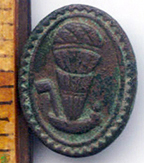 Balloon Corps button, c. 1860s. From the Mount Lowe Preservation Society.
It is important to remember that no archeological site exists within a vacuum, however, and there
are numerous possibilities for how this cuff link came to be in a field in southern Maryland. Did
the owner of a nearby 18th century plantation lose his fashionable balloon cuff link long before
Camp Stanton existed? Was an old cuff link repurposed at a later date? Or was an early ballooning
motif recycled on a 19th century object? While we will never know the exact story behind the
artifact, it illustrates just how momentous the development of flight really was and how the
ability to fly has changed our world.
References
Bristow, David L.
2010 Sky Sailors: True Stories of the Balloon Era.
New York: Farrar Straus Giroux.
Carter, David
n.d. Halsewell 1786.
http://www.weymouthlunarsociety.org.uk/halsewell.htm, accessed January 24, 2014.
Columbian Centinel
1793 M. Blanchard.
http://www.rarenewspapers.com, accessed January 24, 2014.
Crouch, Tom D.
n.d. The Birth of the Balloon.
http://www.airandspace.si.edu/collections/group/the-birth-of-the-balloon,
accessed January 24, 2014.
Heppenheimer, T.A.
2001 A Brief History of Flight From Balloons to Mach
3 and Beyond. New York: John Wiley and Sons, Inc.
Holmes, Richard
2013 Falling Upwards: How We Took to the Air.
New York: Pantheon Books.
Lacroix, Paul
1876 The Eighteenth Century, Its Institutions, Customs
and Costumes. France 1700-1789. New York: Scribner, Welford, and Armstrong.
http://www.americanrevolution.org/clothing/frenchfashion.html, accessed January 24, 2014.
Levinthal, Aaron
2014 Personal Communication. January 15, 2014.
Parker, Mark
2013 Early to Rise. Western and Eastern Treasures
Magazine, Vol. 47.
Sorensen-Mutchie, Nichole
2013 Artifact Analysis: Military Balloon Button. Maryland
State Highway Administration Cultural Resources Bulletin, Vol. 5, Issue 1.