Alex Glass, MAC Lab Public Archaeology Asst.
Death in the 18th century was a common occurrence. Funeral customs during this period were,
"attended by as much ceremony and display as the family resources permitted" (Olson 1999). This
was part of an 18th century trend whereby death and funeral customs were becoming more
commercialized, as the increasing availability of mourning clothes, jewelry and invitations
pushed these traditions into wider practice (Holme 2004) (Fig 1).
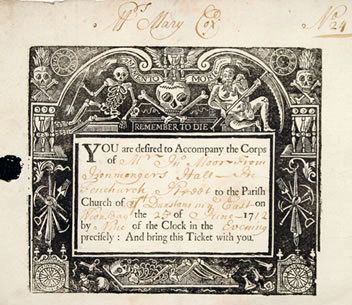 Invitation to the Funeral of Mr. John Moor - 1712, (2006.7)
Gilbreath-McLorn Museum Fund, University of Missouri, Art and Archaeology
Museum, Online Exhibit, "Final Farewell: The Culture of Death and the Afterlife."
http://maa.missouri.edu/exhibitions/finalfarewell/memento2.html.
Invitation to the Funeral of Mr. John Moor - 1712, (2006.7)
Gilbreath-McLorn Museum Fund, University of Missouri, Art and Archaeology
Museum, Online Exhibit, "Final Farewell: The Culture of Death and the Afterlife."
http://maa.missouri.edu/exhibitions/finalfarewell/memento2.html.
Archaeologically, jewelry would preserve better in the ground over time than paper invitations
and clothing, although it is not found frequently. At the Smith's St. Leonard site, at JPPM,
a small copper finger ring fragment was found near a 1711 house foundation. Unfortunately,
because of its fragmentary state, it isn’t possible to say whether or not the Smith ring is
a mourning ring. However, the black enamel that was revealed after conservation is frequently
associated with mourning jewelry.
Mourning rings were made of gold, silver, or copper. The bands were typically enameled in black
or white: black enamel for individuals who were married, and white enamel for those who were
not (Barton 2013, White 2005). The name of the deceased, their age and date of death were also
included on the band. More ornate rings could also feature death-related symbols,
coffin-shaped stones, portraits, or hair fragments from the deceased (White 2005) (Fig 2).
 Figure 2. - A: White Enameled Mourning Ring with Clear Crystal and Skull Decoration,
http://artgallery.yale.edu/collections/objects/mourning-ring-7#sthash.AKINw4wJ.dpuf;
B: Eye Portrait Mourning Ring, http://www.britishmuseum.org/research/collection_online/collection_object_details.aspx?objectId=40562&partId=1&searchText=mourning+ring&images=true&page=1;
C: Black Enameled Mourning Ring with Pick, Shovel, Wings, Hourglass and Bone imagery,
http://www.britishmuseum.org/research/collection_online/collection_object_details.aspx?objectId=34466&partId=1;
D: Coffin Shaped Stone Mourning Ring,
http://www.britishmuseum.org/research/collection_online/collection_object_details.aspx?objectId=41915&partId=1&searchText=mourning+ring&images=true&page=2.
Figure 2. - A: White Enameled Mourning Ring with Clear Crystal and Skull Decoration,
http://artgallery.yale.edu/collections/objects/mourning-ring-7#sthash.AKINw4wJ.dpuf;
B: Eye Portrait Mourning Ring, http://www.britishmuseum.org/research/collection_online/collection_object_details.aspx?objectId=40562&partId=1&searchText=mourning+ring&images=true&page=1;
C: Black Enameled Mourning Ring with Pick, Shovel, Wings, Hourglass and Bone imagery,
http://www.britishmuseum.org/research/collection_online/collection_object_details.aspx?objectId=34466&partId=1;
D: Coffin Shaped Stone Mourning Ring,
http://www.britishmuseum.org/research/collection_online/collection_object_details.aspx?objectId=41915&partId=1&searchText=mourning+ring&images=true&page=2.
The Smith's St. Leonard ring probably would have been less elaborate. It is copper, possibly a
copper alloy called "Pinchbeck," which closely resembles gold in appearance (Oxford English Dictionary).
The band appears to have been broken or cut, possibly damaged when the site was plowed after it had been
deposited. The center stone is also missing. The exterior of the band has some remaining black enamel as does
the back of the ridged setting (Fig. 3).
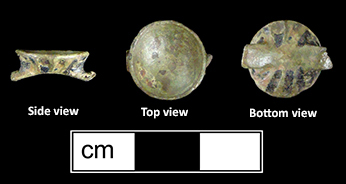 Figure 3. Smith's St. Leonard ring with center stone missing, and the exterior of the band and back of
the ridged setting showing some remaining black enamel.
Figure 3. Smith's St. Leonard ring with center stone missing, and the exterior of the band and back of
the ridged setting showing some remaining black enamel.
Mourning rings are mentioned several times in the probate inventories and wills of the Smith family who
lived at the site. In 1748, Richard Smith bequeathed to his brother John, "the mourning ring sent me
by my uncle Bennett after the death of his wife, my aunt" (MSA, Wills, 477-478). Nathaniel Smith gave
his cousins, "Young Parran and Elizabeth his wife each of them a genteel suit of mourning which I
request they wear for my sake" (MSA, Wills, 390-391) John Smith stated in his will that his twin
cousins, Richard and Charles Smith were also to receive "each of them a suit of mourning" (MSA,
Wills, 105-106) John also left to Susannah Mackall, daughter of a close family friend, James
John Mackall, "the mourning ring my brother Nathaniel Smith left me" (MSA, Wills, 105-106). When
John died in 1754, "2 small mourning Rings 40/ - 2 Larger 50/" were listed in his probate inventory
(MSA, Inventories and Accounts, 446-451). The Smith's inventories and wills indicate mourning
rings, as well as clothing, were a sentimental and valuable item. Not only were provisions made
for extended family to receive suits of mourning, they also received mourning rings that were
handed down from family member to family member. The wills and probate inventories of the
Smith's—and likely their artifacts—suggest that as a prominent family in colonial
Maryland they were active participants in the growing material aspect of mourning.
References
Barton, Caroline
2013 "Mourning rings: portable and poignant souvenirs."
British Museum Blog, accessed 2/2/2014,
http://blog.britishmuseum.org/2013/10/31/mourning-rings-portable-and-poignant-souvenirs/.
Holme, Christine
2004 "Sentimental Cuts: 18th century Mourning Jewelry
with Hair" Eighteenth-Century Studies. Vol. 38, No. 1 Hair (Fall, 2004) pp.139-143.
Olsen, Kristin
1999 Daily Life in 18th-century England.
Greenwood Press. Westport, CT.
Oxford English Dictionary
2014 Oxford English Dictionary. Oxford University
Press. OED Online, accessed 28/2/1014, http://www.oxforddictionaries.com/us/.
White, Carolyn L.
2005 American Artifacts of Personal Adornment,
1680-1820: A Guide to Identification and Interpretation. Altamira Press, Lanham.
Image Sources
Figure 1
Invitation to the Funeral of Mr. John Moor,
http://maa.missouri.edu/exhibitions/finalfarewell/memento2.html.
Figure 2
A: White Enameled Mourning Ring with Clear Crystal and Skull Decoration,
http://artgallery.yale.edu/collections/objects/mourning-ring-7#sthash.AKINw4wJ.dpuf.
B Eye Portrait Mourning Ring,
http://www.britishmuseum.org/research/collection_online/collection_object_details.aspx?objectId=40562&partId=1&searchText=mourning+ring&images=true&page=1.
C Black Enameled Mourning Ring with Pick, Shovel, Wings, Hourglass and Bone imagery,
http://www.britishmuseum.org/research/collection_online/collection_object_details.aspx?objectId=34466&partId=1 .
D Coffin Shaped Stone Mourning Ring,
http://www.britishmuseum.org/research/collection_online/collection_object_details.aspx?objectId=41915&partId=1&searchText=mourning+ring&images=true&page=2