One of the most widespread and colorful fraud schemes in early America came in the form of
medicinal cure-alls. Promising to heal anyone from all kinds of ailments, these attractive
and inexpensive remedies were eagerly purchased by customers. Besides being swindled
out of their money, many patrons had no idea how dangerous these products really were
and what they actually contained.
The first proprietary medicines arrived from England in 1723 (Sellari 1975:66). A select
few were rewarded with patents of royal favor, indicating they were used by the royal
family. These became the most popular imported medicines, including Turlington's Balsam
of Life (Figure 1). After import restrictions related to the Revolutionary War, production
of American-made medicines increased to fill public demand. These alternatives not only
provided a feeling of nationalistic pride but were also less expensive than their
English counterparts (Munsey 1970:65).
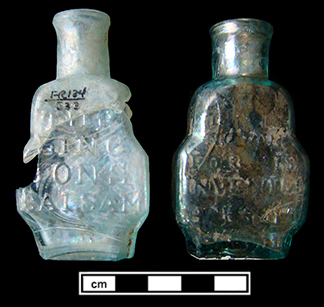 Figure 1: Two Turlington’s Balsam of Life bottles, the left from the Schiefferstadt House
site in Frederick, Maryland and the right found at the Federal Reserve Bank site
in Baltimore City, Maryland. Its unusual bottle shape and embossed letters were used to
distinguish the real version from counterfeits.
Figure 1: Two Turlington’s Balsam of Life bottles, the left from the Schiefferstadt House
site in Frederick, Maryland and the right found at the Federal Reserve Bank site
in Baltimore City, Maryland. Its unusual bottle shape and embossed letters were used to
distinguish the real version from counterfeits.
Collectively these products were referred to as nostrum remedium, 'our remedy,' and patent
medicines (Hagley 2014). Contrary to what the name would suggest, the majority of
patent medicines were not actually patented. The patenting process required the manufacturer
to list every ingredient in the product. Instead, creators would protect their medicines
by registering the name or any unique marks related to the brand itself (Fike 1987:3,
Munsey 1970:65).
Patent medicines became popular among the poor as inexpensive alternatives to potentially
suspicious doctors. These remedies were available without a prescription and simple enough
for the average person to understand. At the height of their popularity patent medicines appeared
in numerous forms such as: balsams, syrups, extracts, tonics, sarsaparillas, cures, remedies,
and bitters. These products claimed to cure anything and sometimes everything including: chills,
fever, aches, pains, dysentery, liver complaints, cancer, consumption, indigestion, various bowel
disorders, female complaints and many others. However, many of these so called medicines were
simply combinations of vegetable extracts, water, sugar and alcohol. Others also included more
harmful and addictive ingredients, including morphine, opium, and cocaine (Fike 1987:3). Many of
these were even marketed for use with young children and infants (Figure 2).
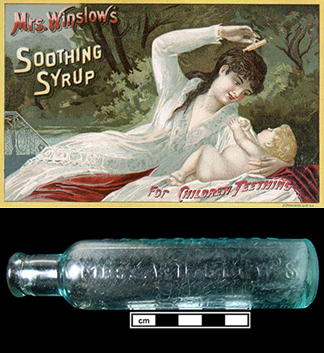 Figure 2: A Mrs. Winslow's Soothing Syrup bottle from the Horpel Collection and an advertisement
card for the medicine. Mrs. Winslow's syrup was advertised to relieve pain in teething
children with descriptions like, "Just wan teaspoonful of Winslow's an' they lay like the
dead till mornin'." However, with its high opium content many children showed signs of
developing addictions and some never woke up (Adams 1905).
Figure 2: A Mrs. Winslow's Soothing Syrup bottle from the Horpel Collection and an advertisement
card for the medicine. Mrs. Winslow's syrup was advertised to relieve pain in teething
children with descriptions like, "Just wan teaspoonful of Winslow's an' they lay like the
dead till mornin'." However, with its high opium content many children showed signs of
developing addictions and some never woke up (Adams 1905).
During the peak of the patent medicine era, 1880-1900, marketing and sales pitches were everywhere.
Advertisements and testimonials promoting nostrums appeared in all sorts of publications, even
medical journals. Publishers became dependent on this lucrative ad revenue and typically
sided with medicine companies against any proposed legislation (Adams 1905, Hagley 2014).
Medicine pitch men also began traveling from city to city selling their medicines. The
most elaborate of these shows were similar to circuses with traveling wagons, live entertainment,
exotic costumes and music to gather the crowd. The Kickapoo Medicine Company was the largest of
these organizations with as many as 75 shows touring on regular circuits (Munsey 1970:67). Patent
medicines became so conventional that one of the most popular brands of Bitters, Hostetter's,
was even given to Civil War infantrymen to boost their spirits before battle (Sellari 1975:39).
This began to change in 1905, when Samuel Hopkins Adams published a series of investigative
articles in Collier's Weekly entitled, "The Great American Fraud" (Figure 3). This was the
first time the general public was exposed to any honest criticism of patent medicines. Adams
described the secret ingredients included in nostums and their harmful effects, citing
numerous examples. Readers were shocked by descriptions of opium-addicted children and
young women dying from headache cures. Adams argued that unless legislation regulated
the ingredients and marketing of patent medicines, people would continue to die from
these deceptive poisons (Adams 1905, Munsey 1970:69).
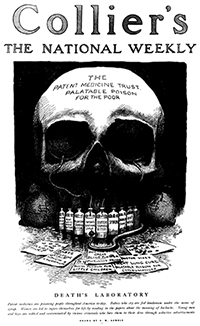 Figure 3: The cover image of Collier's Weekly highlighting the Great American Fraud articles.
This dramatic image would have easily attracted readers and further emphasized Adam's point
that these medicines were merely poisons.
Figure 3: The cover image of Collier's Weekly highlighting the Great American Fraud articles.
This dramatic image would have easily attracted readers and further emphasized Adam's point
that these medicines were merely poisons.
Many believe the public attention gained from these publications caused the federal
government to finally take action with the creation of the Pure Food and Drug Act of 1906.
This required all products containing alcohol, morphine, opium, cocaine, heroin,
chloroform, cannabis or acetanilide to label their products as such. It also
prohibited distributers from making misleading and fraudulent claims about the
effectiveness of their drugs (Fike 1978:3, Lindsey 2014). After bad press and
continued legislation, the market for patent medicines decreased dramatically and
never recovered. However today, the flashy patent medicine era is still remembered
through popular culture and historical reenactments.
References
Adams, Samuel Hopkins
1905 "The Great American Fraud. Collier’s Weekly
36.2.
Fike, Richard E.
1987 The Bottle Book. Gibbs M. Smith Inc., Salt
Lake City, UT.
Hagley Museum and Library
2014 "History of Patent Medicine." Accessed March 26, 2014.
http://www.hagley.org/online_exhibits/patentmed/history/history.html.
Lindsey, Bill
2014 "Medicinal Bottles." Accessed March 21, 2014.
http://www.sha.org/bottle/medicinal.htm.
Munsey, Cecil
1970 The Illustrated Guide to Collecting Bottles.
Hawthorne Books, New York, NY.
Sellari, Carlo and Dot
1975 The Illustrated Price Guide of Antique Bottles.
Country Beautiful, Waukesha, WI.
Image Sources
Figure 2
Winslow's Soothing Syrup Advertisement –
http://www.sha.org/bottle/Typing/medicine/winslowstc.jpg
Figure 3
Death's Laboratory –
http://commons.wikimedia.org/wiki/File:DeathsLaboratory.gif