Archaeological work done in advance of the Federal Reserve Bank construction in Baltimore in 1980
yielded the usual array of filled privies, wells and cellar holes. But under Barre Street,
archaeologists discovered a twenty-foot long section of drainpipe containing thousands of
early twentieth-century artifacts concreted into a solid mass filling the bottom half of
the pipe (McCarthy and Basalik 1980). A little documentary research revealed that the contents
of the pipe were associated with a Chinese-owned commercial laundry located nearby.
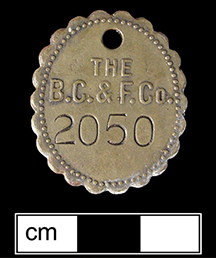 Tool check or worker identification tag from the Baltimore Clothing and Furnishing
Company.
Tool check or worker identification tag from the Baltimore Clothing and Furnishing
Company.
In addition to thousands of straight pins, buttons, safety pins, coins, pieces of jewelry and other
clothing-related items from the pipe, an oval copper alloy disk stamped "B.C. & F. Co. 2050" was
found. This item served as a worker identification tag or as a tool check tag. Tool checks were
used by factory workers to requisition tools; each tag bore the worker's identification number. If
the tool had not been returned at the end of the day, the number would be used to track down the
missing tool to the employee who had checked it out.
A New Jersey newspaper advertisement from 1908 revealed that "B. C. & F." were the initials of
The Baltimore Clothing and Furnishing Company (Red Bank Register 1908), a firm that, in accordance with
garment trade industry standards, produced men’s suits, trousers, sport coats, and overcoats,
as well as men's pajamas, hosiery, ties, underwear and shirts (Kahn 1989:xiii).
This small item is a very tangible reminder of Baltimore's prominent position in the nation's garment
industry. The manufacture of clothing was in its Baltimore heyday in the late 19th and early 20th
centuries, ranking fourth in the nation in 1900 (Stanger 1999). Large clothing production companies
began to replace smaller sweatshops in the early 20th century to satisfy the demand for ready-made
clothing. The mechanization and assembly-line nature of these larger operations maximized efficiency
and profits, but resulted in a workforce that was less skilled overall (Argersinger 1991:86).
The industry provided jobs for recent immigrants to the city, with well over half of the employed
being adult and teenaged females working in low-skill and low wage positions. Skilled
positions—cutting, trimming and pressing—were reserved for men. Worker discontent over
long hours, deplorable working conditions and low wages sparked a number of strikes, the first of
which occurred in 1890 (Kahn 1989:80). Attempts to unionize the workforce were not long in coming
and two competing unions, the United Garment Workers (UGW) and the Amalgamated Clothing Workers
of America (ACWA), struggled for control in Baltimore's men's clothing industry during the early
twentieth century (Argersinger 1991:90).
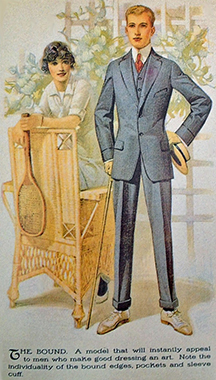 1914 advertisement for L. Greif & Brothers, a leading Baltimore clothing firm.
Photograph from Kahn 1989.
1914 advertisement for L. Greif & Brothers, a leading Baltimore clothing firm.
Photograph from Kahn 1989.
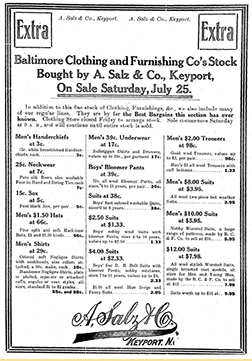 An advertisement from the July 22, 1908 Red Bank Register of Red bank, New Jersey showing the sale
of clothing from the Baltimore Clothing and Furnishing Company.
An advertisement from the July 22, 1908 Red Bank Register of Red bank, New Jersey showing the sale
of clothing from the Baltimore Clothing and Furnishing Company.
References
Argersinger, Jo Ann E.
1991 The City that Tries to Suit Everybody: Baltimore's Clothing
Industry. In The Baltimore Book; New Views of Local History. Edited by Elizabeth Fee, Linda
Shopes and Linda Zeidman. Temple University Press, Philadelphia, pp. 80-101.
Kahn, Philip, Jr.
1989 A Stitch in Time; The Four Seasons of Baltimore's
Needle Trades. Maryland Historical Society, Baltimore, Maryland.
McCarthy, John P. and Kenneth J. Basalik
1980 Summary Report of Archaeological Investigations Federal
Reserve Bank Site, Baltimore, Maryland. Report prepared for the Maryland Historical Trust by
Mid-Atlantic Archaeological Research, Inc., Newark, Delaware.
Red Bank Register
1908 Advertisement for A. Salz & Co. Red Bank Register,
Red Bank, New Jersey. Volume XXXI, No. 5, p. 11 (July 22, 1908).
Stanger, Howard R.
1999 Review of Making Amalgamated: Gender, Ethnicity
and Class in the Baltimore Clothing Industry, 1899-1939. Jo Ann Argersinger. Johns
Hopkins University Press, Baltimore. Reviewed on EH.Net in November 1999. Website
http://www.h-net.org/reviews/showrev.php?id=3567, accessed October 30, 2013.