From 1840 through the 1960s, Carroll County was the world's leading producer of Wormseed Oil, an
uncommon product today but a vital one at the turn of the century. Wormseed Oil was a popular
vermifuge, a deworming treatment for livestock as well as humans until the modern pharmaceutical
industry developed synthetic drugs and other treatments in its place. The Rockefeller Foundation
was an important influence in pressing for its use in the treatment of hookworm (Graybeal 2000).
During the height of production, more than 1500 acres across the county were dedicated to the
cultivation of Wormseed (Chenopodium ambrosioides), an annual plant that grows between 3
and 4 feet tall and prefers loamy soils. When the plant is mature, it is cut and left to dry in
the fields, and then gathered in the early morning when the dew protects the delicate seedpods from
shattering (Teunis 2001).
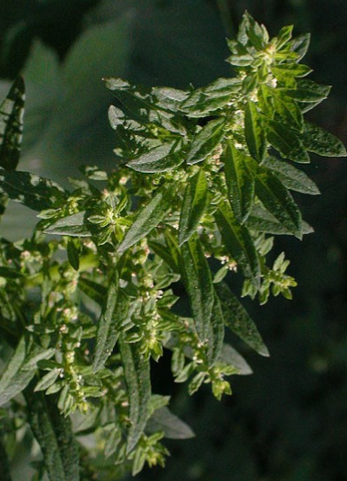 Seedpods of the Wormseed plant contain the valuable oil.
The plants are then packed into large iron kettles for steam distillation, which extracts the precious
oil. A boiler discharges steam into the kettle and in turn the volatile oil is released from the
plant and mixes together with the water vapor. It then passes through a condenser and the liquid
oil and water gather in a trough where the water is removed by allowing the oil to rise to the top
and the water drained off. This liquid is often distilled a second time, which will produce a
heavier oil of higher grade(Teunic 2001). Specific gravity was the primary means of determining
the quality of the product. This 10 hour process could produce up to 100 pounds of wormseed oil.
At its most profitable, 1 pound of oil could fetch as much as $11.50 (Warner 1976)!!!
During the Prohibition Era, visitors to Carroll County were shocked at the flagrant display of
distillation, not realizing the product in question was not alcohol, though perhaps some residents
exploited the situation (Democratic Advocate 1929).
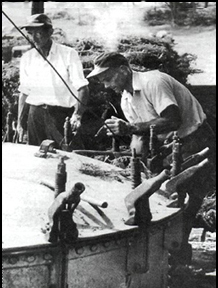 Fastening the clips on a Wormseed Kettle. http://www.farmcollector.com.
Farm Museum staff retrieving the kettles from a farmstead in Sykesville, MD in January. Two of
these wormseed kettles were recently acquired by the Carroll County Farm Museum with the
intention to create an educational display commemorating this unique period of the county's
agricultural history. The Museum is also interviewing the local families who owned and worked
on wormseed farm and still sites to preserve the living historical record (John Sies and
Mark Duvall, personal communication, March 5, 2014 and March 27, 2014). The Maryland
Archaeological Conservation Laboratory is collaborating on this project, providing conservation
advice, and advocacy for the realization of the exhibit. For additional information on the
progress of the Farm Museum's wormseed project and their many events and activities, visit
their website at www.carrollcountyfarmmuseum.org.
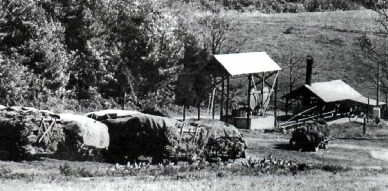 View of a Wormseed Distillery. http://www.farmcollector.com.
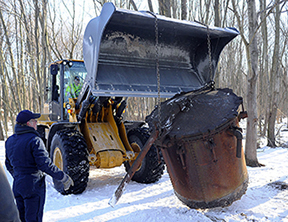 Farm Museum retrieving the kettles from a farmstead in Sykesville, MD in January.
"Autoists have come back with wild stories of stills in public places around Eldersburg, but
they are stills for the production of the only known cure for hookworm." (Democratic Advocate 1929).
References
Graybeal, Jay A.
2000 Carroll Lead World in Wormseed Oil Production,
Carroll County Times, accessed March 6, 2014.
Sandoval, Timothy
2014 Farm Museum Aims to Erect Wormseed Oil
Exhibit, Carroll County Times, accessed March 6, 2014.
Teunis, Jill
2001 Boiling Oil. Farm Collector. Web resource
http://www.farmcollector.com/tractors/boiling-oil.aspx#axzz35YuKrbOa, accessed June 18, 2014.
Warner, Nancy B., et al.
1976 Carroll County, Maryland: A History 1837-1976.
Carroll County Bicentennial Committee. p.168-169.
Democratic Advocate
1929 Democratic Advocate, November 27, 1929,
accessed June 19, 2014.