Any trip to a Rite Aid or the pharmaceutical section of a big box store will yield row
upon row of brightly-colored bottles and jars containing beauty products that guarantee
to make our hair thicker, our skin more luminous and our teeth pearly white. We might
walk into the store for a simple roll of toilet paper, but leave with a bag
bulging with the promise of good health and sex appeal. The populace of early
19th-century Baltimore was apparently no less susceptible to similar product promises
of their own time.
A privy associated with the Bull’s Head Tavern site (18BC139) in Baltimore yielded these
two colorful examples of early 19th-century tin-glazed ointment pots. Ceramic vessels of
this type were used by apothecaries, perfumers and dentists to hold a variety of cosmetic
and medicinal products, including tooth powders and ointments that often contained
interesting ingredients, like bear grease or even beeswax (Houghton and Priestley 2005:7,
Victorian 2014).
 Figure 1: Early 19th-century tin-glazed ointment pot found in privy at the
Bull's Head Tavern site (18BC139) in Baltimore.
Figure 1: Early 19th-century tin-glazed ointment pot found in privy at the
Bull's Head Tavern site (18BC139) in Baltimore.
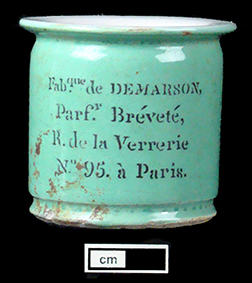 Figure 2: Early 19th-century tin-glazed ointment pot found in privy at the Bull's
Head Tavern site (18BC139) in Baltimore.
Figure 2: Early 19th-century tin-glazed ointment pot found in privy at the Bull's
Head Tavern site (18BC139) in Baltimore.
While the majority of tin-glazed ointment pots were plain, each of the Bull's Head
Tavern pots had been stenciled in French with the names and addresses of Parisian
businesses. One pot is labeled Delacour, P.f./R. De Richelieu/au coin celle d/Menars,
Paris, translated as "Delacour, Perfumers/ Richelieu Street at the corner of Menars, Paris."
In the first half of the nineteenth century, Rue de Richelieu was one of the most
fashionable streets in Paris (Rue de Richelieu 2014). Ointment pot found in privy at
Bull's Head Tavern in Baltimore.The other ointment pot, marked
Fab.que de Demarson,/ Parf.r Brevete/ R. De la Verrerie/No. 95. a Paris, indicates
that the patented product inside was made by the Demarson perfumers, located at 95
Verrerie Street in Paris. This perfumer was established in 1815 as Demarson, and later
went by a variety of names, most recently Plassard (Obscure French Perfume Companies 2014).
The wearing of scent to mask offensive body odors has a history stretching back at least as
far as Biblical times. Perfume received official recognition in 1656 from the French with the
establishment of the Guild of Glove and Perfume Makers (Dugan 2011). Although once restricted
to the wealthy, perfume products began to come into wide use in the nineteenth century (Briot 2011).
French perfume today carries a certain cachet; the names Guerlain, Chanel, Coty and Balmain are
among the many French perfume houses sold today in the United States and many of these companies
are over a hundred years old. One hundred thirty nine perfume houses were recorded in Paris in
1807; these manufacturers were supplied by large flower farms located primarily in Grasse or
Cannes (Briot 2011).
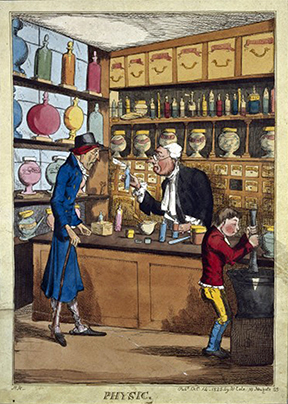 Figure 3: The interior of an English pharmacy, circa 1825. Coloured etching by H. Heath,
Wellcome Image Library. http://marinni.livejournal.com/456482.html
Figure 3: The interior of an English pharmacy, circa 1825. Coloured etching by H. Heath,
Wellcome Image Library. http://marinni.livejournal.com/456482.html
A government report on the 1893 Chicago Columbian Exposition stated "The names of Paris and France
are somehow synonymous with elegance and beauty, and the visitor who was familiar with the
name of the French scientists in medicine, surgery, and pharmacy was not disappointed when he
visited the French section… It was not hard to discover that in the line of perfumes France
took the lead" (Humphrey 1901:1351-1352). Just as today's consumers equate French products with
style and elegance, the presence of these French perfume pots apparently meant the residents
at the Bull's Head Tavern site did too.
References
Briot, Eugenie
2011 From Industry to Luxury: French Perfume in the
Nineteenth Century. Business History Review 85 (Summer 2011): 273-294.
Dugan, Holly
2011 The Ephemeral History of Perfume: Scent
and Sense in Early Modern England. Johns Hopkins University Press, Baltimore.
Houghton, R.J. And M.R. Priestley
2005 Historical Guide to Delftware and Victorian
Ointment Pots. Copyright Bob Houghton and Mark Priestley. Printed by Croxson.
Humphrey, J.D.
1901 Pharmacy. World's Columbian Exposition Report of
the Committee on Awards of the World’s Columbian Exposition, Volume II, pp. 1349-1362.
Government Printing Office, Washington, D.C.
http://archive.org/stream/worldscolumbian01awargoog/worldscolumbian01awargoog_djvu.txt,
website accessed 7-31-2014.
Obscure French Perfume Companies
2014 Obscure French Perfume Companies and their Perfumes.
http://www.ebay.com/gds/Obscure-French-Perfume-Companies-and-their-Perfumes/10000000004222286/g.html,
website accessed 7-30-2014.
Rue de Richelieu
2014 Rue de Richelieu.
http://en.wikipedia.org/wiki/Rue_de_Richelieu, website accessed 7-31-2014.
Victorian
2014 Victorian Ointment Pots.
https://sites.google.com/site/ointmentpots. Website accessed 7-31-2014.