During construction of the Inter County Connector (ICC), under the supervision of the
Maryland State Highway Administration (SHA), many artifacts were found at the Jackson
Homestead site (18MO609) in Montgomery County, Maryland. These are part of a multicomponent
site that includes both prehistoric (Middle Archaic through Late Woodland period) and historic
components. One of the historic components was a nineteenth to twentieth century African-American
dwelling called the Jackson Homestead (ICC Report 2011).
Among the many construction and farm tools found at this site was a fragmentary iron draw knife
(Fig. 1). This recovered object, which had pitting and iron corrosion, has a 43 centimeter blade
with a 10 centimeter tang angled inwards slightly; the other tang was broken off. The wood
handles originally covering the tangs did not survive the burial condition in which the knife
was found. The draw knife was a very versatile tool and essential on all farms in the nineteenth
to twentieth centuries. It would have a cutting blade of varying lengths with tangs forged at
each end and bent at right angles on level with the blade and then fitted with turned wooden
handles (Bealer 1976) (Fig. 2). In many cases, the tangs would go all the way through the wooden
handles and be riveted in place for greater strength (Wildung 1957). A blacksmith would fashion
one out of an old file, hammering and drawing it out, shaping then grounding out a sharp edge
to form a blade with handles on either side level with the blade or somewhat below (Wildung 1957).
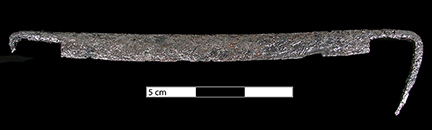 Figure 1: Drawknife found at Jackson Homestead in Montgomery County, MD, after
conservation treatment. (Photo by Caitlin Shaffer, MAC Lab)
Figure 1: Drawknife found at Jackson Homestead in Montgomery County, MD, after
conservation treatment. (Photo by Caitlin Shaffer, MAC Lab)
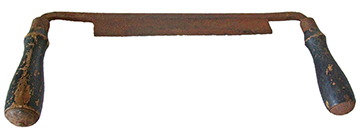 Figure 2: This drawknife may be very similar to the Jackson Homestead drawknife.
Image found on web, http://commons.wikimedia.org/wiki/File:ZiehmesserTop.jpeg#mediaviewer/File:ZiehmesserTop.jpeg.
Figure 2: This drawknife may be very similar to the Jackson Homestead drawknife.
Image found on web, http://commons.wikimedia.org/wiki/File:ZiehmesserTop.jpeg#mediaviewer/File:ZiehmesserTop.jpeg.
Because of the general use of the tool, everyone learned to use it. For the most part, a draw knife
was used to shape wood by trimming off excess and bark by pulling or drawing (hence the name)
the knife towards the user (Fig. 3). To carry out this safely, the wood being worked had to be
held steady in a vise on a secure bench top or while clamped in a shaving horse (Bealer 1976).
Other uses of the draw knife were in tapering the sides of shingles, rough sizing the edges of
floor boards and rough trimming paneling before planing them. The draw knife was used to shape
axe handles, rake handles, stool legs and wheel spokes. Other tools, such as the spokeshave
and scraper, were used for the more delicate finishing after the initial rough work was done by
the draw knife (Sloane 1964).Illustration of various size and shapes of drawknifes.
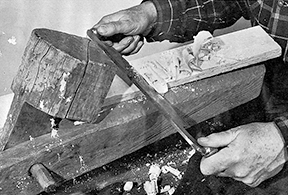 Figure 3: This image shows how a drawknife was used in woodworking (Wildung 1957).
Many different tradesmen such as carpenters, coopers, coachmakers and cabinetmakers used draw
knives (Wildung 1957). They were used to trim slate for school slate and slate for roofs. By
1850, hand splitting and shaving of wood shingles was in decline and by 1900, the handmade
shingles were replaced by the use of tin and slate (Arbor 1994). Several different sizes and
shapes of draw knives were used by the coopers (Fig. 4) to trim and shape barrel staves and
the round tops and bottoms of the barrel known as heads. In wheel-wrighting, the narrower,
flat and straight-bladed draw knives were useful in trimming wheel spokes (Arbor 1994).
Cabinetmakers rough shaped furniture parts such as chair arms and legs. Curved bladed
draw knives were used to scoop out the bottom of wooden seats for the comfort of the
human occupants (Bealer 1976).
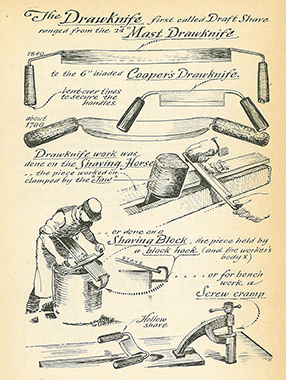 Figure 4: Different shapes and sizes of drawknifes are shown here in this illustration (Sloane
1964).
Figure 4: Different shapes and sizes of drawknifes are shown here in this illustration (Sloane
1964).
A section of the Jackson Homestead report (Volume 1, Table 1, p254) lists tools used for
woodworking purposes. Among these were iron files for the purpose of sharpening other tools,
ax heads, saw blades and an iron draw knife. The report goes on to say that "John T. Adams
and numerous residents in the immediate vicinity were employed as woodchoppers" (ICC
Report 2011). This draw knife would have been used by these men in the job of initially trimming
the rough spots and bark off of the felled trees.
References
Arbor, Marilyn
1994 Tools and Trades of America's Past. The
Mercer Museum Collection.
Bealer, Alex W.
1976 The Tools That Built America. Barre
Publishing. Barre, Massachusetts.
Sloane, Eric
1964 A Museum of Early American Tools.
Ballantine Books, New York.
Wildung, Frank H.
1957 Woodworking Tools at Shelburne Museum.
The Shelburne Museum, Inc. Shelburne, Vermont.
URS Corporation
2011 ICC 2011 Phase II and III Archaeological
Investigations of the Fairland Branch site and the Jackson Homestead (18MO609)
Volume 1. URS Corporation. Germantown, Maryland 20876.