Spanish Fly. The world's most infamous aphrodisiac. The very name conjures images of illicit
affairs, foreign intrigues, and dens of iniquity. Ancient Egyptians used it for orgies. The
Roman empress Livia, wife of Augustus Caesar, spiked her guests' food with it in hopes they
would commit a blackmail-able indiscretion. Madame du Pompadour, mistress of King Louis XV,
mixed it with soap to pump up the passion in their affair. Even the legendary Marquis de
Sade slipped it in chocolates and gave them to prostitutes—an action for which he was
condemned to death (Prischmann and Sheppard 2002; Scales 2013).
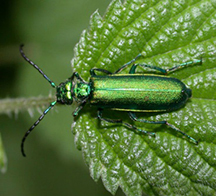 Blister beetle. From http://en.wikipedia.org/wiki/Spanish_fly.
The origin of Spanish Fly, also known as "cantharides," isn't quite so sexy. It is made from
cantharidin, an extremely toxic substance produced by blister beetles of the family Meloidae.
Consumption and topical application of the dried and powdered bug carcasses goes back to
antiquity, and interestingly, much of that use was medicinal. Hippocrates prescribed it for
dropsy. The Chinese used it for ulcers, piles, and rabies. Others thought it cured ailments
as varied as earaches, nausea, gout, bladder stones, gonorrhea, ringworm, rheumatism, obesity,
and even demonic possession and hypochondria—for which the cure was no doubt worse than
the "disease"! This is because merely touching a blister beetle can burn the skin, and eating
more than trace amounts of cantharidin can destroy the stomach lining and lead to death. Although
consumption of Spanish Fly is now banned, cantharidin is still used in some countries to treat
warts, and it recently has been found to have anti-cancer properties (Kim et al. 2013; Prischmann
and Sheppard 2002; Scales 2013).
Evidence for the therapeutic use of cantharidin can be seen in a glass bottle excavated from a
19th-century well at the Federal Reserve site in Baltimore. The bottle was embossed with "BARRY'S
TRICOPHEROUS FOR THE SKIN AND HAIR." This elixir was first sold by a New York wigmaker, "Professor"
Alexander Barry, in 1842 (although he claimed his father invented it in 1801). It was 97% alcohol,
with the rest consisting of cantharidin and castor oil (hairquackery.com 2014). Like some modern
shampoos, the "tingling sensation that tells you it’s working" when applied to skin (actually the
disruption of transmembrane proteins holding cells together) was thought to cure baldness, make hair
luxurious, and prevent graying and dandruff.
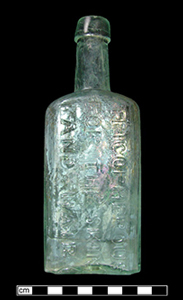 Barry's Tricopherous bottle found at the Federal Reserve site – Photo by Caitlin Shaffer,
MAC Lab
Barry's Tricopherous bottle found at the Federal Reserve site – Photo by Caitlin Shaffer,
MAC Lab
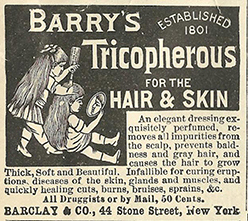 A newspaper ad for Barry's Tricopherous. From
http://oldadsarefunny.blogspot.com/2012/10/1890-ad-barrys-tricopherous-for-hair.html.
A newspaper ad for Barry's Tricopherous. From
http://oldadsarefunny.blogspot.com/2012/10/1890-ad-barrys-tricopherous-for-hair.html.
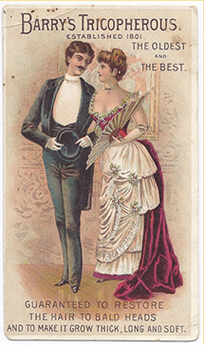 A Barry’s Tricopherous trading card. Image from
http://stalkingthebelleepoque.blogspot.com/2014_04_20_archive.html.
A Barry’s Tricopherous trading card. Image from
http://stalkingthebelleepoque.blogspot.com/2014_04_20_archive.html.
It also could be used to treat skin diseases and wounds, and heal ailing glands and muscles. It soon
proved wildly popular—even the editor of Scientific American endorsed it, and Barry's trading
cards featuring drawings of beautiful women are now collector items (odysseysvirtualmuseum.com 2014).
Amazingly, Barry's Tricopherous is still sold as a hair product today &mdashp; minus the Spanish Fly, of course.
So if you have a bottle, don't bother drinking it — eat some oysters instead!
References
2014 http://www.hairquackery.com/historical-quackery/barrys-tricopherous.shtml.
Website accessed 18 Nov. 2014.
Kim, JA, Y. Kim, B.M. Kwon, D.C. Han
2013 The Natural Compound Cantharidin Induces Cancer Cell Death Through
Inhibition of Heat Shock Protein 70 (HSP70) and Bcl-2-Associated Athanogene Domain 3 (BAG3) Expression by
Blocking Heat Shock Factor 1 (HSF1) Binding to Promoters. Journal of Biological Chemistry 288(40):
28713-28726.
odysseysvirtualmuseum.com
2014 http://odysseysvirtualmuseum.com/products/Barry's-Tricopherous-for-the-Skin-and-Hair-Bottle.html.
Website accessed 18 Nov. 2014.
Prischmann, D.A., and C.A. Sheppard
2002 Love Bugs?: A World View of Insects as Aphrodisiacs, with
Special Reference to Spanish Fly. American Entomologist 48(4): 208–20.
Scales, Helen
2013 Spanish Fly. Chemistry World.
http://www.rsc.org/chemistryworld/2013/10/spanish-fly-cantharidin-podcast.