For this month's Curator’s Choice, I present a ubiquitous, mass-produced, and very ordinary buckle
from the second half of the 19th century or early 20th century (Figure 1). Why is this
interesting? Because every other Curator’s Choice I've ever done has focused on something unusual,
special, or personal to the inhabitants of a site, and it's a change of pace to feature an artifact
that is just plain and common. Unique artifacts often lend themselves to one relatively narrow
interpretation, but that doesn't work for the buckle generic.
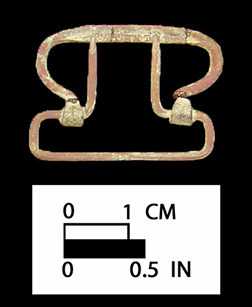 Figure 1: A copper alloy strap buckle from a 19th-20th century domestic site at Joint Base Andrews in
Prince George's County. A partially legible stamp reads "PATENT 18 [?]" Courtesy U.S. Air Force,
Joint Base Andrews.
Figure 1: A copper alloy strap buckle from a 19th-20th century domestic site at Joint Base Andrews in
Prince George's County. A partially legible stamp reads "PATENT 18 [?]" Courtesy U.S. Air Force,
Joint Base Andrews.
By the mid-19th century mass production and interchangeable parts had been adopted by the clothing
industry, so interpretation of clothing-related artifacts from this period can be full of
possibilities. While buckles of the 18th century regularly came in forms that were specific for
use on items such as shoes, spurs, and knee breeches, buckles that were produced to be generic
and useful on many things defy that kind of categorization.
The buckle type featured here was patented by 1855, and several variations of the form were introduced
in subsequent years (Figure 2). These buckles could be made of ferrous alloys (e.g. iron and steel) or
copper alloys (e.g. brass), and some are marked with patent dates or a bit of decoration. The buckles
were used for straps and they were not meant to be seen when people were fully dressed, but their
versatility is evident when you look at old catalogs and surviving clothing. They show up on ladies'
foundation garments (Figure 3), men’s vests (Figure 5), cinches for early blue jeans (Figure 4), and
even "suspensories" for men (Figure 6). In other words, when this artifact is found it isn't possible
to point at it and say, "that's for a [insert garment description here]!" No, the interchangeable
buckles of the industrial era call for curators and archaeologists to abandon the idea of narrowing
interpretation. Instead it’s an opportunity to make a list of everything that might have used this
buckle, and as the list grows, we are exposed to many different items of daily life that enrich our
understanding of how industrialization changed the way people lived and dressed.
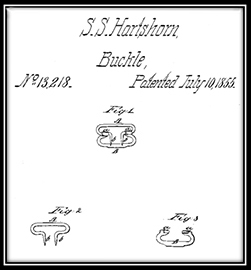 Figure 2: Sketch from an 1855 patent for this type of strap buckle (U.S. Patent
Office 1855).
Figure 2: Sketch from an 1855 patent for this type of strap buckle (U.S. Patent
Office 1855).
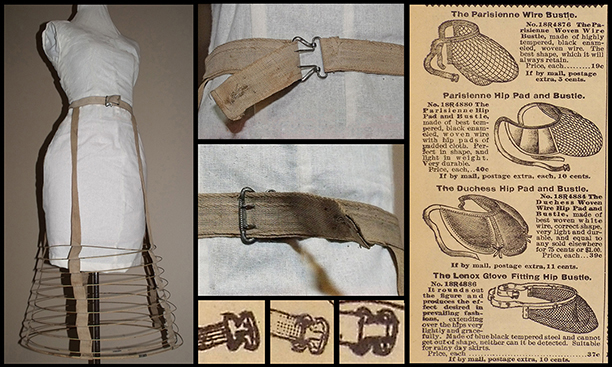 Figure 3: Ladies' foundation garments such as crinoline hoops (left, center, and center top)
and bustles (right, with details at center bottom) attached at the waist with adjustable
straps and buckles (Sears, Roebuck, 1902:942).
Figure 3: Ladies' foundation garments such as crinoline hoops (left, center, and center top)
and bustles (right, with details at center bottom) attached at the waist with adjustable
straps and buckles (Sears, Roebuck, 1902:942).
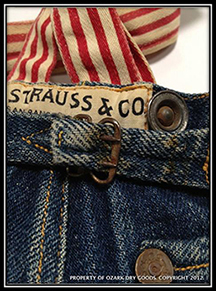 Figure 4: Early jeans often had straps at the back with a buckle so they could be cinched for size,
and they also had buttons for suspenders to hold them up instead of loops for a belt (Union-Made 2012).
Figure 4: Early jeans often had straps at the back with a buckle so they could be cinched for size,
and they also had buttons for suspenders to hold them up instead of loops for a belt (Union-Made 2012).
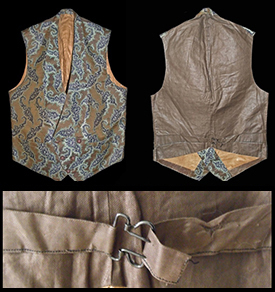 Figure 5: This vest, ca. 1870s, has adjustable straps and a buckle at the back.
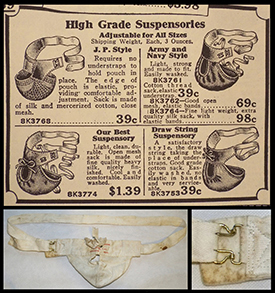 Figure 6: Adjustable strap buckles were also used for men's "suspensories" as advertised in the
1927 Sears, Roebuck Co. catalog (Mirken 1970: 637).
Figure 6: Adjustable strap buckles were also used for men's "suspensories" as advertised in the
1927 Sears, Roebuck Co. catalog (Mirken 1970: 637).
References
Mirken, Alan, editor
1970 1927 Edition of the Sears, Roebuck Catalogue.
Bounty Books, Crown Publishers, Inc., New York, New York.
Sears, Roebuck Co.
1902 The 1902 Edition of the Sears, Roebuck Catalogue.
1986 Edited reprint by Bounty Books, Crown Publishers, Inc., New York, New York.
U.S. Patent Office
1855 Patent US13218, Generic Buckle, Sheldon S. Harshorn.
Google Patents, http://www.google.com/patents/US13218, accessed 29 December 2014.
Union-Made
2012 August 16. Spotted on ebay: Early 1900s Levi Strauss
Salesman Sample. Vintage 20s OZARK Whale Brand ONE POCKET Hickory Stripe PITCHFORK Overalls 42 O.
Posted by invtgwetrust, eBay item 270910935126.
http://union-made.blogspot.com/2012/08/spotted-on-ebay-early-1900s-levi.html
eBay, accessed 10 November 2014.