In 1985, during excavations at the Addison Plantation site in Prince George's County, Maryland,
archaeologists excavated a well, which had been used as a refuse dump during the better part of
the 18th century (Garrow 1986: 375). The waterlogged nature of the lowest section of the well,
which dated to the second quarter of the 18th century, led to the preservation of hundreds of
fragments of wood. Among these wood fragments were a bridge and tuning peg from a stringed
instrument (Figure 1).
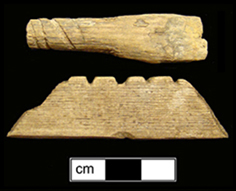 Figure 1: Wooden tuning peg and bridge from a stringed instrument, possibly a gourd banjo.
The bridge appears to be hand carved with irregularly spaced notches of varying depths. The bridge
has four clear notches for strings with a possible fifth notch barely visible where a section
of the bridge has broken off (see the left side of the bridge in Figure 1). The tuning peg
also appears to be hand carved and has a groove in which to run a string. Since these two
objects were found within the same level of the well, an assumption has been made that they
are from the same instrument.
While correctly identified as parts of a musical instrument almost three decades ago, these
objects had received little additional attention until February 2014, when researcher and
musician, John O'Loughlin, examined them. Mr. O’Loughlin noted their "homemade" appearance
and suggested they could be from a type of instrument known to have been made and played by
enslaved individuals from the 17th century onward. He described this instrument as a gourd
with vellum skin and a wooden neck, four or five strings, somewhere between the West African
instrument called an akonting and the later banjo (personal communication, February 11, 2014).
The earliest known depiction of this type of instrument in America can be found in the watercolor
painting "The Old Plantation" which is curated at the Abby Aldrich Rockefeller Folk Art Museum
in Williamsburg, Virginia (Figure 2).
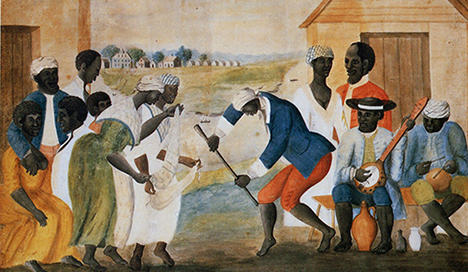 Figure 2: "The Old Plantation" watercolor painting attributed to John Rose, Beaufort County,
South Carolina, c. 1785–1790 (Abby Aldrich Rockefeller Folk Art Museum).
Figure 2: "The Old Plantation" watercolor painting attributed to John Rose, Beaufort County,
South Carolina, c. 1785–1790 (Abby Aldrich Rockefeller Folk Art Museum).
It is well documented that the instrument that we know today as the banjo evolved from very
similar instruments played by the enslaved peoples who were brought to America from West
Africa (Gibson 2001). For decades, researchers and musicologists looked to lutes, such as
the ngoni, as the most likely predecessor to the modern day banjo. The ngoni has an oblong
wooden or gourd body with an animal hide covering and a flat, "unfooted" bridge that either
rests directly on the hide itself or is inserted into a hole in the hide covering (Figure 3).
In more recent years, research conducted by scholars and musicians, Daniel Jatta, Ulf Jägfors,
and Shlomo Pestcoe, has pointed toward the akonting as the more likely archetype of the
early banjos (Pestcoe n.d.). With its round, hollow gourd body and "footed" bridge, the
akonting looks more like a modern day banjo than the ngoni Figure 4). Additionally, the
akonting is played in an almost identical style to the 19th century banjos (Figure 5)
(Allen 2011).
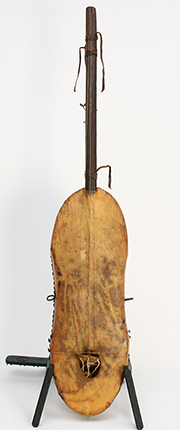 Figure 3: A ngoni, a West African stringed instrument (Bernunzio Uptown Music
n.d.).
Figure 3: A ngoni, a West African stringed instrument (Bernunzio Uptown Music
n.d.).
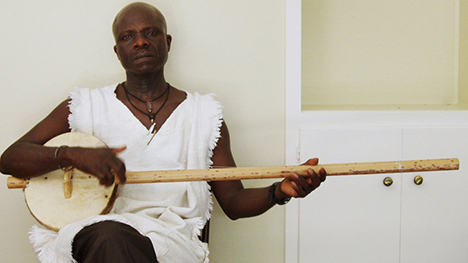 Figure 4: Gambian scholar and musician Daniel Jatta playing the akonting (Allen
2011).
Figure 4: Gambian scholar and musician Daniel Jatta playing the akonting (Allen
2011).
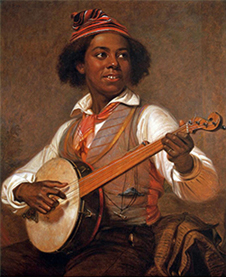 Figure 5: “The Banjo Player” painting by William Sidney Mount, 185 - (The
Athenaeum).
Figure 5: “The Banjo Player” painting by William Sidney Mount, 185 - (The
Athenaeum).
It is possible that the bridge and tuning peg from the Addison Plantation site are from an
instrument similar to one of these West African instruments. Greg Adams, ethnomusicologist
and banjo player, said that the flat, "unfooted" bridge suggests an instrument more like
a West African lute (personal communication, January 14, 2015). However, Pete Ross, banjo
player and builder, stated that, while not common, it is possible for a banjo to have
this style bridge (personal communication, January 14, 2015). Neither the ngoni nor the
akonting have tuning pegs; however, we know that by the late 18th century, some of the
stringed gourd instruments being played by enslaved people in America had tuning pegs,
as evidenced by the painting “The Old Plantation” (Figure 2).
It could be argued that these objects suggest an instrument with blended characteristics of
both the ngoni and akonting and may represent, as John O’Loughlin speculated, the remains
of an instrument that is something between the West African stringed instruments and the
modern day banjo. Creativity, ethnic tradition, variation in skill, as well as availability
of materials, would likely have influenced the construction and style of the gourd instruments
being made and played by enslaved people throughout colonial America. All of which may have
played an important role in transforming West African instruments to uniquely
African-American ones.
*Note: Quote from Thomas Jefferson’s book Notes on the State of Virginia (Peden 1954: 288).
References
Abby Aldrich Rockefeller Folk Art Museum
n.d. Web resource:
http://history.org/history/museums/collections/PaintingsDrawings.cfm,
accessed January 22, 2015.
Allen, Greg
2011 Banjo Roots, Reconsidered Web resource:
http://www.npr.org/2011/08/23/139880625/the-banjos-roots-reconsidered, accessed January 21, 2015.
The Athenaeum
n.d. Web resource:
http://www.the-athenaeum.org/art/detail.php?ID=21919, accessed January 22, 2015.
Bernunzio Uptown Music
n.d. African Ngoni. Web resource:
http://bernunzio.com/product/african-16394/, accessed January 28, 2015.
Garrow, Patrick H. and Thomas R. Wheaton, Jr.
1986 Oxon Hill Manor Archaeological Site Mitigation
Project. Prepared for the Maryland Department of Transportation, State Highway Administration.
Gibson, George R.
2001 Gourd Banjos: From Africa to the Appalachians. Web resource:
http://www.banjohistory.com/article/detail/1_gourd_banjos_from_africa_to_the_appalachians, accessed January
14, 2015.
Peden, William, ed.
1954 Thomas Jefferson, Notes on the State of Virginia.
Chapel Hill: University of North Carolina Press.
Pestcoe, Shlomo
n.d. Banjo Ancestors Detectives: Daniel Jatta & Ulf Jägfors.
Web resource: http://www.shlomomusic.com/banjoancestors_jatta.html accessed January 22, 2015.