On any given day, running errands around town, you are likely to be bombarded with other people's
political views, hobbies and interests, in the form of bumper stickers emblazoned on the car in front
of you at the traffic light. Bumper stickers and t-shirts are some of the primary means of showing
allegiance to sports teams, politicians, schools and beliefs in the twenty-first century, but what
format did getting the word out take in the mid-nineteenth century? The excavation of a filled
privy pit at an archaeological site in the Fells Point neighborhood of Baltimore offered one
intriguing example.
Among the over 4,000 fragments of ceramics, glass and bone recovered from the privy was an
English-made ceramic teacup in a double curve shape commonly manufactured between the 1830s and
the 1850s (Miller 2011). What was of particular interest was the printed design of a man and
woman flanking a shield-shaped motif from which sprouts an oak tree (Figure 1). A banner above the
heads of the figures proclaims "Firm as an Oak," while banners beneath their feet state "Be Thou
Faithful Unto Death." The shield interior contains an open Bible and beehive or skep surrounded
by flying insects, as well as the words "Industry, Freedom, Plenty, Health, Wealth, Wisdom." The
male and female each appear to be holding flags, although these portions of the cup are missing.
Complete vessels found while researching this article suggest that the flags would have read
"Sobriety" (male) and "Domestic Comfort" (female).
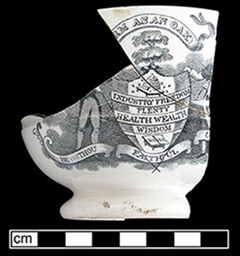 Temperance Movement cup found in the fill of the privy from Fells Point neighborhood
of Baltimore, MD.
Temperance Movement cup found in the fill of the privy from Fells Point neighborhood
of Baltimore, MD.
The cup’s motif, sometimes referred to as "The Teetotal Coat of Arms," symbolizes the moral reform
movement that supported abstinence from alcoholic beverages (Figure 2). This crusade, aimed at
the working class, was popular in both Britain and the United States in the nineteenth century
(Smith 1993). The American Society for the Promotion of Temperance was founded in Boston in
1826. Within twelve years, the temperance movement had over one and a half million members,
and eighteen temperance journals were in publication (Temperance Archive 2015). Members, however,
were not unified in the overall goal—some groups supported reduced alcohol consumption, while others
demanded a complete prohibition.
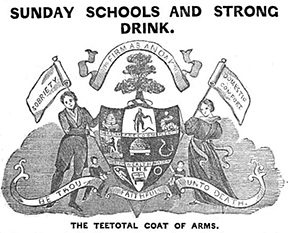 Image of the Teetotal Coat of Arms, printed in1856 in Ipswich Temperence Tracts
No. 102.
Image of the Teetotal Coat of Arms, printed in1856 in Ipswich Temperence Tracts
No. 102.
Can we determine who might have owned this cup? By the mid-nineteenth century, Fells Point was
characterized by mixed commercial and residential activity, with residents largely engaged in
shipping-related trades, such as sail making, ship’s carpentry, and coopering, as well as
commercial activities—grocers, butchers, shoemakers—to support the neighborhood's residents
(Basalik 1994:255). It is possible to narrow down the possible owners to two households that
lived at this Aliceanna Street address in the mid-nineteenth century. John Ritz and August
Rice were both hack proprietors who lived there in the 1840s and 1850s (Basalik 1994:259).
In 1840, the Washingtonian Temperance Society, an anti-drinking group, was founded by working class
men in Baltimore (Daniels 1878). The Washingtonian Temperance Movement viewed alcoholism as an
individual problem, rather than as a large-scale social or moral challenge. Membership in the
Baltimore society rose quickly and by 1841, meetings were being held in Boston and New York
(Maxwell 1950). It is unknown whether Rice or Ritz were members of the Washingtonian movement.
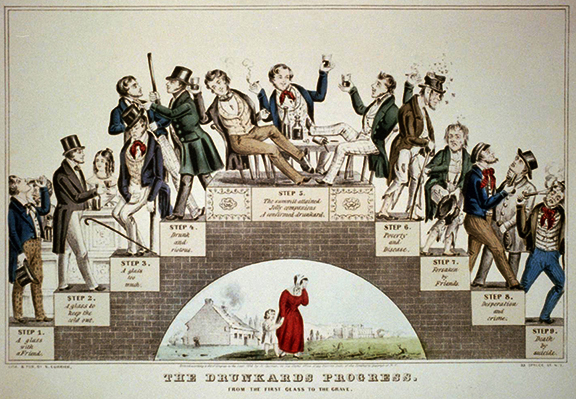 Print of "The Drunkard's Progress 1846. From http://paganpressbooks.com/jpl/DRUNK1B.JPG
This artifact represents the comfort of hot tea, sipped from a cup that reminded one of the
rewards of not succumbing to the temptations of alcohol. Interestingly, glass bottles used to
contain alcoholic beverages were plentiful in the privy assemblage and included champagne,
wine, brandy, and beer bottles. Tumblers and a decanter for enjoying these libations were also
found in with the bottles. The mixed message sent by this assemblage stands as testimony to
the division that continues to separate sectors of our society who view alcohol as evil and
those members who enjoy its flavors and effects.
References
Basalik, Kenneth J.
1994 Urban Development in the Eastern United States:
An Archaeological View of Baltimore. PhD dissertation, Temple University. University Microfilms.
Ann Arbor, Michigan.
Basalik, Kenneth J., and Ted M. Payne
1982 An Intensive Archaeological Survey at the H and S
Bakery Building Site: An Executive Summary Report. Prepared for H & S Bakery by Cultural
Heritage Research Services, Inc., New Castle, Delaware. Report on file at Maryland Historical
Trust, Crownsville.
Daniels, Rev. W.H.
1878 The Temperance Reform and its Great Reformers, an
Illustrated History. New York, Nelson & Phillips. Available online at
https://archive.org/details/temperancereform00daniuoft/page/n8.
Maxwell, Milton A.
1950 The Washingtonian Movement. Quarterly Journal
of Studies on Alcohol. Volume 11:410-452.
Miller, George L.
2011 Common Staffordshire Cup and Bowl Shapes.
Available at
http://www.jefpat.org/diagnostic/Post-Colonial%20Ceramics/Cup%20Shapes/Essay-on-Cup-and-Bowl-Shapes.pdf.
Smith, Rebecca
1993 The Temperance Movement and Class Struggle in Victorian England.
History Department, Loyola University.
http://www.loyno.edu/~history/journal/1992-3/smith-r.html. Accessed 1-20-2015.
Temperance Archive
1954 The Temperance Archive; The Lost Museum. Roy Rosenzweig
Center for History and New Media Website accessed 2-4-2015.
http://chnm.gmu.edu/lostmuseum/searchlm.php?function=find&exhibit=temperance&browse=temperance.