During the 18th century colonial production of commercial goods was limited by the mercantilist
policy implemented by the British crown. Despite legislation restricting colonial manufacture for
local markets there is evidence of several colonial industries, including ceramic production,
for the colonial market.
One potter of note was William Rogers. Rogers immigrated to the colony of Virginia in 1711 and
was granted two lots in Yorktown where he established a brewery (Watkins and Noel Hume 1967:80).
By the 1720s Rogers was operating a pottery works in Yorktown (Barka 2004:18). The colonial
administration of Virginia knew about Rogers’ business, but in an attempt to downplay Rogers'
success to English authorities he was described as "the poor potter," suggesting he was neither
successful nor producing valuable wares (Watkins and Noel Hume 1967, Barka 2004). Rogers' kilns
produced both earthenware and stoneware ceramics for roughly 25 years, and his wares were "exported
to other North American colonies and to perhaps the West Indies" (Barka 2004:31, McCartney and
Ayres 2004:49).
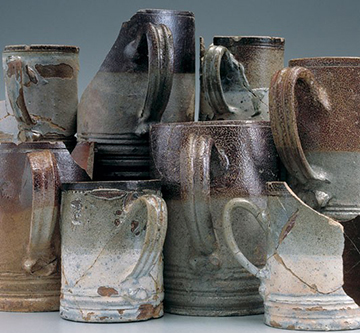 Mugs, William Rogers, Yorktown, Virginia, 1720–1745. Salt-glazed stoneware. (Courtesy, National Park
Service, Colonial National Historical Park, Yorktown Collection.) Image taken from Ceramics
in America 2004.
Mugs, William Rogers, Yorktown, Virginia, 1720–1745. Salt-glazed stoneware. (Courtesy, National Park
Service, Colonial National Historical Park, Yorktown Collection.) Image taken from Ceramics
in America 2004.
At the Smith's St. Leonard site, located at Jefferson Patterson Park and Museum in Maryland, pieces
of Rogers' stoneware have been found in the storehouse cellar and in plowzone. Smith's St.
Leonard was occupied during roughly the same time period as Rogers was producing pottery in
Yorktown. Unlike the standard excise mark of "WR" surrounded by an oval cartouche found on British-made
pottery, the William Rogers sherds are marked with "WR" in a rectangular enclosure. Excavations at
Rogers' kiln sites have found the rectangular cartouche to be a hallmark of his stoneware vessels
(Watkins and Noel Hume 1967:92).
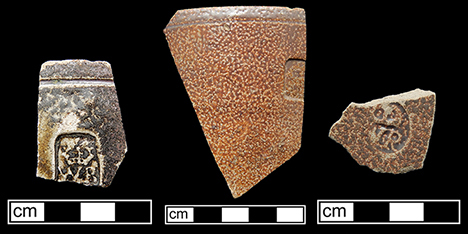 Two William Rogers stoneware mug sherds with rectangular excise stamps, and one English
Brown stoneware sherd with oval excise stamp. All three from Smith's St. Leonard site (18CV91)
Two William Rogers stoneware mug sherds with rectangular excise stamps, and one English
Brown stoneware sherd with oval excise stamp. All three from Smith's St. Leonard site (18CV91)
Rogers' stoneware at the Smith’s St. Leonard site is an interesting occurrence. Outside of Virginia,
it seems uncommon to find William Rogers’ pottery on archaeological sites, yet there is evidence that
suggests he was also selling his wares to merchants in Maryland, North Carolina and New England
(McCartney and Ayres 2004:54). As of 2015 only two stoneware sherds have been identified from the
Smith's St. Leonard site as being made by William Rogers. It is possible that other sherds may
represent his work, but have not been recognized. British mercantile policy in the 18th century
implies that most of the material culture found on colonial archaeological sites was imported from
overseas. However, the presence of Rogers' ceramics at the Smith’s St. Leonard site indicates a
growing colonial independence, and that not all of the colonist’s goods were coming from England.
References
Barka, Norman
2004 "Archaeology of a Colonial Pottery Factory: The Kilns
and Ceramics of the "Poor Potter" of Yorktown." In Ceramics in America. Edited by Robert
Hunter, pp. 15-48. Chipstone Foundation, England.
Collections Database: Five Colleges and Historic Deerfield Museum Consortium.
English Mug. Accession Number HD 94.016.4. Electronic Document.
http://museums.fivecolleges.edu/detail.php?museum=&t=objects&type=ext&f=&s=&record=224&earliest_year=1700&op-earliest_year=%3e%3D&latest_year=1725&op-latest_year=%3c%3D,
accessed May 29, 2015.
McCartney, Martha W. and Edward Ayres
2004 "Yorktown's "Poor Potter": A Man Wise Beyond Discretion."
In Ceramics in America. Edited by Robert Hunter, pp. 15-48. Chipstone Foundation, England.
Watkins, Malcolm C., and Ivor Noel Hume
1967 The "Poor Potter" of Yorktown. Smithsonian
Institution Press. Washington, DC.