Made between the 1880's and 1915, as indicated by the purple tint produced by manganese, this
run-of-the-mill glass was found in a brick-lined privy at the Federal Reserve site (18BC27) in
Baltimore. This shot glass-shaped dosage cup was presumably made in Baltimore and sold by the
pharmacist R.P.C. Scheidt.
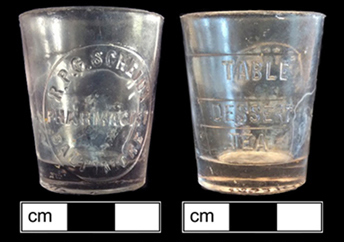 Dosage glass found at a privy at the Federal Reserve site (18BC27) in Baltimore.
Table, Dessert and Tea spoon measuring marks are molded on one side.
Dosage glass found at a privy at the Federal Reserve site (18BC27) in Baltimore.
Table, Dessert and Tea spoon measuring marks are molded on one side.
Dosage glasses have been a surprisingly important part of all of our lives. Being the most common
form of measurement for liquid medicine used to date, these shot glass-sized cups make sure that
we get the perfect amount of medicine to help us.
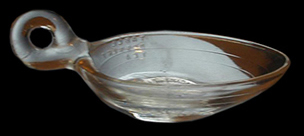 A spoon-shaped dosage glass from http://1gerken.wix.com/dose-glass-collector.
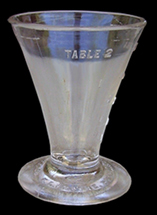 A conical-shaped dosage glass from http://1gerken.wix.com/dose-glass-collector.
Originating in the early 19th century, dosage glasses have become common in many places. Most
often in the shape of a small tumbler or shot glass, there are many other shapes they can take,
such as a spoon or conical. Although not as common nowadays, the dosage glass was once prime
real estate for advertising. Used mostly by pharmacies for their own gain, a few other companies
decided to jump aboard and make the glasses to advertise on them.
A spoon-shaped dosage glass. Most dosage glasses were made from flint glass and will usually be
either clear or have a light gray tint. However, because of a chemical reaction that may occur
due to extremely long exposure to sunlight and magnesium (put into the glasses as a decolorizer
from 1880 to 1915), the glass may take on a purple or amethyst tint. There are colored dosage
glasses; some glass colors include emerald green, cobalt blue and milk white. They are not as
common, as the color makes it more difficult to see the thing you are measuring.
Almost all dosage glasses use tablespoon (Table), dessert spoon (Dessert), and teaspoon (Tea)
measurements. This is because those were the measurements these medicines were made for. Before
dosage cups, people had to use actual spoons they had on hand. So they used their teaspoons
(used for actual tea) for the smallest dosage, their dessert spoons (which have faded out of
our culture but were used for, as the name implies, dessert) for the middle measurement,
and the tablespoon (used for soup and other liquid meals) as the biggest. So the companies
diluted or strengthened their medicines to meet these standards because it made it more
likely the patients would take the proper amount. When dosage glasses came along, instead
of changing the terminology, it just carried over.
References
Gerken, R. Tracy
2015 Dose Glass Collector.
http://1gerken.wix.com/dose-glass-collector. Website accessed 7/21/2015.