In 2011 several pewter spoons and spoon fragments were found during excavations of the cellar in front of
a hearth at the Smith St. Leonard Site kitchen (Cook 2015: pers. comm.). The site stands near the
confluence of St. Leonard's Creek and the Patuxent River in Southern Maryland. According to the 1715
inventory of property owner Richard Smith Jr. , there was listed in the "Kitching Chamber," among many
other items, "1 Doz of pewter spoons" (Richard Smith Jr. Inventory 1715). As noted on the inventory,
the appraised worth of a dozen spoons was one shilling, or a penny, each.
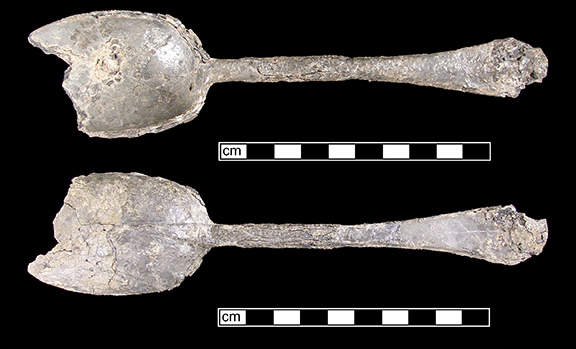 Figure 1: Front and back views of pewter spoon found at the Smith St. Leonard Site
after conservation.
Figure 1: Front and back views of pewter spoon found at the Smith St. Leonard Site
after conservation.
One particular pewter spoon has small hatch marks forming a design on the interior of its bowl. A pewter
spoon found during the excavation of the Whydah pirate ship off Cape Cod has a linear hatch design that
has been incised on the inside of the bowl. The design is of unknown purpose, although similar to the
hatch markings on the Smith St. Leonard spoon (McNair-Lewis 1991). There are examples of other spoons
that have hatch marking designs. In a collection of thirty pewter spoons from the Kingsmill Site, there
are spoon handles with incised linear zigzag markings. These engraved motifs are very similar to West
African Igbo decorative designs (Samford 2007). On the front and back of the Smith St. Leonard spoon
handle are indentations and markings, some similar to the Virginia motifs, that might indicate ownership.
Pewter is an alloy of the tin group. Other metals such as copper and lead were added to produce items of
varying qualities (Masse' 1971). Tin and lead were mined in ancient times in various parts of the world,
such as Mesopotamia (Hoyt 1985). Later the Romans began using pewter, as noted in the writings of Pliny
and Plautus, using mixtures of tin and lead. During the Roman colonization of Britain, tin was mined in
the area of Cornwall, where tin mining still exists today (Masse' 1904).
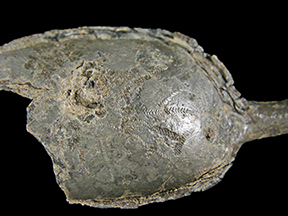 Figure 2: Pewter spoon bowl detail showing hatch marks, from Smith St. Leonard Site.
Pewter spoons were cast by molding. The spoon bowls were then hammered to harden and compact the metal
and make them strong enough for daily use (Hoyt 1985). The soft nature of pewter made it a poor material
for forks and knives. But in looking at the inventories of early American pewter smiths you will see that
spoons were in great and constant demand (Fennimore 1984). Complete spoons are rarely found at
archaeological sites. Such was the case at the Smith St. Leonard Site.
Several attributes of this spoon can be used to date its manufacture. The handle has a small wave-like
round extended end typical of spoons produced between 1700 and 1730 (Hoyt 1985). This style coincides
with the period of Richard Smith Jr.'s occupation of the house between 1711-1714 and the subsequent
residency by his son until the mid-18th century.
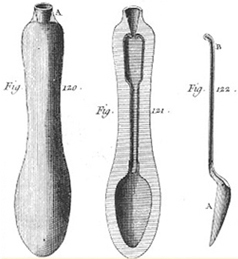 Figure 3. Diderot spoon mold example.
The spoon bowl, which is drawn out, long and narrow, predates 1730, the date after which bowls became
wider. The rat-tail, a V shaped extension running from the back of the handle to the back of the spoon
bowl, functions to strengthen the junction between the handle and bowl, thus helping to support the weight
of the bowl. The length of this rat-tail fits it into the 1700 to 1730 period (Hoyt 1985).
References
Cook, Annette
2015 Personal Communication – Maryland Archaeological
Conservation Laboratory.
Fennimore, Donald L.
1984 Silver and Pewter. The Knopf Collectors'
Guide to American Antiques. Alfred A. Knopf, New York.
Hoyt, Catherine A.
1985 Historical Analysis of Pewter Spoons Recovered from
the Sunken City of Port Royal, Jamaica. Unpublished Master's Thesis. Texas A & M University,
College Station, Texas.
Masse', H.J.L.J.
1904 Pewter Plate. George Bell and Sons, Chiswick
Press, London.
1971 Old Pewter: Chats on Old Pewter. Dover
Publications, Inc., New York.
McNair-Lewis, Gareth
1991 Pewter Artifacts Aboard The Whydah Galley,
Site WLF-HA-1. The 1990-1991 Annual Report of Data Recovery, The Whydah Project.
Richard Smith Jr. Inventory
1715 Maryland State Archives, Inventories and
Accounts, Index 1, Liber 36c, f.1-f.10.
Samford, Patricia
2007 Subfloor Pits and the Archaeology of
Slavery in Colonial Virginia. The University of Alabama Press, Tuscaloosa.