As you lace up your ice skates this winter, you might be perfecting your triple lutz-toe loop combo, or you might just
be trying to stay upright. In either case, you’re joining a long history of people taking to the ice for travel,
sport, and leisure.
Archaeological evidence shows that the earliest ice skates developed as a means of transportation in Northern Europe
around 3,000 B.C. In a cold climate with a landscape full of waterways, skating was a simple, inexpensive, and
very efficient way to travel over long distances or reach otherwise inaccessible areas for hunting (Formenti and
Minetti 2007). These skates, usually made of cow or horse metatarsal bones, were fastened to the wearer's shoes
using leather straps. Because bones do not have an edge to push off of, forward motion was achieved by a long
stick tipped with metal. This technology was clearly in use for quite some time, as William Fitz Stephen describes
such a scene in 1773 London:
'…when the great marsh…is frozen over, numerous bands of young men go out to play on the ice. They… fit
leg-bones of animals to their feet, binding them firmly around their ankles, and hold in their hands poles shod
with iron, which they strike against the ice, and thus impel themselves on it with the swiftness of a bird…'
(N.A. 2015)
Bone skates gave way to wooden skates with metal runners by the 13th century. The sharper blade edge allowed skaters
to propel themselves using just their leg muscles, while making it easier to turn and achieve faster speeds (Formenti
and Minetti 2007). There is ample pictorial evidence that ice skating remained popular throughout the Middle Ages,
and certainly during Europe's Little Ice Age (Formenti and Minetti 2007). 18th and 19th-century ice skates saw
further technical changes — longer blades and purpose-made boots, both of which increased the control of the
skater. Modern day ice skates may look a little different from these earlier models, but the basic idea has remained
essentially unchanged for hundreds of years.
 12th century ice skates with reproduction leather straps, Museum of London.
Skating was an inclusive pastime from very early on. Prints and written records from as early as the 15th century
indicate that activities on the ice were open to people of all ages, classes, and genders (Kestnbaum 2003). In
colonial America, ice skating was commonplace, especially in New York, Delaware, and Pennsylvania, where settlers
of Dutch and Swedish heritage kept up the traditions of their homelands (Struna 1996). Upon visiting New York in
1678, English clergyman Charles Wooley noted, "And upon the Ice it's admirable to see Men & Women as it were
flying upon their Skates from place to place, with Markets upon their Heads & Backs" (Gems et al. 2008). Americans
continued ice skating in the 18th century, not just as a means of transport, but also for leisure. Alexander
Graydon, a Philadelphia lawyer writes, “With respect to skating, though the Philadelphians have never reduced
it to rules like the Londoners, nor connected it with their business like Dutchmen, I will yet hazard the
opinion, that they were the best & most elegant skaters in the world” (Sarudy 2014). The opening of a skating
pond in New York's Central Park in the winter of 1858-59 provided ample opportunity for unchaperoned intermingling
of men and women. Unsurprisingly, the pastime continued to grow in popularity into the 20th century, and it
remains a favorite wintertime activity today.
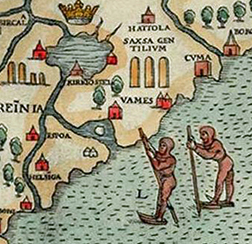 The 16th century map 'Carta Marina' by Olaus Magnus shows ice skaters using poles.
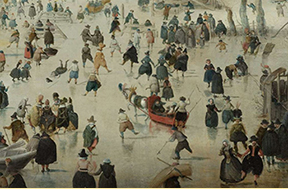 Detail from Winter Landscape with Ice Skaters by Hendrick Avercamp, c. 1608, Rijksmuseum.
This pair of steel blade ice skates, dating to the late 19th or early 20th century, was recovered from archaeological
investigations at the Stoll-Heisel Blacksmith Shop in St. George's, Delaware. The business, destroyed by fire in
1919, did work as a blacksmith, wheelwright, and repair shop (Burrow et al. 2012). The site report notes, 'A pair
of ice skates… may have either just been sharpened and were awaiting pickup or had been dropped off at the shop
shortly before it burned down. Since the fire happened in November or December someone may have had to quickly buy
new skates for the upcoming ice skating season' (Burrow et al. 2012). If the owner did purchase a new pair, there
was no shortage of advertisers promising easy elegance and a heartwarming time on the ice — and who wouldn't
want to experience just that?
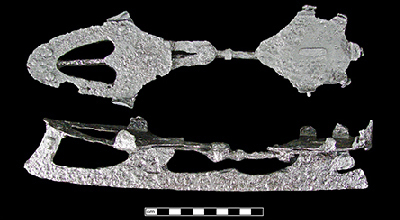 S Ice skates from the Stoll-Heisel site, St. George’s, Delaware.
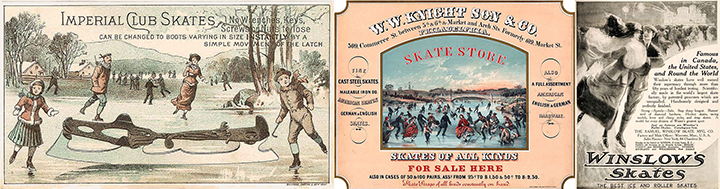 Advertisements for ice skates. Imperial Club Skates (1870s), W.W. Knight Son & Co. (1860s),
Winslow's Skates (1912).
Advertisements for ice skates. Imperial Club Skates (1870s), W.W. Knight Son & Co. (1860s),
Winslow's Skates (1912).
References
Burrow, Ian, Alison Haley, Patrick Harshbarger, and William Liebeknecht
2017 The Small-Town Blacksmith in an Industrializing World: The Stoll/Heisel
Blacksmith Shop (1852-1919) 204 North Main Street St. Georges, Red Lion Hundred Newcastle County, Delaware.
Report prepared for the U.S. Army Corps of Engineers, Philadelphia, PA.
Formenti, Frederico and Alberto E. Minetti
2007 Human Locomotion on Ice: The Evolution of Ice-skating Energetics
Through History. The Journal of Experimental Biology (210): 1825-1833.
Gems, Gerald, Linda Borish, and Gertrud Pfister
2008 Sports in American History from Colonization to Globalization.
Chicago: Human Kinetics.
Kestnbaum, Ellyn
2003 Culture on Ice: Figure Skating & Cultural Meaning. Middletown,
Connecticut: Wesleyan University Press.
N.A.
2015 Find Spotlight: The Art of Medieval Ice Skating.
https://ulasnews.wordpress.com/2015/02/02/find-spotlight-the-art-of-medieval-ice-skating/, accessed November
18, 2015.
Sarudy, Barbara Wells
2014 How 17C Colonial American Women Came to Ice Skate – From
Europe to England to Colonial America.
http://www.b-womeninamericanhistory17.blogspot.com/2014/02/how-17c-colonial-american-women-came-to.html,
accessed November 19, 2015.
Struna, Nancy L.
1996 People of Prowess: Sport, Leisure and Labor in Early
Anglo-America. Urbana: University of Illinois Press.