In this presidential election year it feels on point to offer up some research on political buttons,
18th-century style, so this Curator's Choice is about a glass inset for a button molded with the
names "PHIPPS AND DELAVAL" (Figure 1). This inset would have capped a set of linked buttons, also known
as sleeve buttons or sleeve links in the 18th century. These buttons were the ancestors of modern
cufflinks, but unlike today, sleeve links of the 18th century were not just for dressing up. Instead,
they were worn by men, women, and children of all classes on a daily basis to fasten shirts and shifts.
These buttons were pretty much the smallest accessory that people wore, and that made them cheap compared
to other accessories like shoe buckles or coat buttons. In turn, affordability seems to have made linked
buttons the perfect medium for expressing one's individual personality, including political opinions
(Rivers Cofield 2012).
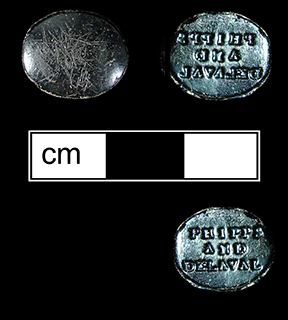 Figure 1: Glass button inset marked "PHIPPS AND DELAVAL" in reverse. Here it is illustrated
from the front (top left) from the back (top right), and with the back reversed to make it
readable (right).
Figure 1: Glass button inset marked "PHIPPS AND DELAVAL" in reverse. Here it is illustrated
from the front (top left) from the back (top right), and with the back reversed to make it
readable (right).
Glass insets were a particularly fine medium for self-expression because anything molded in reverse on
the back of the inset would shine through once the inset was placed in a setting with a reflective foil
back or accent paint. The molded glass inset both held the message, and magnified it for others to
see (See Figure 2).
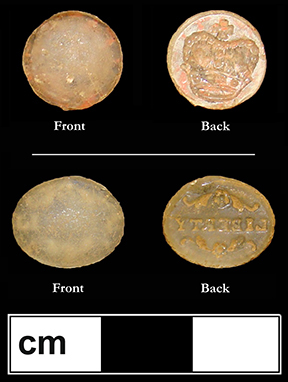 Figure 2: Political buttons with a crown (top), and the word "LIBERTY" in reverse (bottom).
Note the red residue on the inset with the crown, which is probably a painted background color. Both
insets would have been clear when they were new.
Figure 2: Political buttons with a crown (top), and the word "LIBERTY" in reverse (bottom).
Note the red residue on the inset with the crown, which is probably a painted background color. Both
insets would have been clear when they were new.
The MAC Lab has a number of these glass insets in its collections, and while many are just meant to be
pleasing to the eye, some bear specific messages. For example, a glass inset with a crown motif was
recovered at Ft. Frederick, which was built by the British and occupied during the French and Indian
War, ca. 1756-1758. The crown is a pretty clear indicator of its owner's loyalty to the English
monarchy (Figure 3, Top). Another inset found in Annapolis and probably dating to the American
Revolution says "LIBERTY," which goes to show how politics changed in Maryland over a couple of
decades (Figure 3, Bottom).
 Figure 3: When the Phipps and Delaval inset sits on a post-it, it looks shiny and black. When
the inset sits on the intense beam of my cell phone flashlight, though, the light forced through shows
that the glass is deep purple.
Figure 3: When the Phipps and Delaval inset sits on a post-it, it looks shiny and black. When
the inset sits on the intense beam of my cell phone flashlight, though, the light forced through shows
that the glass is deep purple.
In the case of the "PHIPPS AND DELAVAL" inset, however, which was recovered by a collector in Baltimore
County and later donated to the Maryland Historical Trust, the message is not so straightforward. We
have figured out who Phipps and Delaval were, and we know why a button was made bearing their name,
but we aren't entirely sure that the wearer of this button even knew the names were there.
This is an archaeological conundrum that calls for explanation. See, the glass inset is really, really
dark. By that I mean opaque-black dark. Like when-it-sits-on-my-desk-it-looks-like-a-beetle dark.
In fact, only the application of a cell phone flashlight app on its highest setting revealed that
the glass is purple, not black (Figure 4). Which begs the question, would the names Phipps and
Delaval have ever been visible on this button? Was there any reflective foil in the world powerful
enough to make those names pop out through the black hole of a color that this inset manifests? Maybe.
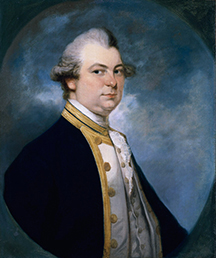 Figure 4: Ca. 1779 Portrait of Captain Constantine John Phipps, 2nd Baron Mulgrave (1744-1792).
National Maritime Museum, London, Greenwich Hospital Collection.
Figure 4: Ca. 1779 Portrait of Captain Constantine John Phipps, 2nd Baron Mulgrave (1744-1792).
National Maritime Museum, London, Greenwich Hospital Collection.
The burial environment is pretty hard on glass, which decays in layers over time, causing the light passing
through the glass to refract in different ways. Archaeologists really don't find glass insets that are
still capable of letting their decorative backs shine through in all of their magnified glory. So it
is possible that this inset has simply lost its translucency over time. If that is the case, then
the names could have shown through, and they are the key to interpreting this artifact. Running
with this scenario, let's explore Phipps and Delaval.
The names refer to Captain Constantine John Phipps, Royal Navy (Figure 5), and Thomas Delaval, who
teamed up to run for parliament for the Great Britain region of Newcastle in 1774. They based their
platform on equal representation in government and the need for elected officials to stick to their
campaign promises or be held accountable (Bradley 2002). They lost. Badly. Their victorious opponents
had roughly twice as many votes as the unfortunate Phipps and Delaval (Bean 1890:507).
Don't feel too sorry for P & D though. Thomas Delaval was quite a successful young industrialist
who landed on his feet even though he "had the misfortune to be drawn into politics" (Welford 1890:254).
Phipps, too, did not seem to have felt the loss. He had already been a member of parliament from
1768-1773, albeit for Lincoln, not Newcastle, and it seems that the 1774 campaign just might
possibly have been some kind of "warm up" (ha ha) activity he undertook after returning from a
1773 expedition to the North Pole. His description of the North Pole adventure represents one of
the earliest published descriptions of polar bears (Phipps 1774)! Phipps later returned to parliament
representing Huntingdon (Wikipedia 2015).
So Phipps and Delaval were political allies who ran for office together and lost, meaning that the
button with their names on it truly was a "campaign" button, albeit an unsuccessful one. If the
names were legible on this button, it would mean that somewhere in Baltimore County there were
Phipps and Delaval sympathizers. Even though they lost, the ideals they stood for were radical in
Great Britain at the time, but they tied into the ideals of the American Revolution very well.
That's because Phipps and Delaval were part of a political movement in Great Britain led by John
Wilkes, who was a popular and outspoken supporter of freedom of the press, freedom of religion,
and more equality in governmental representation (Bradley 2002; Christie 1970; Hammersely 2010).
Wilkes opposed war with the American colonies and condemned Britain's policies on the American
Revolution. So if the names were visible on the button, then we can guess that its owner was
probably a supporter of the American Revolution, or political reform in Great Britain, or both.
But what if the names were NOT legible? Well, I have a theory on that, too. This is 100% speculation
here, but if I were a maker of linked buttons in the 18th century and I had a barely-used glass inset
mold marked with the names of political losers, I might, just possibly, continue to make use of
that mold by filling it with really, really dark glass. That way I could get the most out of
the mold while masking the names of the unfortunate candidates. No one would ever even know the
names were in the finished button unless the inset fell out of the setting, and by then it
would probably be dumped on the colonial market anyway, so who cares? If that hypothetical
scenario is possible, then the owner of this button in Maryland may not have even known the
hidden politics of his or her accessories.
Which is more plausible: political leanings or a thrifty button maker? Who knows? Both scenarios
have value though, because they evoke images of real people, like Phipps and Delaval, their
fans, the patriot-rebels of the American Revolution, and a practical button-maker trying to
make a living. Even if the "truth" behind this button is never known, it has still proven its
capacity for teaching us about 18th-century lives.
References
Bean, William Wardell
1890 The Parliamentary Representation of the Six Northern
Counties of England: Cumberland, Durham, Lancashire, Northumberland, Westmoreland, and Yorkshire,
and their Cities and Boroughs from 1603 to the General Election of 1886, with Lists of Member
and Biographical Notices. Charles Henry Barnwell: Hull, UK.
Bradley, James E
2002 Religion, Revolution, and English Radicalism:
Non-conformity in Eighteenth-Century Politics and Society. Cambridge University Press: Cambridge.
Christie, Ian R.
1970 Myth and Reality in Late-Eighteenth-Century British
Politics and Other Papers. University of California Press: Los Angeles.
Hammersley, Rachel
2010 The English Republican Tradition and Eighteenth-Century
France: Between the Ancients and the Moderns. Studies in Early Modern European History,
edited by Joseph Bergin, William G. Naphy, Penny Roberts, and Paolo Rossi. Manchester University
Press: Manchester.
Phipps, Constantine John
1774 A voyage towards the North Pole: Undertaken by His
Majesty's Command, 1773. Printed by W. Bowyer and J. Nichols for J. Nourse: London.
Internet Archive, http://archive.org/details/voyagetowardsnor00mulg, accessed 27 January 2016.
Welford, Richard
1890 Men of Mark Turn 'Twirt and Tweed. In The Monthly
Chronicle of North-country Lore and Legend, Vol. 4, pp. 250-255. Walter Scott: London.
Wikipedia
2015 Constantine Phipps, 2nd Baron Mulgrave.
https://en.wikipedia.org/wiki/Constantine_Phipps,_2nd_Baron_Mulgrave, accessed 27 January. 2016.