Late in September 2015, the first timbers of a large structure began to emerge from the excavation of a site for
a hotel on the waterfront of Alexandria, Virginia. Historic documents indicated the presence of a large warehouse,
but it was unknown whether the remains of the structure had survived more than two hundred years of urban
development. The warehouse was constructed by John Carlyle at the behest of the Trustees of Alexandria in
1755 [Alexandria Archaeology]. This would be the City’s first public works project, when the town was only
six years old, and Virginia still a British colony. The Trustees leased the building to merchants and businessmen
through the end of the 18th century. It was in this warehouse that Andrew Wales started the town’s first brewery.
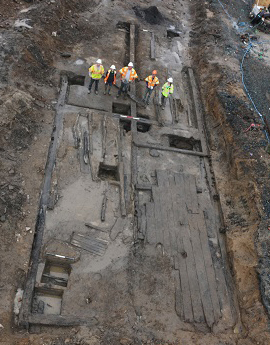 Figure 1. The Thunderbird Archaeology crew posing with the uncovered 1755 Carlyle Warehouse.
John Carlyle was a well-known figure in Alexandria’s history. A Scottish merchant, he ran many businesses including
an import and export trade, retail, an iron foundry, mill and blacksmith shop. As a prominent citizen of Northern
Virginia, he served as one of the original trustees of Alexandria, commissary for the Virginia militia during
the French and Indian War and the Revolutionary War, and justice of the peace for Fairfax County [Spencer 1910,
Carlyle House Park]. The waterfront warehouse is only one of several buildings attributed to John Carlyle and
that bear his name still.
The Carlyle Warehouse is the earliest historic structure archaeologically excavated in Alexandria to date. The
preservation of the wood frame foundation exceeded all expectations. The large beams were supported by stone
piers and connected with mortise and tenon joints as well as dowelled lap and finger joints. In addition to
the foundation, floor boards and sections of collapsed wall and ceiling framing were also preserved. The
overall dimensions of the structure measured 24 feet wide by 90 feet long. Only the eastern-most section
of the structure's foundation was destroyed by previous development activity. Barrels, glass bottles and
tools associated with the building were recovered. Other remains on the site included house foundations, a
brick-lined well, three privies and a fragment of a large ship.
Following thorough documentation of the site, the building timbers were systematically labelled and removed to
the Maryland Archaeological Conservation Laboratory for conservation in November 2015. Over the next several
years, the oak timbers will be impregnated with a stabilizing agent to prevent the wood from cracking and
warping once dry. The Lab staff will make use of a vacuum freeze dryer to control the drying process and
preserve all the dimensional information still available in the wood. This includes historic carpenter's
markings in the form of Roman numerals, as well as tool marks and evidence of how the building was
constructed. At this time, there are no definitive plans for long term exhibit.
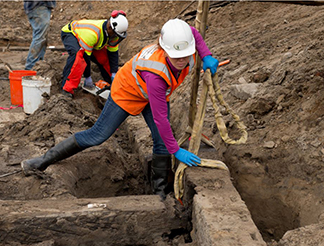 Figure 2. MAC Lab Conservation staff rigging timbers for crane lifts.
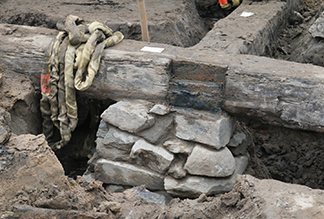 Figure 3. Stone piers supporting the wood foundations
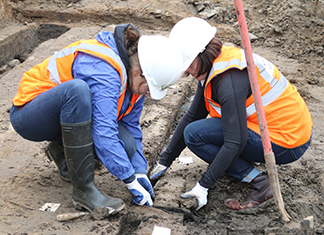 Figure 4. MAC Lab Conservation staff excavating the warehouse floorboards.
References
Alexandria Archaeology Museum
2015 November Public Report.
https://www.alexandriava.gov/historic/archaeology/default.aspx?id=89678, accessed 22 Februrary 2016.
Carlyle House Historic Park
2002 Carlyle House Historic Park, "About John Carlyle"
http://www.nvrpa.org/park/carlyle_house_historic_park/content/about_john_carlyle, accessed 22 February 2016.
Spencer, R.H.
1910 The Carlyle Family."The Carlyle Family." William and
Mary Quarterly Vol.18, No.3. (January). pp. 201–212.
Wikipedia
2016 John Carlyle (merchant).
https://en.wikipedia.org/wiki/John_Carlyle_(merchant), accessed 22 Februrary 2016.