In the early 1980s, archaeological investigations uncovered the remains of Antietam Furnace, a
well-preserved 18th century frontier blast furnace, in Washington County. Constructed in 1761,
this furnace produced a variety of cast iron objects, as well as "pig iron," which would have been
further refined to make wrought iron. The blast furnace was in operation up until the American
Revolution, when the owners received large contracts to cast cannon from the State of Maryland and
the Continental Congress. Since Antietam Furnace was too small for this purpose, it was abandoned and
the larger Mt. Aetna Furnace was constructed nearby in the mid-1770s (Frye 1984: 159).
Some of the most interesting objects cast at the furnace were elaborately decorated cast iron stove plates
for a five-plate, or jamb, stove (Figures 1 and 2). These stoves were used almost exclusively by the German
immigrants in Pennsylvania and the Great Appalachian Valley of Maryland and Virginia (Frye 1984: 90). Used
for radiant heat in northern European homes since the mid-1500s, many of the first German immigrants brought
this style stove with them when they emigrated from Germany (Conococheague Institute Blog 2013).
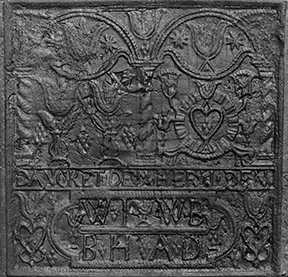 Figure 1: Conserved stove plate from the Antietam Furnace site.
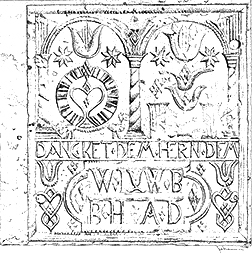 Figure 2: Drawing of a stove plate from the Antietam Furnace site by Johanna Mennucci
(Frye 1984: 94).
Figure 2: Drawing of a stove plate from the Antietam Furnace site by Johanna Mennucci
(Frye 1984: 94).
Tammis Groft describes how a jamb stove would be installed up against a home's central chimney:
The five plates formed an open box that was placed against an aperture in the wall that opened into
the kitchen fireplace of the next room. Live coals were inserted into the stove through the opening in the
fireplace. The adjacent room, thus, was heated economically without the discomfort of smoke (1984: 12)
(Figure 3).
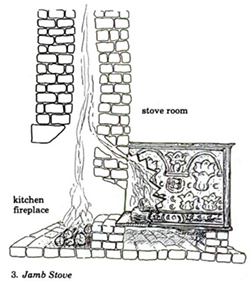 Figure 3: Diagram of jamb stove attached to hearth (Groft 1984:12).
Prior to 1750, jamb stove plates displayed biblically- themed scenes along with quotes from scripture. By
the time stove plates were being cast at Antietam Furnace in the 1760s, the pictorial scenes had been
replaced by a stylized floral motif, but the scriptural quotations remained (Frye 1984: 92).
The eight complete stove plates recovered from Antietam Furnace all had this floral motif, which included
a combination of lozenges, hearts, and tulips. This design became ubiquitous on jamb stove plates after
the mid-1750s. Having no known religious significance, it is unclear why the more interesting pictorial
scenes were abandoned for it (Mercer 1961: 70-72). A German inscription in the center of the plate
read "DANCKET DEM HERN DEM", which translates "Give thanks unto the Lord." The verse was completed on
the front plate: "ERIST FREUNDLICH," with translates "He is good." Only a few fragments of the front
plate survived at the Antietam Furnace site (Frye 1984: 95). A complete example is illustrated in
Mercer (1961: Plate 141) (Figure 4). The initials Figure 4: Example of what the front plate of the
jamb stoves recovered from Antietam Furnace may have looked like (Mercer 1914: Plate 141)."WJ," "WB," and "BH"
stand for the furnace owners William James, William Buchanan, and Barnabas Hughes (Figures 1 and 3). The
initials "AD" are those of an unknown individual, but one who likely had an important role in the
furnace's operation (Frye: 1984: 95).
At the time these stove plates were being cast at Antietam Furnace, the jamb stove was a dying technology
and was being replaced, even in some German homes, by the Dutch six-plated stove (Harris 2013: 3).
These "Holland" stoves had a closed firebox which contained its own wood fire, eliminating the need
to shovel live coals into it from the fireplace. This free-standing and portable stove, with its
own flue at the rear of the top plate, didn't require the Pennsylvania German central chimney. This
allowed it to be installed in rooms with chimneys on a home's outer walls or gable ends (Harris 2013).
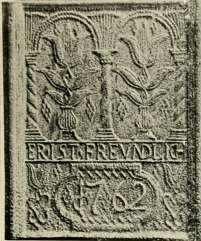 Figure 4: Example of what the front plate of the jamb stoves recovered from Antietam Furnace
may have looked like (Mercer 1914: Plate 141).
Figure 4: Example of what the front plate of the jamb stoves recovered from Antietam Furnace
may have looked like (Mercer 1914: Plate 141).
By the end of the 18th century, large flat plate stoves were no longer being made and many existing stoves
had been disassembled and their individual stove plates used for other purposes (Conococheague Institute Blog
2013). During his early 20th century study of stove plates, Henry Mercer found stove plates being used as
cistern covers, chimney caps, stepping stones, and firebacks (1961: 3). The 19th century six-plate stoves
were a similar design to their 18th century predecessors; however, advancements in technology made them
lighter and more finely cast (Antique Stoves 2000). Versions of these kinds of stoves are still used to
heat homes throughout the United States today.
References
Antique Stoves
2000 A Brief History of Cast Iron Stoves in America. Web resource:
http://www.antiquestoves.com/history.htm accessed March 30, 2016.
Conococheague Institute Blog
2013 Visit Our Newest Exhibit: The Stove Plates of Rock Hill Farm.
Web resource: http://cimlg.org/ciblog/tag/german-jamb-stove/ accessed March 9, 2016.
Frye, Susan Winter
1984 Archeological Excavations at the Antietam Iron Furnace Complex
(18WA288) Washington County, Maryland. Maryland Historical Trust Manuscript Series No. 37.
Groft, Tammis
1984 Cast with Style: Nineteenth Century Cast-Iron Stoves from the
Albany Area. Albany, New York. Albany Institute of History and Art.
Harris, Howell
2013 A Stove Less Ordinary Blog:A Collection of Stoves from American
Museums, I: Plate Stoves. Web resource:
http://stovehistory.blogspot.com/2013/10/a-collection-of-stoves-metropolitan.html accessed March 9, 2016.
Mercer, Henry C.
1961 The Bible in Iron. Doylestown, Pennsylvania: Bucks
County Historical Society.