The Catoctin Iron Furnace was in operation from 1776 to 1903 and remnants of this once industrious facility can
still be seen in the Cunningham Falls State Park, in Frederick County, Maryland. During its working life,
the furnace produced raw pig iron, ammunition during the Revolutionary War, and household items such as
stoves, utensils, and tools (Anderson 2013).
Recently, the Catoctin Furnace Historical Society brought several iron objects in their collection to the
MAC Lab to receive conservation. The objects are items that were either made or used at the furnace and required
cleaning to remove soil and corrosion on the surface, followed by the application of protective coatings. One
of these objects is a cast iron Franklin stove consisting of eight plates that, when assembled, neatly
fit into a fireplace (Figure 1). Two of the stove plates proudly display information about its place of
manufacture, CATOCTIN and W. MAYBURRY. Willoughby Mayburry owned and operated Catoctin Furnace from 1811
to 1820 (Anderson 2013). Of the eight plates, five have fashionable designs from the Early Republic period
molded in to the surface. The designs are comprised of a hanging basket of flowers and fruit, bows, swags of
leaves, a variety of floral motifs, and beaded edging. Figures 2 and 3 demonstrate how the stove plates are
assembled in to a fireplace.
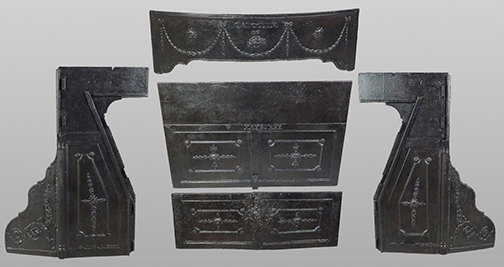 Fig. 1 Five plates from the Catoctin Furnace Historical Society's Franklin stove, with manufacturing
information and molded decoration, after conservation.
Fig. 1 Five plates from the Catoctin Furnace Historical Society's Franklin stove, with manufacturing
information and molded decoration, after conservation.
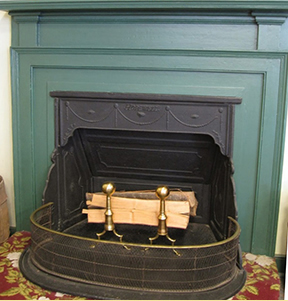 Fig. 2 Example of a Franklin stove in situ at the Hopewell Furnace National Historic Site.
The stove made at Catoctin Furnace is called a Franklin because it is based on a model that was invented by
Benjamin Franklin in the 1740's. Franklin’s original stove plate design incorporated a complex arrangement of
heat exchanger and down-draft flue that would supposedly extract more heat from the fire's fumes and thus
be more efficient in heating a room (Howell 2013). Unfortunately, the design did not work that well, or not
at all, and the stove became a commercial failure for Franklin (Howell 2013). Franklin did not have a patent
on his stove and subsequent inventors and manufacturers began simplifying and improving his design into a
model that would become viable and functional. Throughout the 19th century, some of the improved models were
patented and Franklin's prestigious name continued to be associated with that type of iron stove. The molded
decoration on the stove plates also evolved and varied greatly, reflecting the changes in fashion over time.
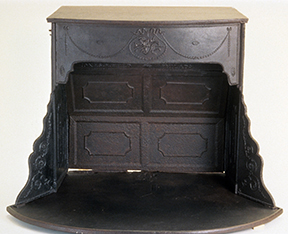 Fig. 3 Another example of a Franklin stove assembled. Collection of Winterthur Museum. Catalogue Number 1983.0210.
http://museumcollection.winterthur.org
Fig. 3 Another example of a Franklin stove assembled. Collection of Winterthur Museum. Catalogue Number 1983.0210.
http://museumcollection.winterthur.org
Despite its design flaws and the development of other modern heating sources, the Franklin stove continued to
appeal to consumers, even in to the 20th century. In a Tod Hunter Inc. catalogue from 1930, the company
offered a variety of reproduction Franklin stoves for sale (Figure 4). The Franklin stoves of the past, such
as the one made at Catoctin Furnace, continue to be admired for their decorative qualities and exemplary display
of iron casting technology.
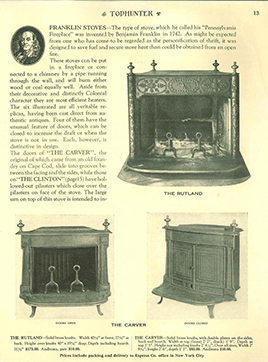 Figure 4. A page from Tod Hunter Inc.’s 1930 catalogue, with a range of reproduction Franklin stoves for sale.
http://archive.org/stream/GratesFranklinStovesFireFrames/GratesFranklinStovesFireplaces#page/n2/mode/1up
Figure 4. A page from Tod Hunter Inc.’s 1930 catalogue, with a range of reproduction Franklin stoves for sale.
http://archive.org/stream/GratesFranklinStovesFireFrames/GratesFranklinStovesFireplaces#page/n2/mode/1up
References
Anderson, Elizabeth Yourtee
2013 Catoctin Furnace: Portrait of an Iron-Making Village.
The History Press, Charleston.
Harris, Howell
2013 A Stove Less Ordinary Blog: A Collection of Stoves from
American Museums, Part II: Franklins. Web resource:
http://stovehistory.blogspot.co.uk/2013/12/a-collection-of-stoves-from-american.html. Accessed 11 April 2016.
Hunter, Todd
1930 Grates, Franklin Stoves & Fire Frames: Authentic Reproductions of
Antique Originals by Tod Hunter Inc. Web resource:
http://archive.org/stream/GratesFranklinStovesFireFrames/GratesFranklinStovesFireplaces#page/n2/mode/1up.
Accessed 11 April 2016.
National Park Service
2016 Catoctin Iron Furnace. Web resource:
https://www.nps.gov/cato/learn/historyculture/furnace.htm. Accessed 11 April 2016.