Alex Glass, MAC Lab Public Archaeology Asst.
Archaeology at the Belair Mansion in Bowie, Maryland has revealed the evidence of formal gardens on the
landscape there. The land for Belair was patented in 1721, but the brick structure that is now a museum,
was not constructed until the 1740's. The home was occupied by the Ogle family, of which several heirs
served as governors of Maryland. As part of the colonial elite, the Ogle estate likely used ornamental
gardens as one way of showing their wealth and status.
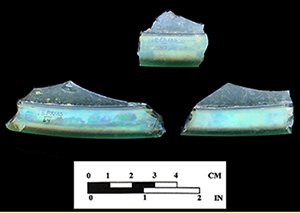 Green glass cloche rim fragments from Belair Mansion (18PR135).
Excavations of the east lawn area in the 1990’s suggest that sometime before the late 18th or 19th century
the work-yard near the mansion house was converted into a garden (Gibb 2002). Two features identified in
this area were described as possible medieval style bench structures, known as exedrae, which could have
served as covered seating areas for viewing the garden (Gibb 2002). While the surface of these features was
being exposed, several garden related artifacts were identified. Among these artifacts were rim fragments of
folded pale green glass. These folded glass rims are fragments of a large diameter glass bell jar, or
cloche (Gibb 2002). Although glass cloches have been used for centuries, based on other artifacts and
features surrounding the area, as well as comparison to other 18th century examples, the cloche fragments
may date to the 18th century.
Eighteenth-century gardeners devised a number of creative ways to extend a growing season or control the climate
for more finicky plants, but one of the simplest was by using a glass cloche. Various gardening how-to
books from the 1700's suggest the use of bell glasses for young plants (Noel Hume 1974). Sites in Williamsburg, VA
and Bacon's Castle in Virginia have also been able to identify fragments in garden areas (Noel Hume 1974, Gibb 2002).
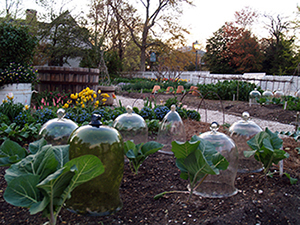 Cloches used in the garden at Colonial Williamsburg. "Dusk in the Colonial Garden." Longwood Graduate
Program. Spring in Colonial Williamsburg. Longwood Graduate Program Blog.
http://agdev.anr.udel.edu/longwoodgradblog/spring-in-colonial-williamsburg/
Cloches used in the garden at Colonial Williamsburg. "Dusk in the Colonial Garden." Longwood Graduate
Program. Spring in Colonial Williamsburg. Longwood Graduate Program Blog.
http://agdev.anr.udel.edu/longwoodgradblog/spring-in-colonial-williamsburg/
A cloche works similar to a greenhouse. They are bell shaped and made from glass with hollow interiors. The jar is
placed over a plant and sometimes propped up on one side for ventilation. Energy from the sun passes through the
glass and warms up the interior of the jar. So, while it may be cool outside, the plant underneath the glass
stays warm, and can continue to grow where otherwise it might not be able to survive. This method is useful for
warm weather crops such as melon and cucumber which need warm temperatures to grow well. This practice allowed
colonial gardeners to get a head start on the growing season by protecting new plants from damaging frosts or
cold mornings.
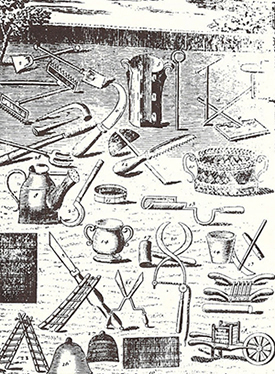 Cloche example (No. 26) among other gardening tools. "LE JARINIER FLEURISTE" by Le Sieur Liger
d'Auxerre printed in 1787. Images taken from earlier publication Necessary Instruments for Gardening from
La Jardinier Solitaire by Fran¸ois Gentil, Louis Liger published in 1706.
http://americangardenhistory.blogspot.com/2013_04_01_archive.html.
Cloche example (No. 26) among other gardening tools. "LE JARINIER FLEURISTE" by Le Sieur Liger
d'Auxerre printed in 1787. Images taken from earlier publication Necessary Instruments for Gardening from
La Jardinier Solitaire by Fran¸ois Gentil, Louis Liger published in 1706.
http://americangardenhistory.blogspot.com/2013_04_01_archive.html.
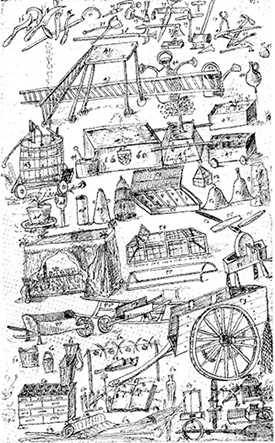 Various cloche examples. Numbers 51,52 and 53. "Garden Tools from John Evelyn's (1620-1706) Elysium
Britannicum, or The Royal Gardens in Three Books" from
http://americangardenhistory.blogspot.com/2013_04_01_archive.html.
Various cloche examples. Numbers 51,52 and 53. "Garden Tools from John Evelyn's (1620-1706) Elysium
Britannicum, or The Royal Gardens in Three Books" from
http://americangardenhistory.blogspot.com/2013_04_01_archive.html.
Plants in the 18th century were an important part of everyday life. Fruit and vegetables to sell or feed the
household were tended daily, and flowers to ward off odors or bad spirits played a significant role in the
lives of 18th century people. It is unsurprising then, that tending a garden was a year round task. A glass
cloche would have been one tool amongst many used in the garden. It was a convenient way to control the
immediate environment around a plant, and their use has continued today.
References
Gibb, James
2002 The Compton Site, circa 1651-1684, Calvert County,
Maryland, 18CV279. Report prepared for CRJ Associates, Inc., Camp Springs, Maryland, 1989.
Noel Hume, Audrey
1974 Archaeology and the Colonial Gardener. Colonial Williamsburg
Archaeological Series No. 7. Colonial Williamsburg Foundation. Williamsburg, VA.