"The eye of a human being is a microscope, which makes the world seem bigger than it really is." Khalil Gibran (1883-1931)
Nineteenth-century physicians often found that they needed more than just the naked eye to assist them with offering
quality health care to their patients. Using magnifying devices, like this rudimentary microscope known as a flea
glass (Figure 1), allowed them to gain a better view of wounds or for routine examinations of ears, eyes and throats.
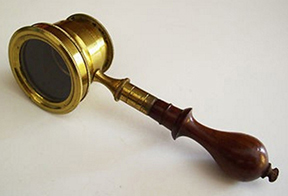 Handled flea glass dating to the second quarter of the nineteenth century.
http://www.worthpoint.com/worthopedia/simple-microscope-flea-glass-245822098
Handled flea glass dating to the second quarter of the nineteenth century.
http://www.worthpoint.com/worthopedia/simple-microscope-flea-glass-245822098
Invented in the 1500s, flea glasses were used primarily for studying insects and other small life forms (hence the
name), rather than for medical purposes. A small, convex lens held nearest to the eye and a larger, flat lens at
the opposite end of a short metal tube allowed for magnification ranges of 6x to 10x.
The lenses and iron fittings of a flea glass or similar simple microscope were recovered from a circa 1850 to 1870
privy excavated at the Federal Reserve site (18BC27) in Baltimore (Figure 2). This magnifying instrument may have
been mounted on a stand, similar to the instrument shown in Figure 3 (Bradbury 1968). A medical use for this scientific
instrument was assumed because the privy fill also contained a number of other artifacts relating to medical care—a
mortar and pestle, a salve jar, a pill tile, a leech jar, a number of medicine bottles and a possible stethoscope.
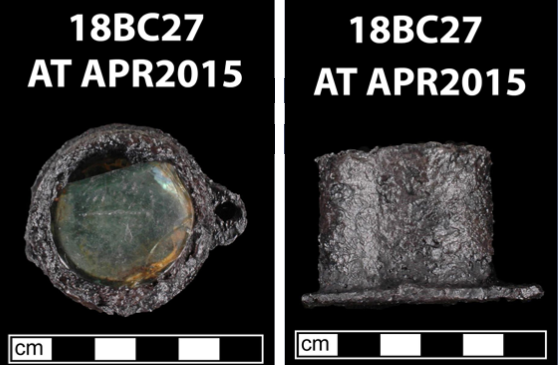 Figure 2. Flea glass or simple microscope from the Federal Reserve site. Top and side views. Photo by Nichole Doub,
Maryland Archaeological Conservation Lab.
Figure 2. Flea glass or simple microscope from the Federal Reserve site. Top and side views. Photo by Nichole Doub,
Maryland Archaeological Conservation Lab.
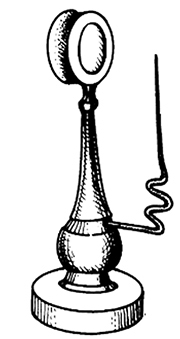 Figure 3. Simple microscope mounted on a stand. Similar instruments were illustrated as early as 1685 in Oculus
Artificialis by Johann Zahn.
Figure 3. Simple microscope mounted on a stand. Similar instruments were illustrated as early as 1685 in Oculus
Artificialis by Johann Zahn.
Documentary records indicate that the privy was located near the Southern Dispensary, a branch of the Baltimore General
Dispensary. A dispensary supplied free medicine and health care for citizens who could not otherwise afford medical
services. The Southern Dispensary, funded by charitable donations and a small appropriation from the city, was incorporated
in 1847 and remained in operation until at least 1889 (Woods 1847; Register 1890). The dispensary offered both clinic
and in-home health care (Polk 1888).
With large populations living in close proximity, it was critical for cities to provide medical services. At various times
during the eighteenth and nineteenth centuries, infectious diseases, including tuberculosis, cholera, yellow fever and
smallpox, struck Baltimore (Mdmedicine 2017). Clinics, like the Southern Dispensary, played key roles in treating
infected individuals and preventing widespread epidemics.
References
Bradbury, S.
1968 The Microscope Past and Present. Pergamon International Popular
Science Series. Pergamon Press, Ltd., Oxford.
Mdmedicine
2017 Epidemics in Maryland. Website accessed January 13, 2017.
http://mdhistoryonline.net/mdmedicine/index.cfm?action=epidemics
Polk, R.L.
1888 The Medical Directory and Register for Baltimore, Washington,
Maryland and District of Columbia. R.L. Polk & Co., Baltimore.
Register
1890 Annual Reports of the Register of the City and the Commissioners of
Finance. John Cox, Printer, Baltimore.
Woods, John W.
1847 The Act of Incorporation and By-laws, of the Southern Dispensary of
Baltimore: Together with a List of Officers for 1847. Baltimore.
Zahn, Johann
1685 Oculus Artificialis Teledioptricus Sive Telescopium. Würzburg,
Germany.