Last summer, the University of Mary Washington held an archaeological field school near Fredericksburg,
Virginia at a historic site that served as a Union officers’ encampment during the winter of 1862 to
1863. An unusual and curious silver fish-shaped artifact was unearthed during the excavation of a midden
associated with the time of the encampment (McMillan 2017). The University of Mary Washington recently sent
the artifact to the Maryland Archaeological Conservation Laboratory to undergo cleaning and stabilization
in the conservation lab. The artifact consists of a fish made from a silver metal sheet and a silver metal
tube soldered to the back (Figure 1). The fish’s scales, eye, and mouth are skillfully chased in to the
surface. The top of the tube, located at the fish’s mouth, is open while the other end is closed and
terminates in to a loop. Although the artifact may resemble a pendant or fishing lure, it is in fact
a type of needlework tool known as a knitting needle sheath (Rivers-Cofield 2017).
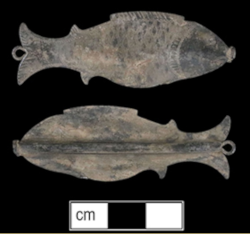 Figure 1. Silver knitting needle sheath, front and back, before conservation treatment.
Some of the earliest dated knitting needle sheaths are from the 17th century. Knitting needle sheaths were
commonplace in the United Kingdom, throughout Europe, and in North America (Rutt 1987, Sullivan 2004). They
were made from diverse materials, including wood, metal, bone, ivory, leather, and straw, and in a variety of
shapes and styles (Sullivan 2004). The sheath styles range from a simple bundle of straw or goose quills
tightly wrapped with colorful string to ornate versions made in silver and brass or intricately carved in
wood (Figure 2). Knitting needle sheaths were attached to the right side of a knitter’s waist (Figure 3).
Some sheaths could be tucked in to apron strings or a belt. Other sheaths required sewing the sheath to a
scrap of fabric and then pinning it to one's clothing at the waist. It is possible that the fish-shaped
sheath was attached to the waist in this manner, using the loop at the end of the tube to attach to a
piece of fabric (Figure 1). The knitting needle was inserted in to the sheath and made immobile, which
freed up the knitter's right hand to work with the yarn more easily. This made knitting easier, faster,
and portable. Illustrations from the 18th century, and later photographs from the 19th century, demonstrated
that women, men, girls, and boys knitted and sometimes did so while they were walking or engaged in other
work, such as herding sheep or carrying peat (Figure 4). Knitting needle sheaths made it possible to
multi-task. The use of knitting sheaths began declining during the late 19th century as commercial
hand-knitting decreased and industrial machine knitting became more common (Rutt 1987). However, the
knitting sheath is not totally obsolete as some knitters still use them to this day.
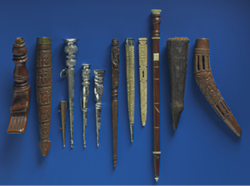 Figure 2. An assortment of knitting needle sheaths in the Fries Museum in the Netherlands.
http: www.handwerkwereld.com/tag/friese-floddermutsen/
Figure 2. An assortment of knitting needle sheaths in the Fries Museum in the Netherlands.
http: www.handwerkwereld.com/tag/friese-floddermutsen/
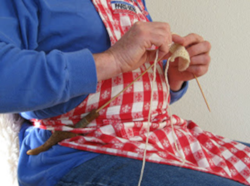 Figure 3. This modern day knitter demonstrates how to use a knitting needle sheath, tucked in the apron
strings at the waist. http://gansey.blogspot.com/2008/02/back-to-basics.html
Figure 3. This modern day knitter demonstrates how to use a knitting needle sheath, tucked in the apron
strings at the waist. http://gansey.blogspot.com/2008/02/back-to-basics.html
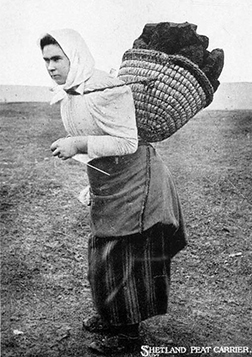 Figure 4. Postcard, circa 1910. A woman knits while carrying peat in Shetland, Scotland.
https://katedaviesdesigns.com/2009/08/10/tea-and-knitting/
Figure 4. Postcard, circa 1910. A woman knits while carrying peat in Shetland, Scotland.
https://katedaviesdesigns.com/2009/08/10/tea-and-knitting/
The silver fish-shaped needle sheath from Virginia is quite a fine, elegant tool and was likely used by
a 'hobby' knitter, not by one that relied on knitting for income. An almost identical silver fish knitting
sheath in the Winterthur Museum collection suggests that the sheath from Virginia dates to the early 19th
century (Winterthur 2017). Archaeologists are not certain why or how the sheath was discarded in the
midden (McMillan 2017). Just like those tall fishing tales, it is difficult to know the truth unless you
were there at the time.
References
McMillan, Lauren
2017 Personal Communication- University of Mary Washington.
Rivers-Cofield, Sara
2017 Personal Communication- Maryland Archaeological Conservation
Laboratory.
Rutt, Richard
1987 A History of Hand Knitting. Loveland, CO: Interweave Press.
Sullivan, Kay
2004 Needlework Tools and Accessories: A Dutch Tradition. Woodbridge, Suffolk: Antique Collectors Club.
Winterthur Museum, Garden & Library
2017 Museum Collection Digital Database. Website accessed February 22, 2017.
http://museumcollection.winterthur.org/single-record.php?resultsperpage=20&view=catalog&srchtype=advanced&hasImage=&ObjObjectName=&CreOrigin=&Earliest=&Latest=&CreCreatorLocal_tab=&materialsearch=&ObjObjectID=&ObjCategory=&DesMaterial_tab=&DesTechnique_tab=&AccCreditLineLocal=&CreMarkSignature=&recid=1959.0560%20A&srchfld=&srchtxt=knitting&id=5168&rownum=1&version=100&src=results-imagelink-only#.WN5l7G8rLct