While certainly not the most photogenic artifact in the collections at the Maryland Archaeological Conservation
Lab, this six inch long strip of “whalebone” did not have to look good to be effective. It spent its useful
life hidden from view, ensuring ladies the hourglass silhouette prescribed by Victorian fashion standards.
Recovered from a Baltimore privy filled between 1850 and 1870, this unusual object was boning from an
undergarment known as a corset.
Baleen, commonly known as whalebone, is actually a keratinous hard tissue that forms in brush-like plates in
the some aquatic mammals of the Cetacea order (MacGregor 1985). In whales in the Mystacoceti suborder,
including the humpback, right, sperm and blue whale, these plates serve to filter the crustacean krill from
seawater, which they then eat. Both flexible and strong, baleen was well-suited to the manufacture of a
number of items, including combs, collar stiffeners, picture frames, fan blades and riding whips
(Lauffenburger 1993:220).
Baleen was apparently first used in women's fashion in the western world in the 1590s, when the hooped petticoats
known as farthingales were stiffened with strips of the substance (Lauffenburger 1993:219). It soon became
an important component of corsets and stays, undergarments used to shape and hold the torso into a prescribed
shape. Baleen strips could be bent to the contours needed for the silhouette demanded by the fashion of the
day. The strips—sometimes dozens per corset—would be inserted into narrow channels sewn into
the body of the undergarment (Holloway Scott 2010).
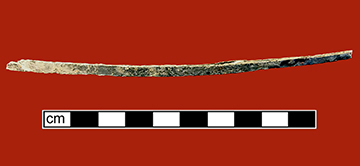 Baleen corset boning from Feature 30 at the Federal Reserve Site (18BC27).
By the mid-19th century, baleen began to be replaced by steel boning, which was less expensive and easier to
manufacture (Holloway Scott 2010). Perhaps its presence in the circa 1850-1870 privy assemblage is explained
by the arrival of newer technology or may reflect broader cultural outlooks about wearing corsets and campaigns
for dress reform (Steele 2001).
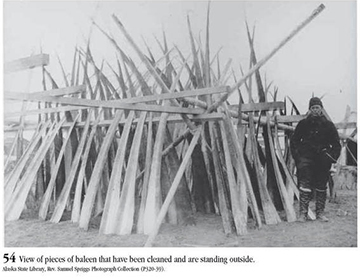 Alaska trader standing with plates of baleen, circa 1900
(http://echospace.org/assets/243.html)
Alaska trader standing with plates of baleen, circa 1900
(http://echospace.org/assets/243.html)
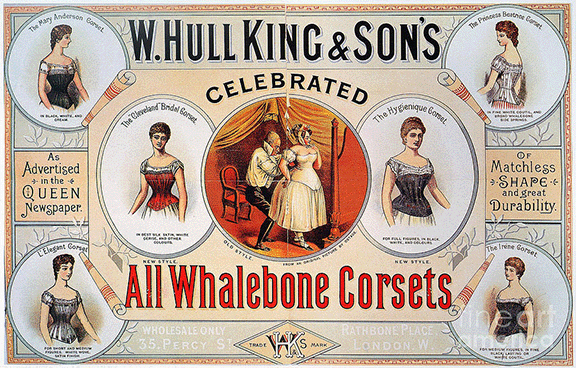 Late 19th-century corset advertisement (http://images.fineartamerica.com/images-medium-large/corset-ad-1898-graner.jpg)
References
Holloway Scott, Susan
2010 More About Corsets: Baleen Ho! Two Nerdy History Girls.
Blog post dated April 7, 2010. Website accessed 1-31-2017.
http://twonerdyhistorygirls.blogspot.com/2010/04/more-about-corsets-baleen-ho.html.
Lauffenburger, Julie A.
1993 Baleen in Museum Collections: its Sources, Uses, and Identification.
Journal of the American Institute for Conservation. 32(3):213-230.
MacGregor, Arthur
1985 Bone, Antler, Ivory and Horn; The Technology of Skeletal Materials
Since the Roman Period. Routledge Library Editions, Archaeology. Volume 41. Routledge, New York.
Steele, Victoria
2001 The Corset: A Cultural History. Yale University Press, New
Haven, Connecticut.