The wearing of hats has seen a sharp decline since the mid-twentieth century, where previously men would
have rarely been seen out of doors without one. Hats have the practical purposes of protecting one's head
from the elements and providing warmth, but they also conveyed personal information such as social status or
type of employment. Hat fashions have changed dramatically over time and geography; however the top hat, also
known as the tall or high hat, has an interesting history that persists through today.
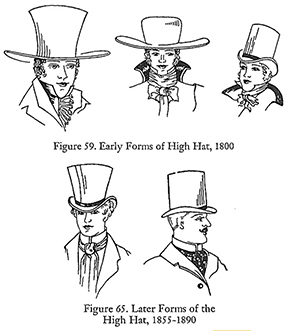 Evolution of the high/top hat. (Lester and Oerke 2004)
The first top hat was created in Middlesex, England by George Dunnage in 1793 and had early popularity both
amongst the upper classes and as a uniform worn by the Imperial Russian Army and British police officers and
postmen. By 1820, the top hat replaced the cocked hat also known as a tricorn and was adopted by all ranks of
society (Bradfield 1987, Byrde 1979). Originally made of felted beaver fur, these were replaced by silk, though the
hats belonging to the poorer classes were made of lesser felts such as rabbit. On the earliest hats, the
crown was rounded and the rims broad. Over time, the crowns lengthened and the brims narrowed to the
general form that we recognize today (Byrde 1979).
Felting was the preferred process for creating the light weight yet durable hats. Beaver felt was especially valued
as it is the sturdiest, warmest, and most hard-wearing of furs. It also has natural water repelling properties
and will hold its shape when wet. Much of the strength is derived from the felting process whereby fibers
interlink in all directions rather than the linking groups of twisted fibers woven in a single
direction (Lester and Oerke 2004). This interlinking also prevents tears and the close interlinking of the
fibers provide additional water resistance. In creating the top hat, the felted fabric was pressed onto a
form with the use of hot iron; the brim was then added with a heated press which joined the two components
yet left no seam. Vigorous brushing would give the felt a high polish (Cummings 1998).
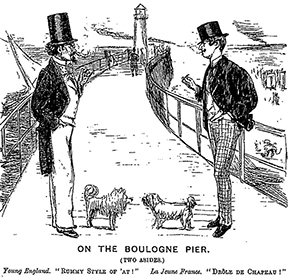 8 Sept. 1866 cartoon from Punch, making fun of headwear worn by fashionable young men
(Cummings 1998)
8 Sept. 1866 cartoon from Punch, making fun of headwear worn by fashionable young men
(Cummings 1998)
As part of the ongoing improvements to Interstate 95, a number of archaeological excavations have taken place
along the Delaware River in Philadelphia. The excavations are being conducted by AECOM in collaboration with
the Pennsylvania Department of Transportation and the Federal Highway Administration. Among the many artifacts
recovered is a felt top hat retrieved from a wood-lined privy dating to the mid-19th century in the Fishtown
neighborhood (Kutys 2017). For more information on the excavations, visit www.diggingi95.com.
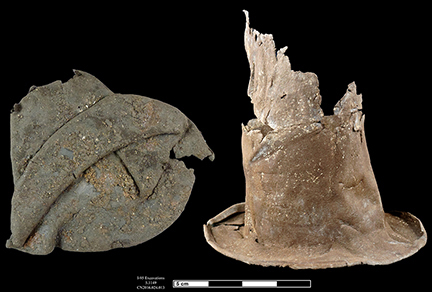 Fishtown Top Hat. Before and after conservation treatment. (MAC Lab)
The preservation of the top hat is due to both the strength of the felt materials as well as the wet environment
from which it was recovered. The dense wet clay that packed in the artifact prevented the organic material from
drying out and created an anoxic environment where biological decay was slowed. With reduced oxygen, the mold,
bacteria and insects that would normally have caused the hat's deterioration could not thrive in the burial
environment and thus saved the top hat in the archaeological record. The conservation itself was very
straight forward and consisted primarily of wet cleaning to remove soiling. A weak consolidant was added to
the final wash in order to lend additional strength to the fabric which was then reshaped around a foam
form and allowed to dry. The hat, in its current state, is almost as robust and stable as the day it was
sold and is a testament to the milliner who crafted it.
References
Bradfield, Nancy
1987 900 Years of English Costume. New York: Crescent Books.
Byrde, Penelope
1979 The Male Image: Men's Fashions in Britain 1300-1970. London:
B.T. Batsford, Ltd.
Cummings, Valerie
1988 The Visual History of Costume Accessories. New York:
Costume and Fashion Press.
Kutys, Thomas
2017 Personal Communication AECOM.
Lester, Katherine and Oerke, Bess Viola
2004 Accessories of Dress: An Illustrated Encyclopedia.
Mineola, NY: Dover Publications.