The Bald Friar petroglyphs are one of the foremost examples of Native American rock art on the eastern coast
of the United States. These petroglyphs were located on several small islands on the Susquehanna River, 3 miles
south of the Maryland and Pennsylvania state line (Lenik 2009). Although records of this rock art date back to
the 1600s, the creators of the carvings are unknown, both their time period as well as their tribe (Nevin 2013).
At this point, the petroglyphs cannot be translated but there are five types of symbols commonly occurring:
parallel lines, cups and cup groupings, circles and circle compositions, diamond compositions, and complex curvilinear
compositions (Hall 2014). There is the occasional easily recognizable symbol (fish, heart, sun, etc.), but the
meaning of the entire stone composition remains unclear. Did the rock carvings warn travelers of dangers in the
river? Where to hunt? Directions? Or was it simply a narrative? While archaeologists pondered these questions,
these petroglyphs were in danger of being obscured and forgotten by history.
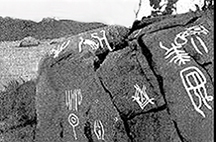 Bald Friar Petroglyphs on Rock Island and Painted in with Chalk. (Miles 1923)
The Bald Friar Petroglyphs are a unique example of destroying a monument to preserve it for future generations. The
construction of the Conowingo Dam in northern Maryland threatened to completely obscure the petroglyphs and
leave them to be forgotten by history. The dam caused the water levels surrounding Bald Friar to rise 30 feet
and submerge the islands (Lenik 2009). Luckily, at this time, academic and public curiosity about these carvings
was at a peak and a decision was made to remove the petroglyphs from the cliffs. Unfortunately, the way chosen
to remove the petroglyphs from cliffs in the 1926 was with explosives (Hall 2014). In 1927, after the stones were
removed from the cliff in this manner, they were reassembled into 90 stones and displayed on cement and brick
plinths at the Maryland Academy of Science in Baltimore, MD (Lenik 2009).
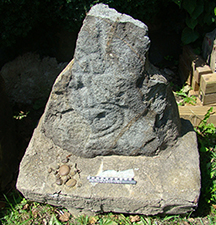 Bald Friar Petroglyphs Displayed on Brick and Cement Plinth in Elkton, MD.
When the Maryland Academy of Science moved to a smaller location in 1944, most of these stones were moved to the
parking lot of Druid Hill Park and forgotten (Hall 2014). In the summer of 2017, a project began to survey all
known Bald Friar petroglyphs in Maryland. Out of 226 petroglyphs from Bald Friar, 197 of the stones were at the
Maryland Archaeological Conservation Laboratory. These petroglyphs were brought inside, cleaned, photographed,
and documented. While not all of the stones contained carved glyphs, there were 78 stones with clearly
distinguishable glyphs. These glyphs are not always very easy to see in condition photographs so different photography
techniques were used to emphasize the carved areas. By taking several photos of the stone with one light source
shining around the stones at oblique angles, it is possible to combine the photos to exaggerate the shadows within
the carved depressions in the stone. When this new photo is converted to black and white, it is a stark
improvement to the normal glyph visibility.
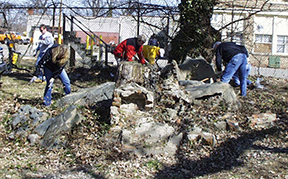 Bald Friar Petroglyphs Being Removed from Druid Hill Park.
All the petroglyphs in the MAC Lab are now cleaned and in storage. The condition, measurements, glyph type and
variability, and rock type have been recorded for each stone. These stones can now be more accessible for research.
The conditions have been made to begin the conservation treatment of these stones. The stone treatments will largely
include removing modern brick and cement from the stones to improve appearance and decrease the size and weight of
the petroglyphs. These stones have been through a tumultuous journey over the last hundred years and hopefully,
through this survey and future conservation treatment, they will be available to be studied and interpreted once again.
 Bald Friar Petroglyph Photograph and Same Petroglyph Raking Light Composite Photograph
in Black and White.
Bald Friar Petroglyph Photograph and Same Petroglyph Raking Light Composite Photograph
in Black and White.
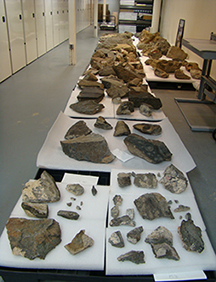 Bald Friar Petroglyphs in MAC Lab Storage.
References
Hall, Charles
2014 The Strange Case of the Bald Friar Petroglyphs. Maryland Historical Trust.
Presented at the 2014 Eastern States Archaeological Federation Conference.
Lenik, Edward
2009 Making Pictures in Stone: American Indian Rock Art of the Northeast.
University of Alabama Press.
Miles, Felix
1923 “Hunting Ancient Relics Along the Susquehanna.” Baltimore Sun, 30 Sept.
Nevin, Paul
2013 "A Story in Stone." Native Americans in the Susquehanna River Valley, Past and
Present. Ed. by David J. Minderhout. Bucknell University Press, Co-Published with the Rowman & Littlefield Pub. Group, Inc.