During the second half of the nineteenth century, it was fashionable for men to sport long, flowing mustaches.
This mustachioed look commenced after the British colonization of India. Whether the British troops wished to emulate
their Indian counterparts, or because facial hair helped them maintain control in this new colony, mustaches became
normal attire for the British military man. Between the years 1860 and 1916, the King's Regulations and Orders for
the Army even went so far as to stipulate that mustaches be sported by troops.
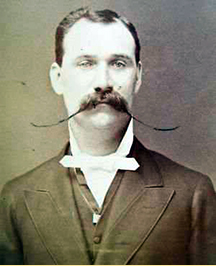 Handlebar mustache man. https://handlebarclubforum.org/imageproxy.php?url=http://i1094.photobucket.com/albums/i449/bleachedfan/cdv-photo-handsome-man-nice-handlebar-mustache190531056912-1.jpg
These mustaches were tamed into shape using a stiff wax made from ingredients like tallow, beeswax, pine resin and
saturated vegetable oil, allowing for artistic sculpting of facial hair. While giving a mustache a groomed
appearance, the wax had the unfortunate tendency to melt when it came into contact with hot beverages. Not only
were careful grooming efforts destroyed, but the melted wax would lend a noxious taste to a cup of hot tea or coffee.
In order to solve this problem, Staffordshire potter Harvey Adams came up with an ingenious invention sometime
between 1850 and 1860—a new style of cup that incorporated a small interior ledge that shielded the mustache from
the steamy liquid inside. A less popular option was a mustache guard patented in 1902 by E.C. Gladwin, designed to
protect the mustache from food, especially soup and hot liquids. Gladwin’s patent stated that the guards could be
manufactured in different colors and fabrics, presumably to coordinate with clothing.
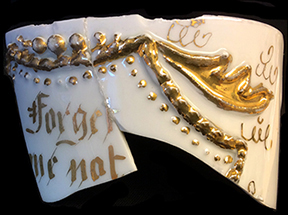 European hard paste porcelain mustache cup with molded decoration and gold gilt band embellishments. Marked
on bottom "Made in Germany." From Brewhouse site 18CV13.
European hard paste porcelain mustache cup with molded decoration and gold gilt band embellishments. Marked
on bottom "Made in Germany." From Brewhouse site 18CV13.
This elaborately molded and gilded porcelain cup bears the sentiment "Forget Me Not" and was almost certainly given as a
gift. A printed mark on the cup base shows that it was manufactured in Germany, although mustache cups were also
made in England, the United States and Japan. Archaeologists at the MAC Lab believe this cup was owned by John Broome
Mackall, who lived at the Brewhouse plantation in St. Leonard Maryland. Mr. Mackall was there at the time of his
death in 1913 and this cup was found as a part of a large group of dishes discarded after he died. The placement
of the cup handle to the right of the ledge tells us that Mr. Mackall was most likely right-handed.
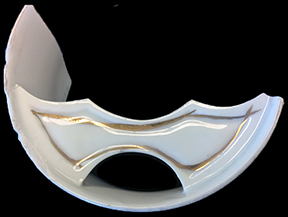 Top view of "Forget Me Not" cup showing mustache protector.
Mustache cups remained popular until the beginning of World War I, when military regulations requiring clean-shaven
faces caused large mustaches to go out of fashion. Handlebar mustaches made it impossible to create a good seal on
gas masks used to protect soldiers against mustard gas. It is interesting to discover that British political and
military actions were responsible for both the rise and the fall of the handlebar mustache in British
and American culture.
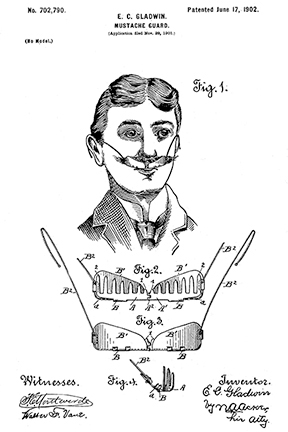 Mustache Guard. https://docs.google.com/viewer?url=patentimages.storage.googleapis.com/pdfs/US70279Q.pdf
References
Atlas Obscura
2017 A Look Back at the Mustache Cups That Kept Tea-Drinkers' Whiskers Dry.
Atlas Obscura, May 31, 2017. Website http://www.atlasobscura.com/articles/mustache-cups,
accessed September 27, 2017.
Kovels
2010 Mustache Cups. Kovels.com.
https://www.kovels.com/price-guide/pottery-porcelain-price-guide/mustache-cups.html?/viking/-milk-glass-laurel-wreath=&eid=773695,
accessed September 27, 2017.
Smallwood, Karl
2015 The Victorian Moustache Cup. Today I Found Out. Website
http://www.todayifoundout.com/index.php/2015/02/victorian-moustache-cup/, accessed September 27, 2017.