It is always a pleasure to find personalized artifacts that can be attributed to a particular family,
especially if they represent a style that is diagnostic of a particular time period. That is the case of
the engraved fork from the Rousby site (18ST751), which is located adjacent to Harper's Creek aboard the Naval
Air Station Patuxent River (Figure 1A). Interestingly, while many specific details about the fork become evident
after a little research, it retains an air of mystery because it was found in a rather unexpected place.
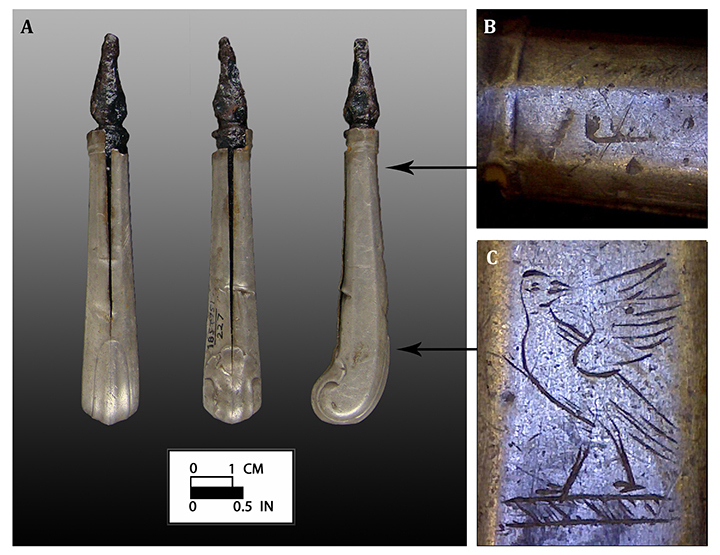 Figure 1: Three sides of the silver-handled fork from the Rousby site (A). Note that the seam of the thin molded
silver handle is splitting because of pressure from corrosion of the iron fork fragment at its center.
The handle's worn silversmith mark (B) and falcon crest (C) are shown under microscopy; neither shows well on
the handle without a raking light. Courtesy of the Naval Air Statio, Patuxent River, Naval District Washington.
Figure 1: Three sides of the silver-handled fork from the Rousby site (A). Note that the seam of the thin molded
silver handle is splitting because of pressure from corrosion of the iron fork fragment at its center.
The handle's worn silversmith mark (B) and falcon crest (C) are shown under microscopy; neither shows well on
the handle without a raking light. Courtesy of the Naval Air Statio, Patuxent River, Naval District Washington.
The fork has a “pistol grip” handle with an octagonal cross-section and foliate decoration. Based on these details,
it likely dates to the first half of the 18th century (Brown 2001; Moore 1999). The functional end is made of
iron while the handle is composed of thin sheets of molded silver filled with resin to hold the iron fork in
place. This style had the appearance of silver, but it actually contained very little of the precious metal,
making it both more durable as a utensil and more affordable. A maker’s mark appears on the handle, though it
is so worn that it has not been possible to determine the silversmith it represents (Figure 1B).
The fork would have belonged to a set and it dates to a period when having sets of utensils to offer visiting
guests was a relatively new phenomenon (Figure 2). Prior to the 18th century, people typically carried their
own utensil sets with them when traveling (Moore 1999:195). A host’s ability to provide matching sets of
utensils was a symbol of wealth and gentility, which was further emphasized when the handles were engraved with
a family crest. This handle does boast that personal detail — an engraving of a falcon with open wings
(Figure 1C), which represents the crest of the Carroll family in Maryland (Figure 3).
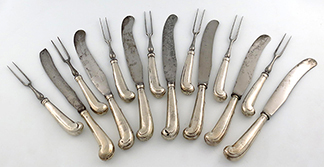 Figure 2: The fork from the Rousby site would have belonged to a set of forks and knives such as this one
offered at a 2015 auction (https://www.woolleyandwallis.co.uk/Lot/?sale=SV140715&lot=1026&id=295332).
Figure 2: The fork from the Rousby site would have belonged to a set of forks and knives such as this one
offered at a 2015 auction (https://www.woolleyandwallis.co.uk/Lot/?sale=SV140715&lot=1026&id=295332).
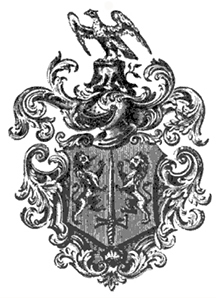 Figure 3: The Carroll Coat of Arms (https://en.wikipedia.org/wiki/Charles_Carroll_of_Carrollton).
The Carrolls were Catholics who moved to Maryland from Ireland in search of better opportunities, only to arrive at
a time when Protestants overthrew the proprietary rule of the Calvert family and began passing laws to suppress
Catholicism (Hoffman 2000). Prior to their arrival in Maryland, the Carroll family crest was a falcon with wings
at rest, but when Charles Carroll “the Settler” (so called to differentiate him from other Charles Carrolls in
the family) emigrated in 1688, he changed the crest to open wings as a symbol of the family's flight (Mason Rowland 1898).
Some members of the Carroll family accumulated a lot of land and wealth, and having silver marked with their crest
would have been one way to display their status while also identifying the utensils in case of theft. In
1749 Charles Carroll of Annapolis had a number of silver items stolen, and he placed an ad in the Maryland
Gazette that read:
November 8, 1749. LOST or Stolen from the Dwelling House of Charles Carroll, Esq; in the City of Annapolis
about ten Days ago, one old Silver Mug, holding above half a Pint; with a Coat of Arms engraved thereon, being a
sword erect, between two Lyons rampant: Likewise three Silver Spoons, with a Crest engraved on each, being a
Falcon, with wings expanded, standing on a Stump having a Branch on each Side. If offered to be pawn'd or
sold, whoever will secure the Person so offering the same, shall upon Conviction of the Thief, be
intitled [sic] to a Reward of Five Pounds, to be paid by CHARLES CARROLL (The Maryland Gazette 1749).
While Charles Carroll never occupied the Rousby site, there was a Carroll family connection. In 1767 Captain Henry
Carroll married Araminta Thompson and she inherited the property known as Susquehanna Point, where the Rousby
site is located. The couple built a house on the parcel ca. 1770-1775 (King 1996). In addition to being a ship
captain, Henry Carroll became a successful farmer on the Susquehanna Point plantation. The probate inventory
taken of his property in 1776 listed assets valued at £1360.8.8, including 112 ounces of "indifferent" silver
at 6 shillings per ounce, 64 ounces of “very old” silver at 4 shillings per ounce, and "1 Doz. knives & forks"
worth 6 shillings which could very well reference the set that included the fork from the Rousby site (Maryland
State Archives 1945-1946). If the silver-handled utensils matched the "old" and "indifferent" silver, that
would make sense, because the style of the fork was out of fashion by 1776.
After Henry's death, Araminta remarried and eventually moved to Prince George's County with her second husband,
but she and Captain Henry Carroll had six children, and their grandson Henry J. Carroll eventually inherited
Susquehanna Point in the 1840s. By that time the home built by Araminta and Captain Henry Carroll was in
ruins, and their grandson apparently preserved the ruins as a landscape feature when he built a new home
in the same area (King 1996). It was also in the mid-19th century that the silver fork with the Carroll falcon
crest somehow made it into the archaeological record over a quarter mile away from the houses the
plantation owners built.
The Rousby site is named after one of its 17th-century inhabitants, and in fact, it is the 17th-century
component of the site that really prompted the archaeological study that yielded the fork. The site has a
mid-19th-century component though, including fill deposits and a trash pit containing a lot of oyster
shell (Child et. al. 2002). Although no direct evidence of a 19th-century structure was found, the study
of that part of the site was limited, and the presence of the trash pit suggests that there was a domestic
occupation of some kind, such as a slave quarter associated with Henry J. Carroll's plantation. It is
the discovery of the fork in this area that makes the find somewhat mysterious.
How did a personalized silver fork that was around 100 years old end up as trash, not in the house where
its original owner had lived, but farther away near a possible slave quarter? Was the old fork stolen like
Charles Carroll's spoons had been? That seems impractical since the silver content was so little and the
resin-filled handle might have been difficult to melt down. Perhaps the fork was given as a gift to a
slave or tenant. If Henry J. Carroll inherited an old set of utensils, gifting might have been a practical
way to pass on the out-of-date items. Alternately, the fork could have simply been found and moved by
the occupants of the Rousby site, particularly if the people who lived there included slaves who labored to
construct the new Carroll house and turn the old ruins into a landscape feature.
More archaeology is needed to determine if the 19th-century component of the Rousby site does, in fact,
represent a slave quarter, but regardless of what the site represents, it is clear that the Carroll
family's silver-handled fork had some kind of life beyond its original function as a display of wealth
and gentility in the big house, and that chapter in this artifact's life remains an archaeological mystery.
References
Brown, Peter
2001 British Cutlery: An Illustrated History of Design, Evolution and
Use. York Civic Trust. Philip Wilson Publishers: London.
Child, Kathleen M., Sean Alexander, Michael B. Hornum, and Martha Williams
2002 Phase II Archaeological Evaluation of Site 18ST751, Naval Air Station
Patuxent River, St. Mary's County, Maryland. Report Prepared for Commander, Atlantic Division, Naval Facilities
Engineering Command, Norfolk, Virginia.
Hoffman, Ronald
2000 Princes of Ireland, Planters of Maryland: A Carroll Saga,
1500-1782. University of North Carolina Press: Chapel Hill, North Carolina.
King, Julia A.
1996 "The Transient Nature of All Things Sublunary": Romanticism, History,
and Ruins in Nineteenth-Century Southern Maryland. In "The Transient Nature of All Things Sublunary":
Romanticism, History, and Ruins in Nineteenth-Century Southern Maryland. In Landscape Archaeology: Reading
and Interpreting the American Historical Landscape, edited by Rebecca Yamin and Karen Bescherer Metheny,
pp. 249-272. University of Tennessee Press: Knoxville, Tennessee.
The Maryland Gazette
1749 Advertisement for Charles Carroll's Lost or stolen silver. November 22.
No. 239, page 4. http://msa.maryland.gov/megafile/msa/speccol/sc4800/sc4872/001278/html/m1278-1056.html,
accessed 31 October 2017.
Maryland State Archives
1945 Huntington Collection of Maryland State Archives Security Microfilm.
Prerogative Court (Inventories), Liber 125, Folio 256-262.
1946 http://mdhistory.net/msaref10/msa_te_1_044/html/msa_te_1_044-0465.html,
accessed 31 October 2017.
Mason Rowland, Kate
1898 The Life of Charles Carroll of Carrollton, 1737-1832: With his
Correspondence and Public Papers. C. P. Putnam’s Sons: New York.
Moore, Simon
1999 Cutlery for the Table: A History of British Table and Pocket
Cutlery. The Hallamshire Press: Sheffield, England.