Archaeologists document everything they excavate because context can tell the
story of how the artifacts were used. This Curator's Choice is a perfect example
of why that practice is so important.
I was recently asked to identify artifacts that might have been used by women in
the 18th century. As I looked in our study cabinets, one of the things I wanted
to find was evidence of keys and storage chests, since women tasked with running
a household would have used these items to control access to valuable things like
linens and other domestic provisions. The best examples I found came from the Oxon
Hill Manor site (18PR175), a plantation owned by the Addison family in Prince
George's County, Maryland.
In a drawer full of hinges, door locks, and other architectural items from a structure
that was built ca. 1690 and destroyed in a fire by ca. 1730, I discovered what I
believed to be decorative trunk or chest hardware (Figure 1). I confirmed this ID
by comparing the hardware to surviving examples in museums (Figure 2), and then I
looked deeper into the collection in case there were more pieces that had not yet
been pulled for conservation and study. Sure enough, a lot of the badly corroded
iron found in the same area turned out to represent more chest fittings (Figure 3).
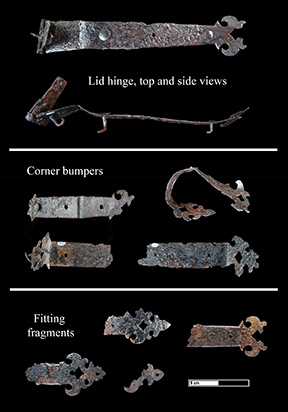 Figure 1: Conserved trunk or chest fittings from the Addison plantation
(18PR175).
Figure 1: Conserved trunk or chest fittings from the Addison plantation
(18PR175).
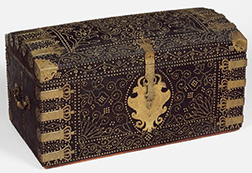 Figure 2: Highly decorative travelling trunk made in England ca. 1680-1700. © Victoria
and Albert Museum, London (https://collections.vam.ac.uk/item/O58220/travelling-trunk/.
Figure 2: Highly decorative travelling trunk made in England ca. 1680-1700. © Victoria
and Albert Museum, London (https://collections.vam.ac.uk/item/O58220/travelling-trunk/.
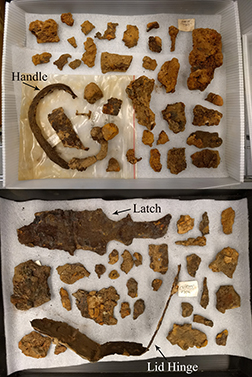 Figure 3: More chest fittings were found in the area, but were so badly corroded that they were not
considered high-priority candidates for conservation. The handle, front lock latch, and a lid hinge
are recognizable.
Figure 3: More chest fittings were found in the area, but were so badly corroded that they were not
considered high-priority candidates for conservation. The handle, front lock latch, and a lid hinge
are recognizable.
It is incredibly satisfying to be able to make sense of horribly corroded iron that
seems unrecognizable. In the case of this trunk, some pieces are so badly corroded
that even when x-rays were taken to look through the corrosion to the object inside,
it was still hard to recognize pieces like the front lock plate (Figure 4). It is
only possible to figure out what some of the fittings are because of their association
with the trunk hardware that is in good shape, which is why it is so important for
archaeologists to know which artifacts are found together.
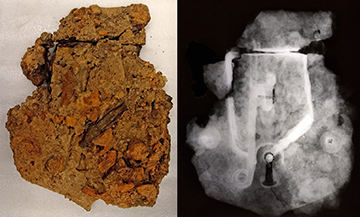 Figure 4: The lock plate is so badly corroded that not much of the core metal remians. The x-ray
does reveal some decorative details though, as well as the lock mechanism and the nails that attached
the lock to the chest.
Figure 4: The lock plate is so badly corroded that not much of the core metal remians. The x-ray
does reveal some decorative details though, as well as the lock mechanism and the nails that attached
the lock to the chest.
Now that the hardware has been identified as parts of a larger piece of furniture, it
is possible to get an idea of what the trunk would have looked like. The hinges for
the lid have a deliberate bend indicating that the lid was about 2.5" high.
Similarly, the bent nails used to attach the iron fixtures can be measured to
determine the thickness of the boards used to make the chest. The handle is relatively
large, suggesting that the chest was both sizable and heavy-duty. When compared to
examples in museums, these components allow for a conjectural recreation. But museum
pieces tend to represent the best, most decorative survivals, so it is also important
to look at what isn't present in the archaeological assemblage. This chest was not
decorated like the one pictured in Figure 2 because no brass tacks were found nearby.
In order to understand how the Addisons used this robust iron-bound chest, one need
only look at where it was recovered and what other artifacts were found in the same
area. This particular group of artifacts was found up against a wall in a wood-lined
cellar (Figure 5). The only other artifacts found in quantity there were fragments of
wine bottles, signifying that the chest was probably used to store imported wine. This
makes sense for the Oxon Hill plantation, because the Addisons were wealthy merchants
and tobacco planters who could afford bottled wine, and they might have imported it
themselves.
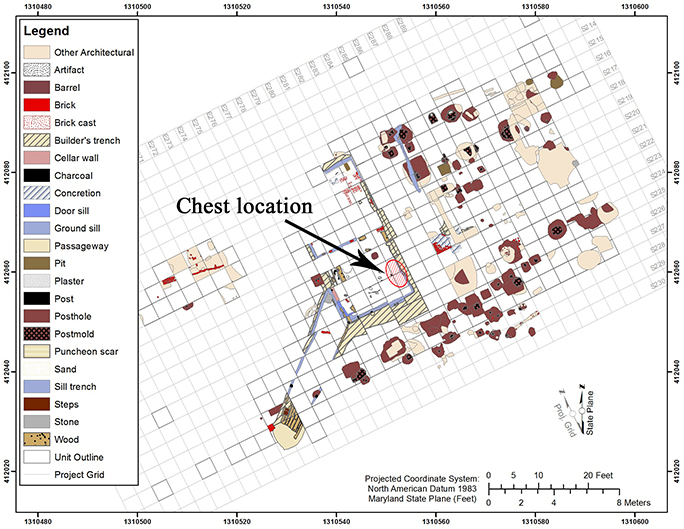 Figure 5: Plan view excavations in Area Va of the Addison plantation (18PR175). The ca. 1690
post-in-ground structure burned down by 1730. The chest fittings were found against a wall in the cellar
along with hundreds of fragments of wine bottle glass. Map adapted from Colonial Encounters
(http://colonialencounters.org/Galleries/GallerySiteMapsSS.aspx?ImageID=4432&From=SiteSummary
Figure 5: Plan view excavations in Area Va of the Addison plantation (18PR175). The ca. 1690
post-in-ground structure burned down by 1730. The chest fittings were found against a wall in the cellar
along with hundreds of fragments of wine bottle glass. Map adapted from Colonial Encounters
(http://colonialencounters.org/Galleries/GallerySiteMapsSS.aspx?ImageID=4432&From=SiteSummary
Shipping records contemporary to the occupation of Addison plantation are indicative of
how wine was packaged and valued. In 1697, five dozen bottles of red port and a dozen
bottles of canary were packaged in a chest valued at 10 shillings and shipped to Maryland
aboard the John. The value of the wine itself (£5.14.0) was listed separately
from that of the six dozen bottles that held it (£1.1.0). Another chest arrived in Maryland
aboard the Jeffries a year later holding 26 gallons of claret and three gallons
of canary in 131 bottles. All components of this shipment were individually valued: the
chest (12 shillings), claret (£7.16.0), canary (£1.4.0), bottles (£1.7.6), and corks and
wiring (4 shillings) (Sheffield vs. Stark, UK National Archives).
The trunk hardware in the Addison cellar might represent this kind of shipment. The chest
itself has iron hardware and a lock for security, and while the ironwork is decorative,
it is not as valuable as that of chests with brass fittings and tacks for decoration. A
chest used for shipping would transition well to the cellar for storage, where the wine
could age in its bottles until the Addisons decided to break it out for dinner, a
special occasion, or to entertain guests.