Small figurines can trace their origins to the prehistoric and ancient world.
Miniature, martial-themed figures made of metal have been unearthed at archaeological
sites throughout the world, representing individuals such as Roman infantrymen, Norse
Valkyrie, medieval mounted knights, and 18th-century standard bearers (Ortmann 1974;
Forsyth and Egan 2005). Marching in the footprints of history, cultural resource management
firm AECOM recently excavated five, two-dimensional toy soldiers from a brick-lined privy
shaft at a site in Philadelphia, along Interstate-95 (Figure 1) (Kutys 2018). AECOM has
been conducting the excavation for the Pennsylvania Department of Transportation and the
U.S. Department of Transportation Federal Highway Administration. The military figures
have temporarily encamped at the MAC Laboratory while they undergo conservation, as soil
and corrosion obscured some of the soldiers' and horses' fine details and remnants of red
colored paint still present on the surface required stabilization (Figure 2).
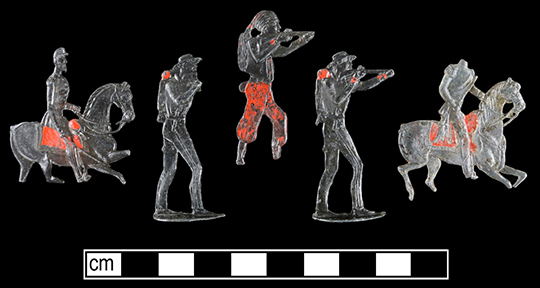 Figure 1. Toy soldiers excavated in Philadelphia, after conservation treatment.
The height of the figures, from left to right, are: 3.8 cm, 4.7 cm, 4.4 cm, 4.7 cm, and
3.5 cm. They are about 1 mm thick (Image: MAC Lab).
Figure 1. Toy soldiers excavated in Philadelphia, after conservation treatment.
The height of the figures, from left to right, are: 3.8 cm, 4.7 cm, 4.4 cm, 4.7 cm, and
3.5 cm. They are about 1 mm thick (Image: MAC Lab).
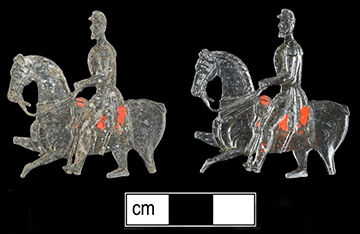 Figure 2. Before and after treatment image of the mounted figure wearing a
type of cap called a Kepi (Image: MAC Lab).
Figure 2. Before and after treatment image of the mounted figure wearing a
type of cap called a Kepi (Image: MAC Lab).
The figures wear uniforms resembling those worn during the American Civil War, which were
styled after the uniforms being worn by European armies in the mid-19th century (Kutys 2018;
Lukezic 2018). These type of two-dimensional toy soldiers are referred to as 'flats,'
and in the German language are called zinnfiguren (tin figures) or zinnsoldaten (tin soldiers).
As their German names imply, the 'flats' are likely made of tin or a metal alloy that includes
tin. Flat, tin soldiers began as a child’s plaything in the 18th century and were one of the
first mass-produced toys. Prior to that, toy soldiers had been primarily made for and used
by royalty, aristocrats, and generals to study and plan military strategy or were collected
for their artistic qualities. They were made in workshops throughout Europe, but the
pewter-working artisans of Germany dominated the manufacture and export of the toy
soldiers (Ortmann 1974). The Bavarian towns of Nuremberg and Fürth, in particular, were
a center of production during the 18th, 19th, and 20th centuries and were home to several
workshops that created intricately detailed tin figures and other toys in large
quantities (Schwarz and Schraudolph 2000).
To create a toy soldier, a mold had to be made first. The molds were constructed from two
smooth, polished blocks of slate (Figure 3). The artisan would create a drawing of the
figure and then transfer the outline of the figure to one of the slate blocks. Hand
tools, such as a burin, would then be used to engrave and render the figure in to the
slate. Soot was deposited over the engraved mold and then pressed firmly against the
smooth, uncut surface of the second part of the mold. This accurately transferred
the image of the figure on to the second part of the mold so as to match and coordinate
with the first part of the mold. The corresponding image was then hand carved. Once
the figure of the soldier was engraved, channels were carved in to the molds for
casting purposes. A channel was cut for pouring in the liquid metal and smaller
grooves were added to allow air to escape, so as to avoid the formation of bubbles
and other casting flaws (Ortmann 1974; Lukezic 2007).
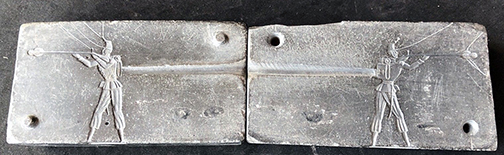 Figure 3. Example of a mold for a two-dimensional toy soldier, engraved in a block of
slate, mid to late 19th century. Note the large channel for pouring in the molten metal and the
smaller grooves to allow air to escape during the casting process.
https://www.ebay.com/item/A-Finely-Engraved-Mid-Late-19th-Century-Flat-Tin-Soldier-Slate-Mold-/332566404540
Figure 3. Example of a mold for a two-dimensional toy soldier, engraved in a block of
slate, mid to late 19th century. Note the large channel for pouring in the molten metal and the
smaller grooves to allow air to escape during the casting process.
https://www.ebay.com/item/A-Finely-Engraved-Mid-Late-19th-Century-Flat-Tin-Soldier-Slate-Mold-/332566404540
To cast the toy soldier, the two-part mold was pressed firmly together, pre-heated,
and the molten metal alloy poured in to the channel (Figure 4). Once the metal cooled,
the toy soldier was removed from the mold and cleaned. Cleaning included removing excess
metal, such as casting sprues, from the figure and using files to finish the edge or
surface (Figure 5). The final step was painting the figures (Figure 6). Well cared for
molds could have a long working life and be used to cast thousands of toy
soldiers (Ortmann 1974).
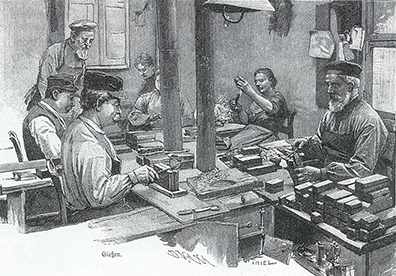 Figure 4. Molten metal is poured in to the slate molds. Illustration of a German workshop, circa 1891 (Schwarz
and Schraudolph 2000).
Figure 4. Molten metal is poured in to the slate molds. Illustration of a German workshop, circa 1891 (Schwarz
and Schraudolph 2000).
 Figure 5. After the toy soldiers are removed from the molds, they are cleaned. Illustration of a German workshop,
circa 1891 (Schwarz and Schraudolph 2000).
Figure 5. After the toy soldiers are removed from the molds, they are cleaned. Illustration of a German workshop,
circa 1891 (Schwarz and Schraudolph 2000).
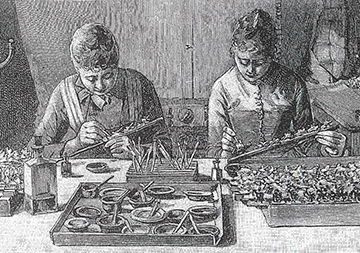 Figure 6. Painting the toy soldiers. Illustration of a German workshop, circa 1891 (Schwarz
and Schraudolph 2000).
Figure 6. Painting the toy soldiers. Illustration of a German workshop, circa 1891 (Schwarz
and Schraudolph 2000).
Three-dimensional plastic toy soldiers may be more prevalent and popular now. However,
workshops in Germany have maintained their long tradition of pewter-working and the flat,
metal toy soldiers are still available and made by craftspeople there today.
References
Forsyth, Hazel and Geoff Egan
2005 Toys, Trifles & Trinkets: Base Metal
Miniatures from London 1200 to 1800. Museum of London. Unicorn Press: London.
Kutys, Thomas
2018 Personal Communication – AECOM.
Lukezic, Craig
2007 Pewter Toys from the Roosevelt Inlet Shipwreck.
The Bulletin of the Archaeological Society of Delaware 44: 45-64.
2018 Personal Communication – Delaware State
Historic Preservation Office.
Ortmann, Erwin
1974 The Collector's Guide to Model Tin
Figures. G.P. Putnam's Sons: New York.
Schwarz, Helmut and Erhard Schraudolph
2000 Paradestücke: Zinnfiguren aus Nürnberg und
Fürth. Museen der Stadt Nürnberg/ Spielzeugmuseum. W. Tümmels: Nürnberg, Germany.