Earlier this year, the MAC Lab was asked to treat two cannons for the Jamestown-Yorktown
Foundation and the National Park Service. One cannon, forged in the Mt. Aetna Furnace
of Washington County, Maryland in the latter half of the 18th century, yielded some odd
discoveries during treatment.
If this cannon had been previously fired, we would have first utilized x-radiography to
peer inside the bore and check for powder and projectiles that might still be present.
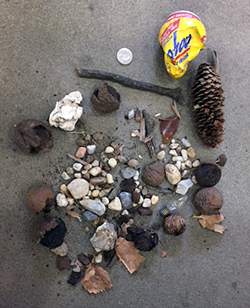 Figure 1: Objects recovered from the bore of the Mt. Aetna cannon.
However, we know from one key feature that the Mt. Aetna cannon was never fired; in fact,
it was never even finished. This is evident from the presence of a sprue at the end of
the muzzle (see Figure 2). A sprue is a conically-shaped attachment that is a product of the
casting process. In the 18th century, a cast would have first been fashioned from loam,
baked, and then assembled vertically with the breech end at the bottom. A funnel-shaped
cavity at the top fed the molten metal down into the mold, thus creating the sprue that
we see on the Mt. Aetna cannon. During the finishing process, the sprue would have been
sawn off (Callegari 1994:56).
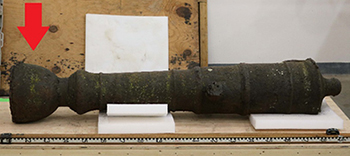 Figure 2: The Mt. Aetna cannon before treatment (arrow indicates the
sprue.
Figure 2: The Mt. Aetna cannon before treatment (arrow indicates the
sprue.
After cleaning the exterior of the cannon by abrasion using ground walnut shells, we had
to change tactics in order to clean the interior. We needed to delve deep into the
bore to remove dirt and other objects that might have been lodged inside of it, and
we modified some of our favorite hand tools in order to accomplish this. With some
difficulty, we removed an assortment of natural debris and modern items (see Figure 1).
These included broken glass, a lightbulb, stones, dried plant matter, a Yoohoo can,
and a 1978 quarter. Tour groups visiting the lab during this time found these items
to be a somewhat amusing assemblage.
The items that we found inside the Mt. Aetna cannon were not unlike langrage, a term
used to describe a mixture of small, sharp impromptu projectiles that soldiers and sailors
might ram into the cannon, and fire at an enemy. Langrage might include broken glass,
small pieces of shot, bolts and other small pieces of hardware such as nails (Wilde-Ramsing
and Carnes-McNaughton 2018:105). Such improvised weapons have been recovered from the
bores of excavated cannons, including those from the wreck of the Queen Anne's
Revenge, the infamous flagship of the pirate Blackbeard (Page 2018).
After we applied protective coatings to it, the Mt. Aetna cannon journeyed down to
the American Revolution Museum at Yorktown, where it is currently on display. As much
as we were entertained by the strange debris inside the cannon, we hope that future
generations won't leave us with the task of removing such items from this cannon in
the years to come.
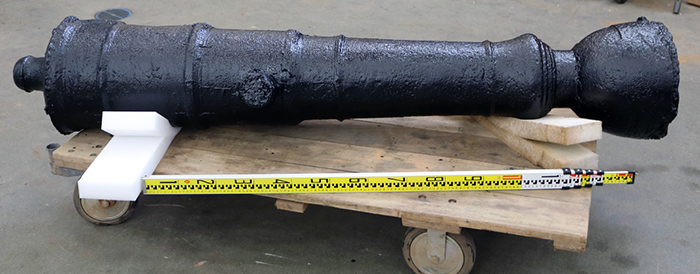 Figure 3: The Mt. Aetna cannon after treatment.
References
Callegari, Dennis
1994 Cook's Cannon and Anchor: The Recovery and
Conservation of Relics from HMB Endeavour. Kangaroo Press Pty Ltd.
Page, Courtney
2018 "Langrage." Queen Anne’s Revenge Project,
Natural and Cultural Resources.
https://www.qaronline.org/conservation/artifacts/arms-and-armament/langrage, accessed 17 July 2018.
Wilde-Ramsing, Mark U., and Carnes-McNaughton, Linda F.
2018 Blackbeard's Sunken Prize: The 300-Year
Voyage of Queen Anne's Revenge. The University of North Carolina Press, 2018.