At the MAC Lab, we often get asked, "Why do you keep all that stuff?" There are many reasons for
retaining the nearly 9 million artifacts we have at the Lab, but one is because the true nature
of an object isn't always immediately apparent. Sometimes it takes new information or new investigative
techniques to figure out what you actually have. But if you don't keep the artifact in the first
place, you will never be able to employ them.
A case in point is a nondescript iron block that was recovered by archaeologist Julie King in a
plowed field at Jefferson Patterson Park and Museum nearly 30 years ago. It measured approximately
4 inches by 2.3 inches. It was 2/3 of an inch thick, and weighed nearly 1.5 pounds. There were
no obvious markings visible on its heavily corroded surface. The nature of this object was
unclear; there was even speculation that it could have fallen off some piece of 20th-century
farm equipment. However, because it was found at the 17th-century home of Richard Smith, Sr.,
it was kept with the rest of the artifacts from the site.
 Smith Site iron block, after treatment.
 Smith Site iron block, before treatment.
Three decades later, MAC Lab Curator Becky Morehouse was going through the bags of artifacts from
the Smith Site, looking for metal artifacts that might benefit from conservation treatments. Since
the MAC Lab did not exist when the site was excavated, only a limited number of items had been
cleaned and stabilized at that time. When she came upon the iron block, she hesitated. Was it
even worth the time and money for treatment? But something compelled her to send it to Head
Conservator Nichole Doub for evaluation. Nichole shared Becky's doubts, but luckily Nichole
had a new intern, Monica Martinez, who needed simple objects to clean as part of her training.
What could be better to learn on than a plain iron block?!
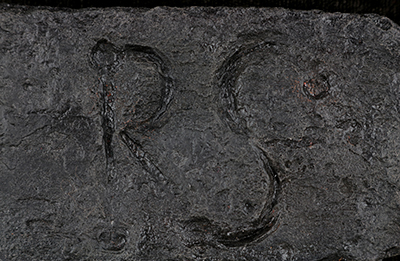
However, as Monica began to remove the rust from the block, something — a groove of some sort
— began to appear on the surface. It soon became apparent to her that it was a letter. She
went to Becky and asked if she had anticipated markings on the block. The answer was definitely
"no!" Eventually Monica took off all the rust, revealing the letters "RS." The letters were engraved
with a flourish, capped at their ends by small dots.
Given that the block was found at the home of Richard Smith, Sr., it is likely that the letters are
the initials of him or his son, Richard Smith, Jr. It is rare to find artifacts that are
marked with the identification of a specific person; only one other such artifact — Susanna
Smith's silver thimble — has been found at the three colonial-era Smith sites at JPPM. So
the "RS" block was an unexpected and exciting find. We don't yet know its purpose, although it
may well have just been a personalized knick-knack made by a friendly blacksmith. But if we
hadn't retained it at the Lab for all those years, even though packed away in an unopened
box, we never would have had the opportunity to make a direct, tangible connection with someone
who lived here more than 300 years ago. So we're definitely glad we did!