In mid-nineteenth century America, a wide variety of foodstuffs—pickles, olives, fruits,
mustards, ketchup—were available to consumers in glass containers. These culinary bottles
were blown and molded in an astonishing array of shapes, sometimes quite specific to the food
contained within. Some of them were also quite elaborately decorated by today's more functional
commercial standards (Figure 1).
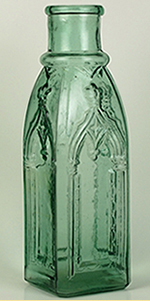 Figure 1. The molded motifs on this cathedral pickle bottle reflect the Gothic
Revival style popular in mid-nineteenth century America.
Figure 1. The molded motifs on this cathedral pickle bottle reflect the Gothic
Revival style popular in mid-nineteenth century America.
The wide-mouthed 8.5" tall bottle shown in Figure 2 was most likely originally used to hold
horseradish. The grated root of horseradish was popular among English and German immigrants,
who used the condiment to flavor meats and fish, as well as potatoes, cabbage and even bread.
Since the process of grating the roots was not only time consuming, but also a sinus irritant,
there was a ready market for prepared horseradish (D'Costa 2012). Horseradish became one of the
first prepackaged condiments sold in the United States (Wright 2011).
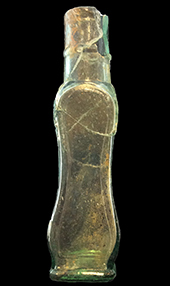 Figure 2. The neck ring and wide mouth of this violin shaped bottle indicate that it
was used for bulky food items, like horseradish.
Figure 2. The neck ring and wide mouth of this violin shaped bottle indicate that it
was used for bulky food items, like horseradish.
The fragmented bottle had been discarded in a mid-nineteenth-century privy in the Jones Falls
area of Baltimore (18BC66). Filled mainly with glass and stoneware liquor bottles, this privy
appeared to have been associated with a saloon, possibly owned by Robert B. Elliott. During
this period, the neighborhood contained a number of eating and drinking establishments that catered
to laborers associated with the maritime industries.
Since the original foil or paper label did not survive the acidic environment of the privy,
it is impossible to say with certainty that the bottle held horseradish. This shape has also
been used for pickles. Another culinary bottle—Parker Brothers London Club Sauce—was also
recovered in the privy. This product, which can probably be best compared to A-1 steak sauce, was
marketed for use with meats, game, steaks, soups, and fish. It is easy to imagine Elliott's
saloon offering horseradish and club sauce alongside hearty, simple steak and chop meals for
its working-class customers.
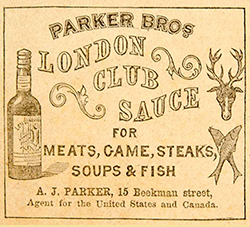 Figure 3. 1860 paper label for Parker Brothers London Club Sauce.
https://www.periodpaper.com/products/1860-ad-antique-parker-bros-london-club-sauce-food-condiment-15-beekman-st-nyn1-237411-nynl-054
Figure 3. 1860 paper label for Parker Brothers London Club Sauce.
https://www.periodpaper.com/products/1860-ad-antique-parker-bros-london-club-sauce-food-condiment-15-beekman-st-nyn1-237411-nynl-054
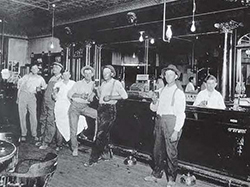 Figure 4. Saloon interior. http://daughterofthegoldenwest.blogspot.com/2010/12/american-old-west-saloons-17-in-series.html
References
D'Costa, Krystal
2012 Seeing is Believing: The Story Behind Henry Heinz's
Condiment Empire. Scientific American<.
https://blogs.scientificamerican.com/anthropology-in-practice/seeing-is-believing-the-story-behind-henry-heinzs-condiment-empire/.
Wright, Janeen
2011 The Herb Society of America's Essential Guide to
Horseradish. Website accessed December 20, 2018 at
http://www.herbsociety.org/file_download/inline/00a657ad-4bfa-4db8-945f-526586c09c2f