In 1988, while dredging for clams off Kent Island in Queen Anne's County, local archaeologist Darrin Lowery and
friend William Roe disturbed an underwater feature, likely the remains of a 17th-century barrel well
(Lowery 1995: 63). Fragments of preserved oak timbers, as well as an assemblage of early 17th-century
artifacts that included case bottle sherds, North Devon gravel-tempered earthenware and Rhenish brown stoneware
sherds, a large trade bead, and a tulip-shaped Susquehannock tobacco pipe were recovered.
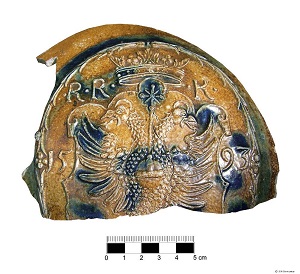 Figure 1: Rhenish brown stoneware sherd from the Medallion site, 18QU300, Kent Island,
Queen Anne's County. Photo courtesy of Darrin Lowery.
Figure 1: Rhenish brown stoneware sherd from the Medallion site, 18QU300, Kent Island,
Queen Anne's County. Photo courtesy of Darrin Lowery.
The most significant of these artifacts was a Rhenish brown stoneware sherd with a double-headed eagle
motif, the initials "R.R.K.", and the date 1593 (Figure 1). This sherd came from a large Bellarmine, or
Bartmann, vessel which would likely have had three medallions on its body, one on the front (with date)
and two on either side. The stoneware bottle would also have had a bearded man's face on the vessel's
neck, hence the name Bartmann, which is German for "bearded man". The double-headed eagle motif
represents the coat-of-arms of the Holy Roman Emperor Rudolf II, who reigned from 1576-1612 (Figure 2).
One R standing for Rudolf, the K for Karolus, and the second R likely for Rex. Similar vessels from the
Frechen and Raeren potteries in Germany were produced in the 16th and 17th centuries (Figure 3).
 Figure 2: Coat-of-arms for Rudolf II, Holy Roman Emperor (Wikipedia contributors n.d.)
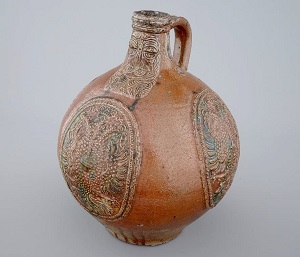 Figure 3: Example of a Rhenish brown stoneware Bartmann jug from a Frechen pottery (Rob
Michiels Auctions n.d.).
Figure 3: Example of a Rhenish brown stoneware Bartmann jug from a Frechen pottery (Rob
Michiels Auctions n.d.).
The 1593 date is intriguing and when it was discovered it was thought to be the earliest dated historic ceramic sherd
in Middle Atlantic (Lowery 1995: 63). However, molds with decorative motifs that include a date were used for
years and earlier ceramic designs were often used in later periods so, as tempting as it is to do so, it
cannot be assumed that it was manufactured in the late 16th century.
Considering the other artifacts with which its associated, this sherd does support an early to mid-17th century
date for the barrel well, which led Lowery to suggest that this artifact assemblage could be evidence of
William Claiborne's personal residence and trading post, Fort Crayford (Lowery 1995: 63). Claiborne was an
English colonist who originally immigrated to Virginia in 1621 as the colony surveyor and later became
Virginia's secretary of state and a member of the governor's royal council. In 1627, he was granted
permission to trade with the native peoples along the Chesapeake Bay and eventually established a trading
post on Kent Island in 1631 (Encyclopaedia Britannica 1998).
According to 19th-century historian Thomas Scharf, "Fort Crayford stood near Craney Creek, now a pond"
(1879: 137). A quick search of Google maps clearly shows Craney Pond still on the western side of Kent
Island today, not far south from the area where Lowery and Roe made their discovery in 1988. Thirty
years later, these dredged artifacts are still some of the only archaeological evidence of one of the
earliest colonial settlements in Maryland.
References
Lowery, Darrin
1995 Early 17th Century Sites in the Upper Chesapeake Bay
Region: An Analysis of Five Archeological Sites in Queen Anne's and Talbot Counties. Maryland
` Archeology 31(1,2): 59-68.
Encyclopaedia Britannica
1996 William Claiborne: American Colonial Governor.
https://www.britannica.com/biography/William-Claiborne, accessed January 28, 2019.
Rob Michiels Auctions
n.d. A rare Frechen bellarmine jug with double eagle seals,
dated 1604.
https://www.rm-auctions.com/en/european-ceramics/3424-a-rare-frechen-bellarmine-jug-with-double-eagle-seals-dated-1604,
accessed January 28, 2019.
Scharf, Thomas J.
1879 History of Maryland: From the Earliest Period
to the Present Day, Vol. I. John B. Piet, Baltimore.
Wikipedia contributors
n.d. Coat of arms of Rudolf II, Holy Roman Emperor.
https://commons.wikimedia.org/wiki/File:Coat_of_arms_of_Rudolf_II,_Holy_Roman_Emperor.png,
accessed January 28, 2019.