Discovered during the 1987 excavation of Brown's Wharf by archaeologists from the Baltimore Center for Urban
Archaeology (BCUA), this wooden barrel was found filled with debris, including a metal funnel, part of a
candlestick, a leather shoe, a spoon, some rope, and a broken champagne bottle that helped date the 180-year-old
barrel (Figure 1). Most impressively it contained five dozen fish (later identified as menhaden) with their
scales and fins preserved in the tar-like substance that also filled the barrel (Figure 2). A number of
these fish were frozen for trace-element research by the University of Maryland.
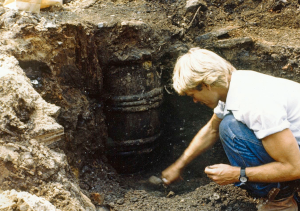 Figure 1: An archaeologist carefully excavating the wooden barrel.
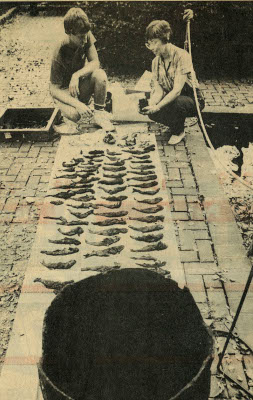 Figure 2: BCUA curator Louis Akerson and archaeologist Scott Simmons examining the contents of the barrel.
Reprinted from The Evening Sun Perry E. Thorsvik.
Figure 2: BCUA curator Louis Akerson and archaeologist Scott Simmons examining the contents of the barrel.
Reprinted from The Evening Sun Perry E. Thorsvik.
Post excavation, the barrel was treated at BCUA's conservation facility. During treatment it was cleaned and
allowed to slowly dry out, before being placed in a storage facility and eventually making its way to Maryland
Archaeological Conservation Laboratory for permanent curation. Unfortunately, while moving the barrel from one
storage location to another the barrel was not sufficiently supported, resulting in the shifting of the staves
and sagging of the rings. This gave the barrel a tilted appearance and destabilized its overall structure.
To fix this problem and provide a long-term storage solution, it was decided that the best course of action was
to construct a new support system. This structure was made of archival materials, that would fit within the
barrel and prevent further destabilization. To achieve this stability, a ridged cardboard tube core was coated in
a polyethylene and nylon barrier film. Four rings of thick conservation grade Ethafoam were then cut and
surrounded in Tyvek to prevent the rough Ethafoam surface from catching on the wood. These rings were then
slid onto the core inside the barrel fitting tight enough to support, but not break the wooden staves (Figure 3).
This process was a success in providing the much-needed support; it also significantly straightened the
barrel. To complete this project, a custom coroplast box was constructed so the barrel can be stored
safely (Figure 4).
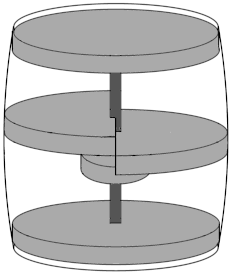 Figure 3: Diagram of interior support system.
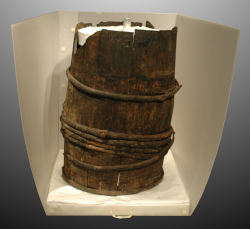 Figure 4: Barrel in its new box.
References
Keefer, Joey, and Scott Simmons
1987 Excavation of Barrel. Excavation Notes from October 28th, 1987.
Roylance, Frank D.
1987 Fish Story. The Evening Sun. September 17th, 1987.
Stevens, Kristen L.
1989 An Investigation of the Archaeological Resources Associated
with the Brown's Wharf Site (18BC59) on Thames Street Baltimore Maryland. Baltimore Center for Urban
Archaeology, Research Series No. 28.