In 1980, Lana Brown — a tenant living on the farm of Mary Marvin Patterson — found a variety of
prehistoric artifacts along the Patuxent River shoreline of the property. She brought them to Mrs. Patterson,
who was intrigued by the finds and decided to explore the history of her property. Lana later showed the objects
to Mike Smolek, the State's archaeologist for Southern Maryland. Mrs. Patterson agreed to let Mike and Wayne
Clark, another archaeologist with the Maryland Historical Trust, join Lana for a week of walking the plowed
agricultural fields on the property, looking for artifacts that indicated the location of a site. By the
time their survey was completed, they had examined 43 sites, 36 of which were new to science (Clark and
Smolek 1980). Meanwhile, Lana continued to find artifacts on the shoreline. Three in particular caught
everyone's attention — large, well-made stone blades found close to one another.
 Figure 1: Lana Brown.
Prehistoric Native Americans would sometimes store stone artifacts in buried caches, and these are occasionally
found by archaeologists. The objects in the cache could be functional tools or tool blanks put away for
future use, or they could be symbolic or ceremonial in nature, not intended for day-to-day use. Lana's
cache blades appeared to belong to the latter group, as they were quite large, very carefully chipped,
showed no evidence of use-wear, and were made of an imported green stone, Normanskill chert from New
York. Although caches were used throughout prehistory, blades made from Normanskill chert often date to
the Middle Woodland period, roughly 200-900 A.D.
 Figure 2: Cache blades found on the Patterson farm.
But this is not just a story about Lana's cache blades and the other artifacts she discovered; instead, it is
about what happened after she found them. Mrs. Patterson had been thinking about donating her property to an
organization as a way to memorialize her late husband, Jefferson. After the exciting discoveries made by Lana
and the State's archaeologists, she agreed to give her 512-acre waterfront farm to the State of Maryland,
thereby creating Jefferson Patterson Park and Museum.
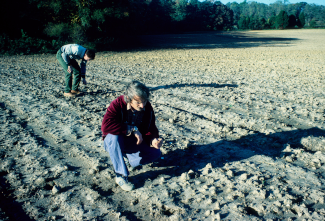 Figure 3: Mike Smolek (foreground) and Wayne Clark collecting artifacts during the Patterson
farm survey.
Figure 3: Mike Smolek (foreground) and Wayne Clark collecting artifacts during the Patterson
farm survey.
We often get asked what are the most significant artifacts among the 8,000,000 objects stored at the MAC
Lab. There are many answers to that question, but in a certain sense, Lana's cache blades are the most
important. After all, the MAC Lab probably wouldn't even exist if it weren't for Lana's artifact
discoveries and the subsequent series of events that resulted in the establishment of JPPM and the
construction of the Maryland Historical Trust's main artifact repository there. It is for that reason that
the cache blades — the most unusual objects in Lana's collection — are prominently displayed
at our Visitor Center. They may have been symbolic or ceremonial objects to prehistoric Native Americans,
but they are also symbols for JPPM, still cached together in a way that honors our creation story and
the "ancestors" who brought us into existence!
References
Clark, Wayne E., and Michael A. Smolek
1980 The Patterson Estate on St. Leonard Creek: An Archaeological
Site Inventory. Maryland Historical Trust Manuscript Series No. 16. Maryland Historical Trust: Annapolis,
MD.