In the years before the American Revolution and the establishment of a federal mint, the North American colonies
relied on foreign coins for their primary currency. With control over colonial trade and manufacturing in the
hands of Britain, a country without access to major sources of precious metals and with no gold or silver to
be mined in eastern North America, colonists turned to coinage from other countries (Lasser et al. 1997: 1).
Spanish silver and gold pieces were obtained through trade with the southern Spanish Latin American colonies
and were predominantly used by wealthy colonists for large transactions and the import of goods (Smoak 2017: 472).
The poor and middling colonists, as well as the enslaved, relied more on coins of a smaller denomination to
conduct commerce (Kelleher 2016: 49).
As in North America, colonies in the Caribbean also struggled to provide sufficient currency for use in towns and
on plantations. Goods such as tobacco, rum, and sugar were often used as a form of currency but the Caribbean
islanders also found other innovative ways to deal with the lack of coinage, such as cutting Spanish silver
coins into more usable pieces, or counterstamping coins for use in a specific colony (Salamanca-Heyman 2004: 57;
Kelleher 2016: 50). The most common silver coin was the Spanish dollar, also called a "Piece of Eight" from the
way it was cut into 8 pie-shaped wedges (Figure 1). Counterstamping was the act of applying a stamp to a coin
to change its value and/or to indicate it would be accepted as legal tender in a place other than where it was
originally issued (Doty 1982: 75). Various types of European coins of small denomination were counterstamped for
use in several of the Caribbean colonies.
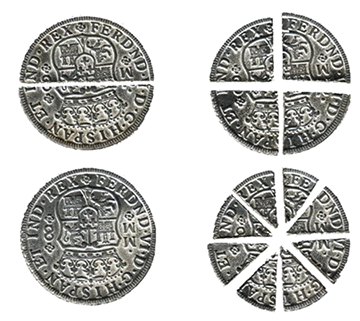 Figure 1. Examples of how a Spanish silver dollar or a piece of eight was cut to make smaller
denominations.
Figure 1. Examples of how a Spanish silver dollar or a piece of eight was cut to make smaller
denominations.
While the Spanish dollar was recognized as a global currency in the early colonial period, as Spanish power waned
and Britain, France and the Netherlands competed to dominate in the Caribbean colonies, large volumes of diverse
foreign coins found their way into circulation. Some of the most common coins in use along with the dollar were
underweight Portuguese-Brazilian gold coins known as "Joes," Spanish two-reales, and stamped French copper coins
known as "black dogs" or "stampees" (Kelleher 2016: 50; Smoak 2017: 472). This coinage, particularly the small
counterstamped copper coins, was primarily used by enslaved individuals. Foreign coinage was critical to economic
life in the Caribbean colonies for people across the social spectrum (Smoak 2017: 472).
Occasionally, coinage from the Caribbean would find its way to the North American colonies, perhaps in the pocket
of a sailor or an enslaved individual who was being transferred for sale. One such coin, with a "TB/o" counterstamp
for use in the colony of Tobago, was recovered from a small midden feature during excavations at Brown's Wharf in
the Fells Point Historic District in Baltimore City (Figure 2). The Baltimore Center for Urban Archaeology
monitored and tested the site during redevelopment along Thames Street in the late 1980s.
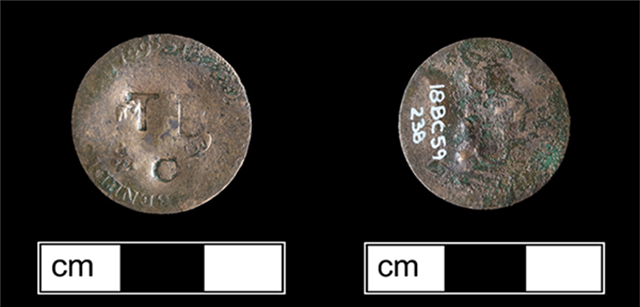 Figure 2: 1749 French 2 Sols coin with barely visible crowned "C" stamp (reverse, right)
and counterstamped with "TB/o" (reverse, left) for use in the colony of Tobago in the French
Caribbean. From the Brown's Wharf site in Fells Point, Baltimore City.
Figure 2: 1749 French 2 Sols coin with barely visible crowned "C" stamp (reverse, right)
and counterstamped with "TB/o" (reverse, left) for use in the colony of Tobago in the French
Caribbean. From the Brown's Wharf site in Fells Point, Baltimore City.
This coin began its life in 1749 as a French 2 sols and was likely used as small change in France for many years
before being selected for official use in the French Caribbean colonies (Smoak 2017: 474). The coin received a
crowned "C" stamp on the reverse to mark it for official use and "TB/o" on the obverse for use specifically in
Tobago (Krause et al. 1998: 236). The legend "SIT NOM DOM H BENEDICTUM," translated "Blessed be the name of
the Lord," along with the date 1749, can still be partially seen surrounding the counterstamp on the reverse.
A faint shadow of a "C" is all that remains on the reverse side. The reverse legend "LUD XV D G FR ET NAV REX,"
translated "Louis XV, by the grace of God, King of France and of Navarre," is completely worn away. The coin
in Figure 3 is an example in much better condition.
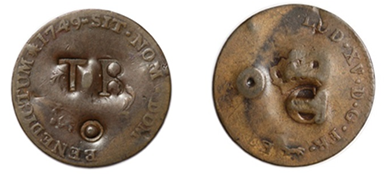 Figure 3: 1749 counterstamped French 2 sols similar to the coin found at Brown's Wharf,
with clearer stamping (East Rock Coins n.d.).
Figure 3: 1749 counterstamped French 2 sols similar to the coin found at Brown's Wharf,
with clearer stamping (East Rock Coins n.d.).
In the late 18th and early 19th centuries, Brown’s Wharf was the home of affluent residents and tradesmen such
as sea captains, ship joiners (builders), and ship chandlers (dealer in supplies and equipment for ships).
It was a center for importing, exporting, and storing goods from around the world, including sugar, coffee,
indigo, tobacco, and cocoa from the Caribbean and Central and South America, as well as linen, shirts, hats,
shoe insoles, and other clothing items from Europe (Figure 4) (Stevens 1989: 6). Enslaved persons were also
listed among the cargo of many ships that docked at the Fells Point wharves (Arnett 1975).
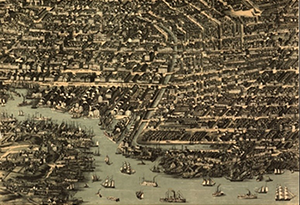 Figure 4: 19th-century bird's eye view of Baltimore, including the inner harbor and
Fells Point (E. Sachse and Co. 1870).
Figure 4: 19th-century bird's eye view of Baltimore, including the inner harbor and
Fells Point (E. Sachse and Co. 1870).
It's not difficult to imagine this small French Caribbean coin dropping from the pocket of a dock worker, a
sailor, of perhaps even an enslaved individual being transferred to Baltimore from the Caribbean for sale,
only for it to be excavated by archaeologists over 200 years later.
References
Arnett, Earl
1975 "Fells Point Tour Includes One of the Oldest Warehouses."
Baltimore Sun. March 19, 1975. Web resource:
https://www.newspapers.com/image accessed 23 September 2019.
Doty, Richard G.
1982 The Macmillan Encyclopedic Dictionary of Numismatics.
New York, New York: Macmillan Publishing Co., Inc.
East Rock Coins
n.d. Web resource:
https://www.eastrockcoins.com/product/black-dogg-tobago-countermark-vlack-444, accessed 23 September 2019.
E. Sachse and Co.
1870 E. Sachse and Co.'s bird's eye view of the city of Baltimore, 1869.
Map. Web resource: https://www.loc.gov/item/75694535/, accessed 23 September 2019.
Kelleher, Dr. Richard
2016 "Coins of the Tudors and Stuarts: Colonial Money in North American
and the Caribbean." Web resource:
https://www.academia.edu/33455470/Coinage_of_Colonial_North_America_and_the_Caribbean, accessed 23 September 2019.
Krause, Chester L., Clifford Mishler, and Colin R. Bruce II, ed.
1998 Standard Catalog of World Coins: 18th Century Edition
1701-1800. Iola, Wisconsin: Krause Publications.
Lassar, Joseph R., Gail G. Greve, William E. Pittman, and John A. Caramia, Jr.
1997 The Coins of Colonial America: World Trade Coins of the
Seventeenth and Eighteenth Centuries. Williamsburg, Virginia. The Colonial Williamsburg Foundation.
Quora
n.d. Web resource:
https://www.quora.com/Which-was-the-currency-most-used-for-commercial-exchange-in-the-sixteenth-seventeenth-eighteenth-and-nineteenth-centuries-as-is-the-US-dollar-now,
accessed 23 September 2019.
Salamanca-Heyman, Maria Fernanda
2004 "St. Eustatius and the Caribbean Trade System: A Study of
Eighteenth and Nineteenth Century Coins from the Caribbean." Dissertations, Theses, and Masters Projects at William
and Mary W & M ScholarWorks. Paper 1539626445.
Smoak, Katherine
2017 "The Weight of Necessity: Counterfeit Coins in the British
Atlantic World, circa 1760-1800." William and Mary Quarterly 74(3): 467-502.
Stevens, Kristen L.
1989 An Investigation of the Archaeological Resources Associated
with the Brown’s Wharf Site (18BC59) on Thames Street, Baltimore, Maryland. Baltimore Center Urban
Archaeology Research Series No. 28.