The human desire for adornment can be traced at least as far back as 40,000 years ago, when Neandertals
inhabited Europe. Scientists excavating caves where Neandertals lived have discovered carved and polished
teeth from mammoth and other animals that appear to have been worn as pendants. Since it was easily workable,
bone was used by prehistoric peoples to create all manners of personal adornment items, including beads,
gorgets, pendants and rings.
The two bone finger rings shown in Figure 1 are, however, of much more recent origin.
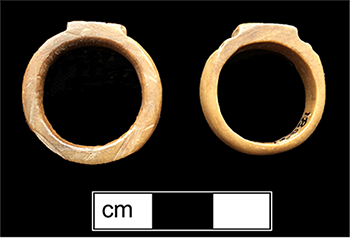 Figure 1. Side view of two 19th-century bone rings from the Fells Point nieghborhood of
Baltimore.
Figure 1. Side view of two 19th-century bone rings from the Fells Point nieghborhood of
Baltimore.
They were found in the fill of a wood-lined trash pit at the Queen Street Lot 23 archaeological site (18BC52)
in Baltimore. The pit was located in the rear yard of a late 18th- to early 19th-century brick rowhouse along
South Bond Street in the Fells Point district of the city. Other artifacts found with the rings included
ceramics dating from the second quarter of the ninteenth century, so it is likely these rings date to the
same time period.
The rings each display a similar overall style, containing a flat rectangular face with a simple carved design.
One displays a star or asterisk motif, while the other is decorated with an anchor framed with four dots
(Figure 2). The latter ring is more skillfully finished, with a stepped profile and a nicely polished band.
The star on the other ring is more crudely carved and the band still bears what appears to be scratches and
scarring from the knife used to make the ring (Figure 1).
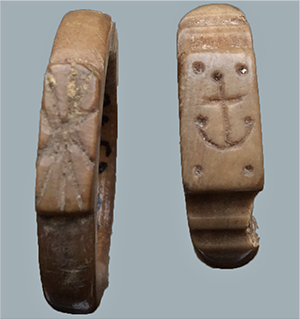 Figure 2. Simple carved motifs on the two Fell's Point rings.
The anchor design, as well as the site's location in the Fell's Point neighborhood of Baltimore — a prime
shipbuilding area in the city — suggests that these rings may have been carved by a sailor. This idea
is further supported by the history of the property where the rings were discovered. of the lot's
first owners was mariner George Wells, whose tenure fell during the late 18th century. During his ownership,
the lot at 854 South Bond Street was the site of the London Coffee House — the earliest coffee house
in Baltimore. Similar to a tavern, the establishment likely attracted the business of sailors. The adjoining
property was owned by a shipbuilder who operated an inn on the premises until around 1810. Nicholas
Stansbury, a ship chandler (someone who sells supplies and equipment for ships) by trade, lived at 856 South
Bond Street lot in the early 19th century (Etherton 1994).
Sailors have long been documented as crafting items from bone and ivory to pass the time during long voyages.
Sailors on whaling ships had ready access to bones and teeth of these marine mammals and perfected the art of
scrimshaw, or scrollwork, engravings, and carvings done in bone or ivory (Figure 3). Pie crimpers, combs,
corset busks and similar items were likely made as gifts for loved ones back home (Malley 1983).
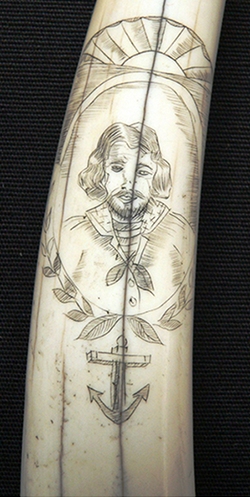 Figure 3. Closeup of a sailor's image on a walrus tusk, circa 1900. Connecticut or Rhode
Island. https://en.wikipedia.org/wiki/Scrimshaw#/media/File:Scrimshaw_Walrus_Tusks_Closeup1.jpg
Figure 3. Closeup of a sailor's image on a walrus tusk, circa 1900. Connecticut or Rhode
Island. https://en.wikipedia.org/wiki/Scrimshaw#/media/File:Scrimshaw_Walrus_Tusks_Closeup1.jpg
References
Etherton, Kevin
1994 An Archival Investigation of Cultural Resources Associated with
Captain Wells' House and the London Coffee House, Fells Point, Baltimore, Md. BCUA Research Series
No. 48. Report on file at MAC Lab.
Malley, Richard C.
1983 Graven by the fishermen themselves; Scrimshaw in Mystic
Seaport Museum. Mystic Seaport Museum, Inc., Mystic Connecticut.