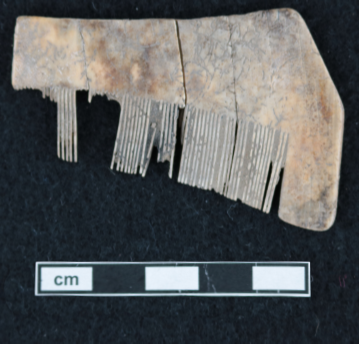
 Figure A: An example of a partial bone fine-toothed comb from the Smith's St. Leonard
Site in Calvert County, Maryland,
Figure A: An example of a partial bone fine-toothed comb from the Smith's St. Leonard
Site in Calvert County, Maryland,
Of the many different pests to plague humans head lice, in particular, have continued to be a persistent
companion. A single louse egg, or nit, can lead to a full infestation of the scalp if not properly cared for.
As such infestations pass through contact and risk developing into epidemics such as typhus, preventative hygienic
methods have been practiced by people all over the world for centuries. The earliest method of dealing with these
pesky blood-sucking parasites can still be seen today when observing monkeys as they groom companions, appropriately
named nit-picking. The earliest humans must have done the same, though with time our hygienic tools have
vastly improved.
First carved out of ebony, boxwood, bone, and hardwood, fine-tooth combs were used to literally comb through
and separate lice and their nits from the scalp (Figure A). With long, narrow teeth the double-sided one piece
(Figure B) or alternative single-sided composite combs (Figure C) historically were used by everyone from the
common person up to the highest elite (White 2005: 104-105).
Though lice do not discriminate when selecting hosts, the material of historical combs differs greatly depending
on social status. Some of the oldest comb artifacts, made from elaborately carved ebony and ivory, show the
elite classes suffered from lice just as much as the masses, who utilized hardwood and later on metal combs
for their durability (Figure D). Lead combs grew popular in the seventeenth century with the belief that the
material would preserve the color of one’s hair (Lester and Oerke 2004:134).
Improving on the durable metal design, vulcanite — vulcanized rubber — was first developed in 1839
by American inventor Charles Goodyear and later patented by his brother in 1851 (Odyssey's Virtual Museum
n.d.). This hard rubber material formed the unbreakable comb, widely popular in the 19th and 20th
centuries (Figure E).
There are other lines of defense in preventing an infestation of lice, including cutting the hair short or even
simply keeping the head shaved. During the 17th century, the trend of powdered wigs stemmed partially from this
practice of keeping the head shaved as lice prevention. However, without proper cleaning, the pomade base,
mostly made out of animal fat and boiled apples and applied on wigs before adding fine starch or wig powder,
would attract parasites such as lice. These changes were only furthered with the added fragrance of delicious
scents of orange flower, orris root, lavender and nutmeg (Galke 2015).
Even with proper laundering, grown lice can survive when separated from the host for nine days and their eggs as
long as forty days (Rhodes Stitt 1919: 400). Beyond the nit comb, alternative solutions have been developed through
time ranging from old wives' tales of dried date powder to more modern delousing shampoos designed to drown lice.
These harsh chemicals have been proven to do more harm to the human than to the pest, as seen in the 2006 FDA
listed toxin lindane, a once common lice shampoo ingredient (Borden 2011). Becoming immune to the chemical washes
introduced in the last century, lice have evolved and to this day there is no known method for prevention and
treatment without side effects, other than nit-picking (Skerrett 2012). The best tool remains the fine-tooth or
delousing comb.
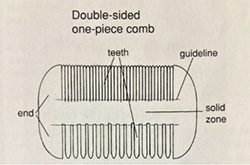 Fig. B: The Double-sided one piece comb (White 2005: 105).
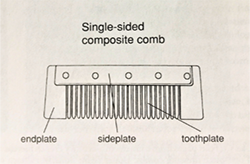 Fig. C: The Single-sided composite comb (White 2005: 105).
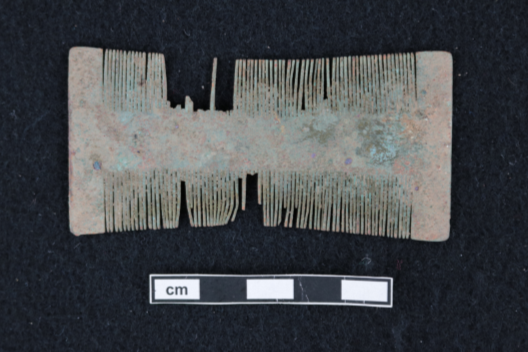 Figure D: This copper alloy double-sided comb is an example of the popular metal version. From the
Brumbaugh-Kendle-Grove Farmstead Site in Washington County, Maryland.
Figure D: This copper alloy double-sided comb is an example of the popular metal version. From the
Brumbaugh-Kendle-Grove Farmstead Site in Washington County, Maryland.
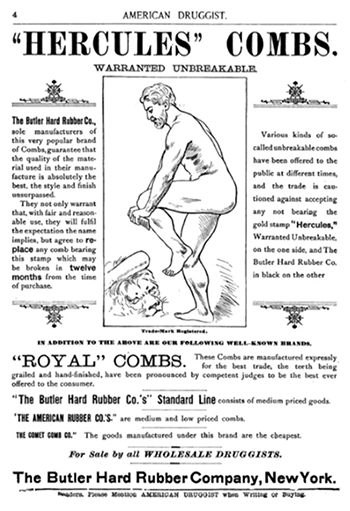 Figure E: Advertisements such as the "Hercules" Comb spoke to the durabiity of the innovative
vulcanized rubber comb first developed by Goodyear in the 1800's (American Druggist 1891).
Figure E: Advertisements such as the "Hercules" Comb spoke to the durabiity of the innovative
vulcanized rubber comb first developed by Goodyear in the 1800's (American Druggist 1891).
References
American Druggist
1891 American Druggist: An Illustrated Trade Journal 20.
Borden, Jeremy
2011 Perils of New Pesticides.
https://publicintegrity.org/business/workers-rights/a-crawling-issue-head-lice-treatments-worse-than-the-pest-itself/,
accessed 12 November 2019.
Galke, Laura
2015 "Perukes, Pomade and Powder: Hair Care in the 1700's."
https://livesandlegaciesblog.org/2015/01/28/perukes-pomade-powder/, accessed 18 November 2019.
Lester, Katherine, and Bess Viola Oerke
2004 Accessories of Dress: An Illustrated Encyclopedia.
Mineola, New York: Dover Publications, Inc.
Odyssey's Virtual Museum
n.d. http://www.odysseysvirtualmuseum.com/products/Hair-Comb.html,
accessed 5 November 2019.
Rhodes Stitt, Edward
1919 The Diagnostics and Treatment of Tropical Diseases.
Philadelphia, New York: P. Blakiston's Son & Co.
Skerrett, Patrick J.
2012 "Treatment of head lice effective with one dose and no combing."
https://www.health.harvard.edu/blog/new-treatment-for-head-lice-effective-with-one-dose-and-no-combing-201211015484,
accessed 18 November 2019.
White, Carolyn L.
2005 American Artifacts of Personal Adornment 1680-1820: A Guide to
Identification and Interpretations. Oxford, UK: Rowman & Littlefield Publishers, Inc.