This wonderful artifact (Figure 1), recovered from a privy filled during the third quarter of
the 19th century, turns out to be a multi-level play on words. It is part of a cast-iron bank in
the shape of a building and if you look closely, you can see the word "BANK" cast above the door. And
to make matters even better, this "bank" bank was recovered from an archaeological site in Baltimore on
a property that was about to become the Sharp Street location of the Federal Reserve Bank of Richmond.
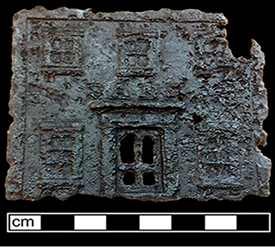 Figure 1. Front of a cast iron bank recovered from the Federal Reserve Site (18BC27),
Feature 30.
Figure 1. Front of a cast iron bank recovered from the Federal Reserve Site (18BC27),
Feature 30.
Highly collectible today, cast iron banks began production in the 1860s (Ketchum 1981:116). Because this
bank did not have moving parts like mechanical cast iron banks, it was known as a still bank. It was
produced around 1872 by J. & E. Stevens of Cromwell, Connecticut. The Stevens brothers opened their hardware
manufacturing business in 1843, producing tools, hooks and other household items (AntiqueToys.com 2017).
From around 1870 until the turn of the twentieth century, their product line turned primarily to cast iron
banks, as well as simple toys like cap pistols. The J. & E. Stevens Company "is considered to have been
the earliest and largest manufacturer of cast-iron toys in the country" (DeVoe 1971). The company produced
over 300 models of both mechanical and still banks between 1869 and 1890 (McCain 1997).
When purchased, the bank would have been brightly painted to appeal to consumers. This complete example (Figures
2 and 3) was painted in red and green with gold accents, but different color combinations were also available.
The top and bottom of the bank were fastened to the building by a rod with screw fasteners at the top of
the cupola and on the base.
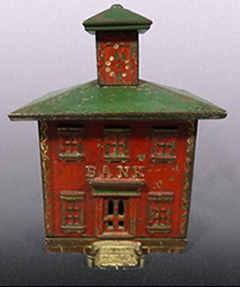 Figure 2. Complete example of the J. & E. Stevens cupola bank, height: 5.75", Private
collection.
Figure 2. Complete example of the J. & E. Stevens cupola bank, height: 5.75", Private
collection.
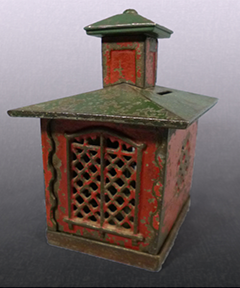 Figure 3. Back of the Bank. The screw at the top of the cupola is visible as a small dome.
Private collection.
Figure 3. Back of the Bank. The screw at the top of the cupola is visible as a small dome.
Private collection.
References
Antique Toys.com
2017 "A brief history of J. & E. Stevens of Cromwell Connecticut." Antique
Toys E-Museum. Website accessed December 10, 2019 at
https://www.antiquetoys.com/product/antique-j-estevens-co-ca-1869-cast-iron-halls-excelsior-bank-mechanical-bank-for-sale/?v=7516fd43adaa.
DeVoe, Shirley
1971 19th-Century Connecticut Toymaking: The Iron Toys of the J. & E.
Stevens Company of Cromwell, Conn. Connecticut Historical Society Bulletin, July, 1971.
Ketchum, William C., Jr.
1981 Toys and Games. Cooper Hewitt Museum, Smithsonian.
McCain, Diana Ross
1997 Cromwell was Home to Toy Makers. The Hartford Courant.
October 22, 1997. Website accessed December 9, 2019 at https://www.courant.com/news/connecticut/hcxpm-1997-10-22-9710310971-story.html.