During a winter storm in 1998, the remains of a 19th-century shipwreck were exposed along the coast of
Assateague Island and reported by local historian, Paul Van Driessche. The Van Driessche Wreck site was
revisited by the Maryland State Underwater Archaeologist to conduct more comprehensive documentation and
surveying. Re-excavating the sand buried wreckage exposed coppered stained wood belonging to a two-masted
schooner from the second half of the 19th century. With the keel, bow, and stern completely missing,
as well as the complete lack of cargo, the functionality of the vessel is unknown but it may have been
a merchant or whaling ship. The little remnants archaeologists were able to sample included caulking
(Figure A) and fasteners made of brass and iron, one of which is a complete drifting bolt (Langley
et al. 2002) (Figure B).
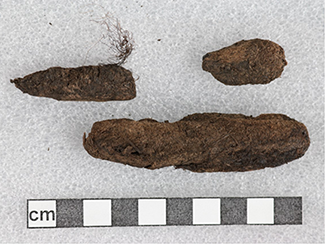 Figure A. Caulking sample from the Van Driessche Wreck.
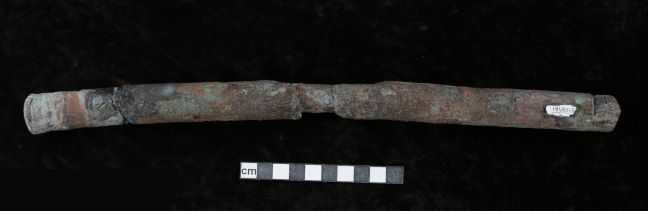 Figure B. Copper alloy drift bolt from the Van Driessche Wreck site. Notice the left end of the
artifact has been shaped into a flattened end for easier driving directly into the beams.
Figure B. Copper alloy drift bolt from the Van Driessche Wreck site. Notice the left end of the
artifact has been shaped into a flattened end for easier driving directly into the beams.
Before the mass production of weldable modern material like steel and aluminum revolutionized the maritime
industry, large vessels were constructed of large wooden beams. In comparison with the modern boat building
techniques of bolting or welding steel and aluminum fragments together, wooden beams were joined together to
create the frame of the vessel using joiners or fasteners (Figure B). Caulking would then be driven between
any joined pieces to both tighten the hull and reduce the movement between deck planks (Traditional Maritime
Skills). Caulking is traditionally made mostly of oakum, loosely twisted hemp fibers saturated with tar, as
well as other cotton and general rope fibers.
Metal fasteners came in the form of nails, bolt, and rivets made from wrought or cast iron, steel, copper,
bronze, and brass. Bolts specifically are a fastener cut to length from a rod, most often made of iron,
with the head and tip worked into shape by a hammer (Leigh Stone 1993: 33, 34).
The term drift refers to the difference between the diameters of the bored hole and the bolt that is driven
into it. These cylindrical steel and iron rods were joiners essential in ship construction prior to the
invention of modern adhesives (Catsambis et al. 2014: 1119).
Modern adhesives not only require less force but also do not rust or have the potential to split wood like
iron bolts do (Watts 2008).
A hole, 1/8 inch to 1/16 inch smaller in diameter than the fastener diameter would be bored in the beams and
then the bolt would be hammered obliquely through the seams, creating a lateral connection between the two
pieces (Ritter 1990: 5-132) (Figure C).
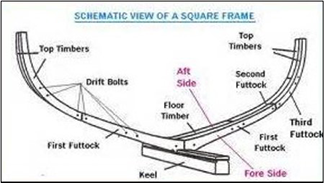 Figure C. Boats were constructed from the joining of curved timber futtocks usng fasteners,
including drift bolts, as illustrated above (Schooer Emestine-Morrissey Association 2016).
Figure C. Boats were constructed from the joining of curved timber futtocks usng fasteners,
including drift bolts, as illustrated above (Schooer Emestine-Morrissey Association 2016).
At times referred to as drift pins by the steel shipbuilding community, pins are headless and sometimes
tapered compared to bolts. Widely used for areas with ample wood or areas that needed strong re-enforcement,
drift bolts were prominently used due to their large size, durability, and the worked flattened head. The shaped,
flat end of the drift bolt made it easier to drive the bolt directly into the beams (Leigh Stone 1993: 35).
They were used to join rudders and leeboards, as well as broader boat frame features like the knees, ribs,
and hull planking (McCarthy 2005: 180; Sheard 1998: 78).
References
Catsambis, Alexis, Ben Ford, and Donny L. Hamilton
2014 The Oxford Handbook of Maritime Archaeology. Oxford University Press.
Langley, S.B.M., P. Van Driessche, and J. Charles
2002 Archaeological Overview and Assessment of Maritime Resources in
Assateague Island National Seashore, Worcester County, Maryland & Accomack County, Virginia. Maryland Historical Trust.
Leigh Stone, David
1993 The Wreck Diver's Guide to Sailing Ship Artifacts of the 19th
Century. Underwater Archaeological Society of British Columbia.
McCarthy, Michael
2005 Ships' Fastening: From Sewn Boat to Steamship. Texas A&M University Press.
Ritter, Michael R.
1990 "Timber Bridges: Design, Construction, Inspection, and Maintenance." U.S.
Department of Agriculture, Forest Service.
Sheard, Bradley
1998 Lost Voyages: Two Centuries of Shipwrecks in the Approaches to
New York. Aqua Quest Publications, Inc.
Schooner Ernestina-Morrissey Association
2016 "Futtocks and Frames Beginning to Take Shape."
http://www.ernestina.org/news/futtocks-and-frames-beginning-to-take-shape/ accessed 24 February 2020.
Traditional Maritime Skills
n.d. "Caulking Decks and Hulls."
http://www.boat-building.org/learn-skills/index.php/en/wood/caulking-decks-and-hulls/ accessed 24 February 2020.
Watts, Simon
2008 "Using Drift Pins."
https://www.woodworkersjournal.com/using-drift-pins/ accessed 21 February 2020.