A short time ago, an object arrived at the MAC Laboratory for conservation treatment that provides
a glimpse into the life of an officer during the time of the War of 1812. The cavalry helmet, in
addition to a type of jacket called a coatee, is part of a significant early 19th-century uniform
assemblage in the collection of the Washington County Historical Society that is connected to Jacob
Huyett, a past resident of the county (Figure 1). Sergeant Jacob Huyett served during the War of 1812
and, according to family history, fought in the Battle of North Point and the Defense of Baltimore
(Cueto 2020). Huyett was a member of the Maryland Militia’s Light Dragoons and part of the cavalry
unit known as the Hagerstown Blues.
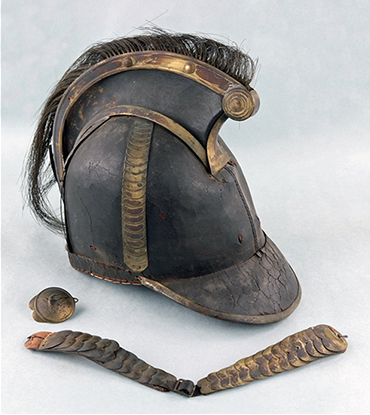 Figure 1. Sergeant Jacob Huyett's cavalry helmet, before conservation treatment.
As a member of the militia, Huyett would have been responsible for outfitting himself, paying for his
uniform and equipment out of his own pocket (Kimmel 2020). The hardened leather helmet features a
horsehair crest along with the comb and is decorated with copper alloy fittings (Figure 1). The
leather chinstrap is covered by multiple copper alloy scales.
One end of the strap would have been covered by the round, copper alloy decorative boss featuring an
eagle with spread wings (Figure 2). A metal plate was once attached directly to the front of the helmet
and likely would have resembled the one in Figure 3 (Kimmel 2020). Huyett's helmet, with shiny metal
fittings and flowing horsehair crest, would have added a striking and dazzling appearance to his uniform.
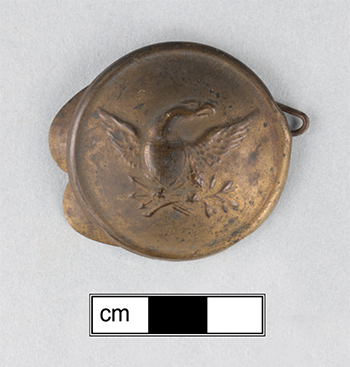 Detailed of copper alloy metal boss from the chinstrap.
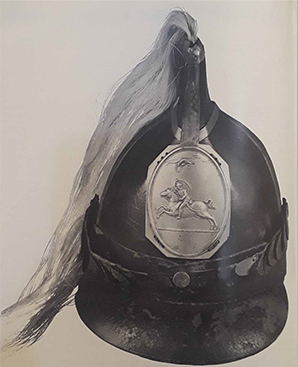 Figure 3. Light dragoon helmet, ca. 1814, in the collection of the Smithsonian
Museum. Photo: Howell and Kloster 1969: 10.
Figure 3. Light dragoon helmet, ca. 1814, in the collection of the Smithsonian
Museum. Photo: Howell and Kloster 1969: 10.
The pattern of Huyett's helmet was influenced by helmets being worn by British and other European cavalry
units at the time (Chartrand 1992, Kochan and Rickman 2000). The cavalry helmets’ design also takes
inspiration from the Classical Revival style that was in vogue then, where aspects of architecture,
art, décor, and fashion were copied from the ancient Greek and Roman worlds.
Tragically, Huyett died in 1840 from a horse and carriage accident while attending a political rally for
William Henry Harrison (Cueto 2020). However, Huyett's memory and story lives on at the Washington County
Historical Society. The cavalry helmet will return to the Historical Society once the conservation treatment
is complete, where it will be reunited with and proudly displayed alongside the coatee Huyett wore during
his War of 1812 service (Figure 4).
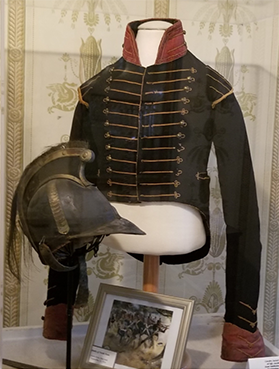 Figure 4. Sergeant Huyett's helmet and coatee on display at the Miller House Museum in
Hagerstown, MD. Photo: Washington County Historical Society.
Figure 4. Sergeant Huyett's helmet and coatee on display at the Miller House Museum in
Hagerstown, MD. Photo: Washington County Historical Society.
References
Chartrand, René
1992 Uniforms and Equipment of the United States Forces in the
War of 1812. Old Fort Niagara Publications, Youngstown.
Cueto, Anna
2020 Personal Communication. Washington County Historical Society.
Howell, Edgar M., and Donald Kloster
1969 United States Army Headgear to 1854: Catalog of United States
Army Uniforms in the Collections of the Smithsonian Institution Volume I. Smithsonian Institution Press,
Washington.
Kimmel, Ross
2020 Personal Communication. Maryland Park Service (retired).
Kochan, James L., and David Rickman
2000 The United States Army 1812–1815. Men-at-Arms Series
345. Osprey Publishing, Oxford.