Have you baked a pie lately? Most likely not. These days most people buy their pies from a bakery or
a grocery store. For the home pie bakers among us, have you ever used a pie crimper to seal and
finish the crust? I’d guess no. Pie crimpers, also known as jaggers, jagging irons, jiggers, coggling
wheels, or dough spurs were kitchen tools used to lattice pastry crust and add a decorative edge while
sealing in the pie's juices (Snodgrass 2004) (Figure 1).
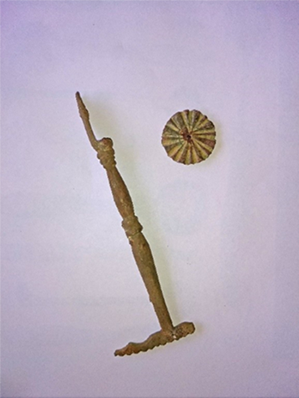 Figure 1: Pie crimper shaft (left) from the Bennett's Point site in Queen Anne's County,
MD and a crimper wheel (right) from the Josiah Henson Birthplace site in Charles County, MD.
Figure 1: Pie crimper shaft (left) from the Bennett's Point site in Queen Anne's County,
MD and a crimper wheel (right) from the Josiah Henson Birthplace site in Charles County, MD.
Any small knife could be used to trim pastry but by the sixteenth century, brass crimpers were being
manufactured for wide use in household kitchens. Early versions of a crimper had a spoon bowl on one
end and a cutting wheel, often jagged or toothed, on the other. The spoon bowl was eventually replaced
with shapes, such as crescents, leaves, stars, or hearts to decorate the crust and to seal the pie's
edges or with pinchers to pinch the crust closed (Figure 2). Some crimpers also included a fork for
pricking crust to allow steam to escape (Snodgrass 2004). Except for the replacement of the spoon
bowl, crimpers remained largely unchanged for almost 400 years before they fell out of regular use in
the mid-20th century (Sambrook and Brears 1996: 146).
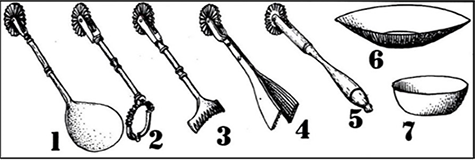 Figure 2: Examples of pie crimpers (nos. 1-5) (Sambrook and Brears 1996: 147).
Most people think of pie as a traditional American dessert, but pie's history can be traced as far back as
ancient Egypt. In 6000 B.C., the Egyptians began making "galettes," or what we would think of as a rustic
freeform pie, filled with honey. By 1300 B.C. bakers for the pharaohs were adding nuts and fruit to their
pies (What's Cooking America n.d.). Later in the 5th century B.C., the Greeks created their own pie pastry
using flour and water, which is even mentioned in the plays of the Greek writer Aristophanes (BBC n.d.).
This pastry, not intended to be eaten, was wrapped around meat and acted as a cooking vessel to seal in
the juices and flavor. The Romans learned pie-making from the Greeks and brought the recipes home with
them. They included oysters, mussels, lampreys, and other meat and fish in their pies. Recipes for pies
made their way across European over the Roman roads and, by the 12th century, pies were a staple of the
European diet (BBC n.d.).
The early European pies, like the Greek and Roman versions, were primarily meat pies with a crust that was
purely functional. Built to be architecturally sound and lacking seasoning or fat, these bland, solid dough
boxes were known as "coffyns" and had to be cracked open in order to scoop out the meat filling (Chavez-Bush 2018;
Gross 2015) (Figure 3). This type of pastry didn’t just serve as a baking dish, it also served the
practical purpose of preserving the food within and allowing for easy transport (Clarkson 2009). Fruit
pies, as we know them today, were first made in the 16th century, and the first cherry pie was made for
Queen Elizabeth I (American Pie Council 2019; BBC n.d.).
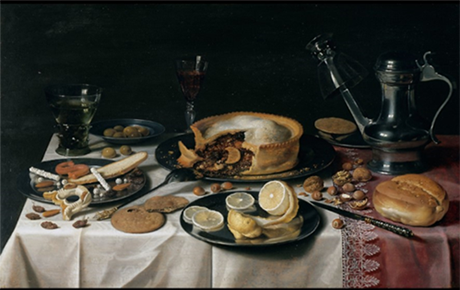 Figure 3: Still Life by Pieter Claesz, 1625 (Art Institute of Chicago n.d.).
Pie came to America with the first English settlers. The early colonists cooked their pies in long narrow
pans calling them "coffins" as in England. It was during the American Revolution that the term crust, like the
hard, outer surface of bread, began to be used (BBC n.d.). As Americans moved west, they made the best
use of the resources available to them, turning vegetables such as rhubarb, green tomatoes and onions,
into sweet desserts that reminded them of home (Gross 2015). Pies became such an important part of the
pioneer diet that was often served at every meal. They soon became the favorite of contests at county
fairs, picnics, and other gatherings throughout the country, which has led to our ubiquitous use of
the phrase "as American as apple pie."
References
The American Pie Council
2019 The History of Pies.
Web resource: http://www.piecouncil.org/Events/NationalPieDay/HistoryOfPies accessed April 20, 2020.
Art Institute of Chicago
n.d. Web resource: https://www.artic.edu/artworks/21682/still-life
accessed April 20, 2020.
BBC
n.d. A Shortcrust History of Pies. Web
resource: https://www.bbc.co.uk/bitesize/articles/zmtn2sg accessed April 20, 2020.
Chavez-Bush, Leigh
2018 Medieval Europeans Didn't Have Tupperware, They Had Pastry
Coffins. Web resource: https://www.atlasobscura.com/articles/who-made-first-pie accessed April 20, 2020.
Clarkson, Janet>
2009 Pie: A Global History. United Kingdom: Reaktion Books.
Web resource: https://www.google.com/books/edition/Pie/FZoJAgAAQBAJ?hl=en&gbpv=0 accessed April 20, 2020.
Gross, Rachel E.
2015 How Pie Got Its Sweetness. Web Resource:
https://slate.com/human-interest/2015/03/history-of-pie-how-savory-meat-pies-evolved-into-americas-favorite-dessert.html
accessed April 20, 2020.
Sambrook, Pamela A., and Peter Brears
1996 The Country House Kitchen, 1650-1900. Sutton Publishing, Gloucestershire.
Snodgrass, Mary Ellen
2004 Encyclopedia of Kitchen History. Taylor and Francis Group, New York.
What's Cooking America
n.d. History of Pies. Web resource:
https://whatscookingamerica.net/History/PieHistory.htm accessed on April 20, 2020.