Bus or train fare tokens, tool tokens, slot machine tokens, wooden nickels – these are just a few of the
tokens that businesses have used over the years as promotional pieces, to extend credit or to serve as legal
tender redeemable for a specific product or service. Although similarly shaped and sized, tokens are generally
easy to differentiate from coins, since they were made of less expensive materials, like tin, aluminum, pewter,
brass or wood. Trade tokens—created by general stores, bars and saloons, grocers, barbers and many
others—were most popular in the United States between 1870 and 1920 (Wikipedia 2020).
This curious aluminum token (Figure 1) was discovered in a brick-lined privy at the Federal Reserve Site (18BC27)
in Baltimore, Maryland. It was produced around the turn of the 20th century by Solomon (Sol) Sipser, a wine and
liquor merchant at 215 Hanover Street in Baltimore. In 1896, Sipser took over Kolle and Kaiser (also known as
Keyser), a liquor business that operated at the same Hanover Street address from 1887 to 1896 (CIT). Sipser's
business was listed in the Polk's Baltimore City Directory as early as 1899 and as late as 1906 (Polk 1899, 1906).
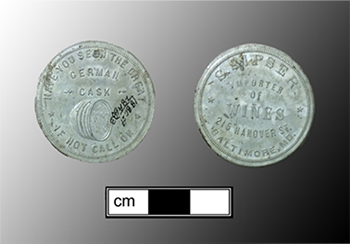 Figure 1. Aluminum token from S. Sipser Wine and Liquor Merchant.
Sipser, born in Hungary in 1863, immigrated to the United States in 1885. In 1900, he and his wife Sally and their
three sons lived upstairs in the rented three-story building at 215 Hanover Street, where he operated the wine
business (Ancestry.com).
Sipser produced other promotional materials, like stoneware liquor jugs in various sizes (Figure 2) printed with the
business name and address. The opposite side of the Sipser token sports an image of a wooden cask, along with
the words "Have You Seen the Great German Cask – If Not Call On" (Figure 1). The holder of the token
would presumably flip the token over to learn the name and address of the business where the great cask could be
found. Sipser's business stationery listed him as a direct importer of German and French wines (Figure 3), so
it is likely that the cask referenced on the token held German wine. The finest German wines were fermented in
casks, with the best results obtained from very large casks—the famous Heidelburg tun measured 31 feet long by
21 feet in height (DeColange 1880:445). Some of these casks were elaborately decorated, as suggested by the cask
shown on the token. Searching through Baltimore newspapers of the turn of the century did not reveal any items
about Sipser's promotion, but it is likely that the cask was large enough to attract potential customers into the shop.
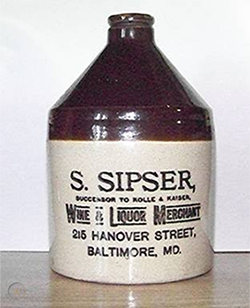 Figure 2. Photo from Worthpoint.com.
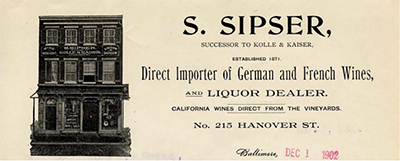 Figure 3. Sipser's letterhead depicted the Hanover Street storefront at the turn of the twentieth century.
References
Ancestry.com
1900 United States Federal Census. Provo, UT, USA: Ancestry.com Operations Inc., 2004.
DeColange, L.
1880 The American Dictionary of Commerce, Manufactures, Commercial Law and Finance.
Volume 1. Estes and Lauriat, Boston. Website accessed
March 18, 2020 at https://play.google.com/store/books/details?id=BnhQAAAAYAAJ&rdid=book-BnhQAAAAYAAJ&rdot=1.
Polk, R. L.
1899 Polk's Baltimore City Directory, Volume 15. R.L. Polk & Company, Baltimore.
1906 Baltimore City Business Directory, 1905-1906. R.L. Polk & Company, Baltimore.
Pre-Pro.com
2020a Kolle & Kaiser. www.Pre-Pro.com Distillers and Importers. Website accessed March
18, 2020 at http://www.pre-pro.com/midacore/view_vendor.php?vid=BWI8734.
2020b Sol Sipser. www.Pre-Pro.com Distillers and Importers. Website accessed
March 18, 2020 at http://www.pre-pro.com/midacore/view_vendor.php?vid=BWI9262.
Wikipedia
2020 Token Coin. Website accessed March 18, 2020 at
https://en.wikipedia.org/wiki/Token_coin.