Until the late 19th century, refined sugar was sold in loaf form — cylindrical cones that were molded into
different sizes (some as tall as three feet!), wrapped in paper and sold to the individual consumer (Figure 1).
Breaking the hard sugar into smaller chunks to be processed for cooking or sweetening beverages required a tool
that would have been instantly recognizable to our colonial ancestors. Sugar nippers (also called nips, cutters
or tongs) had curiously-shaped blades and were designed to be used like scissors to separate smaller chunks of
sugar from the cone. Miss Leslie's Lady's House-Book, published in 1850, advised readers that "a pair
of sugar-nippers are indispensable, for breaking small the loaf-sugar after it has been cracked with a stout
knife and a mallet or hammer." (Leslie 1850:235).
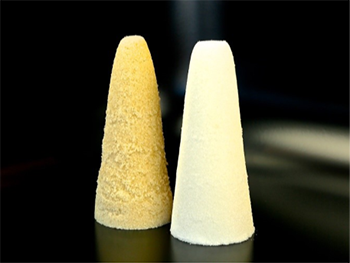 Figure 1. Refined white and brown sugar molded into cones. Photo from
www.Cocktaildudes.com.
Figure 1. Refined white and brown sugar molded into cones. Photo from
www.Cocktaildudes.com.
A pair of iron sugar nippers were discovered during archaeological excavations at Oxon Hill/Addison Plantation
(18PR175) in Prince George's County, Maryland (Figure 2). They were found on the ground surface near the former
Addison manor house, built in 1710 and destroyed by fire in 1895 (McCarthy et al. 1990).
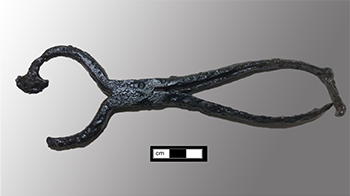 Figure 2. Sugar nippers from Oxon Hill Plantation.
The Addison family's sugar nippers were of the handheld variety. A small leg or spike that projected from one of
the handles at a right angle was held against the tabletop to steady the nippers and provide more control
(Figure 3). The Addison sugar nippers were missing this spike, and one of the blades was broken as well.
Tabletop nippers were mounted horizontally on boards, allowing the user greater force with the blades
(Old and Interesting 2009).
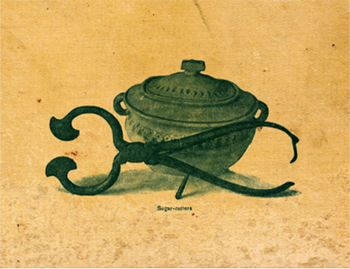 Figure 3. Sugar nippers and sugar dish depicted in a print of unknown date. The shape and decoration
on the sugar dish date its manufacture to the early 19th century. Illustration from
http://www.victorianpassage.com.
Figure 3. Sugar nippers and sugar dish depicted in a print of unknown date. The shape and decoration
on the sugar dish date its manufacture to the early 19th century. Illustration from
http://www.victorianpassage.com.
Sugar nippers for use in the kitchen were generally made of iron—like the Addison example—or of silver
for use with tea services. Some iron examples were decorated at the joint between the two handles (Jamestown
Yorktown Foundation 2015), but the Addison example was undecorated.
Granulated and cubed sugar, introduced in the late 19th century, were the death knell for sugar nippers. Since
that time they have been relegated to the odd kitchen curiosity that shows up in antique shops.
References
Jamestown Yorktown Foundation
2015 Sugar Nippers: An Essential Component of Well-Equipped 18th-Century
Kitchens. Website accessed March 13, 2020 at https://www.historyisfun.org/blog/sugar-nippers/.
Leslie, Eliza
1850 Miss Leslie's Lady's House-book: A Manual of Domestic Economy. A. Hart, Philadelphia.
McCarthy, John P. and Jeanne A. Ward, George D. Cress, and Charles D. Cheek
1990 Intensive Archeological Survey of the Addison Plantation Site and
Intensive Archeological Testing of the Addison Manor Foundations, Beltway Parcel, PortAmerica Development, Oxon Hill,
Prince George's County, Maryland. John Milner and Associates, West Chester, PA. Website accessed March 17, 2020
at http://colonialencounters.org/files/sitereports/Addison-3.pdf.
Old and Interesting
2009 Sugar Cutters & Nippers. Old & Interesting; History of Domestic Paraphernalia. Website
accessed March 13, 2020 at http://www.oldandinteresting.com/sugar-nippers.aspx.