The US Life Saving Service (USLSS), established in 1878, is the predecessor to the US Coast Guard, tasked to
help those "in peril upon the seas." Stations fell into three categories: lifesaving, lifeboats, and houses
of refuge [Noble 2014]. Assateague Island, an Atlantic barrier island shared by Maryland and Virginia, was
home to four USLSS lifesaving stations that responded to over 250 ships in peril [NPS 2020] between 1875 and
1915 until merged with the US Revenue Cutter Service to form the United State Coast Guard [Beard & Hanson 2004].
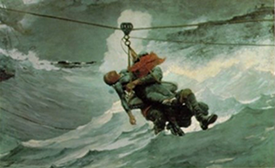 The Life Line, by Winslow Homer 1884 show the use of a breeches buoy and the block and tackle
system used to carry wreck victims to safety. Credit Philadelphia Museum of Art.
The Life Line, by Winslow Homer 1884 show the use of a breeches buoy and the block and tackle
system used to carry wreck victims to safety. Credit Philadelphia Museum of Art.
The USLSS had two methods of aiding vessels stranded near the shore: by boat and by a rope stretched between
the shore and wrecked vessel. The latter was achieved by using a cannon-like instrument known as a Lyle Gun,
which can fire a projectile with an attached line up to 600 yards. This messenger line was then used to pull
out a strong cable so that either a life car or beeches buoy [Nobel 2014] could transport persons from vessel to
shore without putting a rescue craft in the water and risking the lives of the rescuers.
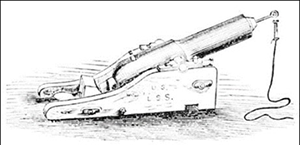 Lyle gun ready to fire. Credit United States Lighthouse Society.
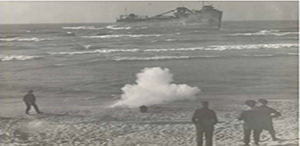 The firing of a Lyle Gun to a frieghter grounded in Lake Michigan in 1939. Credit unknown.
The line thrower, commonly referred to as a Lyle Gun, was designed by ordinance specialist, Col. David A. Lyle
(1845-1937). The Army had been tasked by the Secretary of the Treasury who oversaw the Life Saving Service, to
improve lifesaving equipment. By 1878, Lyle developed an accurate, lightweight gun that was in use at lifesaving
stations around the country [Barnett 1976]. The 2 ½” smoothbore gun became the standard line-throwing gun of the USLSS.
The Lyle Gun was replaced by the Coast Guard in 1952 first by line-throwing rockets and then by helicopters. It
is estimated that the Lyle Gun contributed to the rescue of approximately 4500 individuals [NPS.gov 2015].
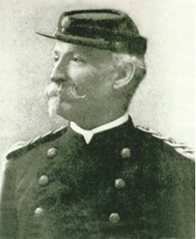 Col. David A. Lyle, inventor of the Lyle "Life Saving" Gun. Credit Springfield Armory NHS archives.
US NPS.
Col. David A. Lyle, inventor of the Lyle "Life Saving" Gun. Credit Springfield Armory NHS archives.
US NPS.
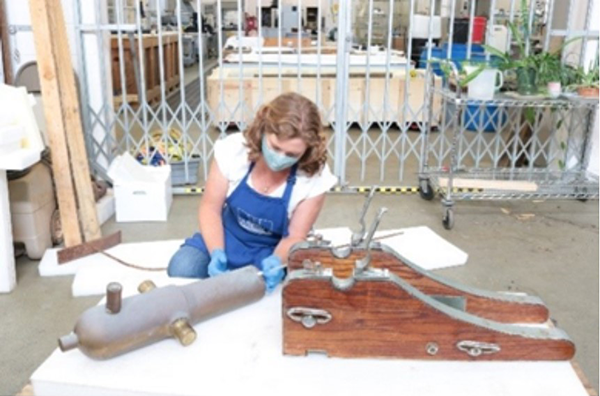 Assoteague Lyle Gun undergoing conservation treatment at the MAC Lab.
References
Anonymous
2015 David Lyle and His Life Saving Gun.
https://www.nps.gov/spar/learn/historyculture/david-lyle.htm.
2020 USLSS – Assateague Island National Seashore.
https://www.nps.gov/asis/learn/historyculture/uslss.htm.
Barnett, J. Paul
1976 The Lifesaving Guns of David Lyle. South Bend Replicas.
Beard, Tom and Hanson, Stephen Jose
2014 The Coast Guard. Hugh Lauter Levin Associates, Seattle, WA.
Shanks, York, and Shanks
1996 The U.S. Life-Saving Service: Heroes, Rescue, and
Architecture of the Early Coast Guard. Costaño Books, Petaluma, CA.