It is not uncommon for archaeologists to find animal bones at both prehistoric and historic sites. These
remains can tell us what kind of relationships the inhabitants had with animals--whether they were domesticated
or wild or whether they formed a regular part of their diet. Through a close study of the type and the amount of
animal remains we find, we can determine how people were hunting, preparing, and cooking animals for food. A major
faunal type we find in the Chesapeake region are fish bones. With their small size and delicate features, sometimes
it is difficult for archaeologists to find, let alone identify what part of the skeleton a particular bone once
belonged to. One of the most curious skeletal remains of a fish is a small, smooth-surfaced bone the size of a
pebble called an otolith (Figure A).
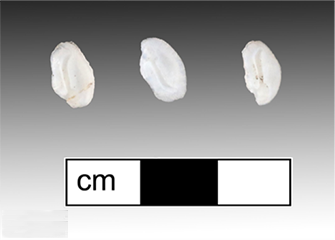 Figure A.
Figure A: Otoliths found through dry screening at the Smith St. Leonard Site (18CV91), occupied
between 1711 and 1754. The small size of the otoliths often cause them to be missed by archaeologists, calling for
careful consideration of every little-pebble look alike.
Figure B and C: Notice the difference in the two faces of the same otoliths. Figure B is of the
flatter, more concave face of the otolith that offers little species information. Figure C on the right has a
more shapely, convex shape that is distinct to a unique species of fish.
Figure D: An example of an incredibly thin slice of an otolith, cut in the laboratory using a
low-speed diamond bladed saw. The thinness of the otolith cross-section allows scientists to see the difference
between the opaque and translucent zones. Each zone indicates different periods of growth in the fish's
lifespan (Florida Fish and Wildlife Conservation Commission).
Otoliths are the ear-stone of the fish; a feature found in all fish other than sharks, rays and lampreys (Casteel
1976:17). Each fish has 3 pairs of otoliths that float inside its soft inner ear canals (Fishing and Wildlife
Canada). Each otolith is made up of small build-ups of calcium carbonate crystals. These calcium deposits are
derived from both the food the fish eats and the water it lives in during its lifespan. So what is the purpose
of these growing ear stones? These deposits seem to be part of the system in charge of controlling the fish's
equilibrium and hearing (Castell 1976:17). There is some suggestion that otoliths may be a functional mechanism
of depth perception or serve as a method of measuring sound frequencies.
By studying otoliths, archaeologists can find out a lot of information about the fish once native to a region. The
size of the otolith, for example, can be used to estimate the approximate size of a fish. Even more
interestingly, the shape of the otoliths can help archaeologists to determine what species of fish were being
caught and eaten by a site's inhabitants. By looking at the comparatively more sculpted form of the underside
of the otolith, it is possible to identify an adult otolith to the generic or species level of fish (Figure B,
Casteel 1976:21).
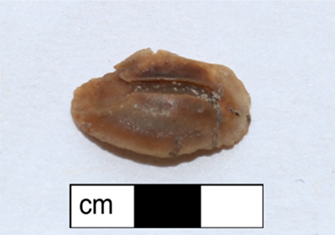 Figure B.
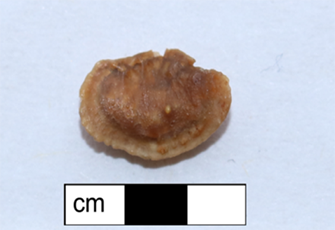 Figure C.
It is not just the size and shape of otoliths that offer information, as zooarchaeologists can also look at the
individual calcium deposits. While calcium deposits can build up at different rates throughout each year of a
fish's life, much like tree rings, by counting the number of deposits zooarchaeologists can estimate the age
of a fish (Figure D). Within a laboratory setting, a very thin slice or cross-section can be removed and the
rings can be clearly counted. Another method of counting the otolith rings, or annuli, is to crack the otolith
in half and then lightly burn it. The burning defines the annuli rings, allowing them to be counted (Fishing and
Wildlife Canada).
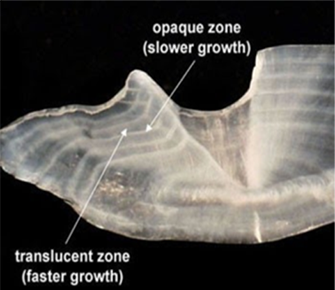 Figure D.
References
Casteel, Richard W.
1976 Fish Remains in Archaeology; and Paleoenvironmental Studies. Academic Press.
Fisheries and Oceans Canada
2018 "Otoliths, removal and ageing."
https://dfo-mpo.gc.ca/science/aah-saa/otoliths/students/removal-prelevement-eng.html Accessed 17 July 2020.
Florida Fish and Wildlife Conservation Commission
n.d. Introduction to Ageing Fish: What Are Otoliths?
https://myfwc.com/research/saltwater/fish/age-growth-lab/ageing-fish-otoliths/. Accessed 17 July 2020.