Voters often spread word about which political candidate they are supporting by showcasing objects
with catchy slogans and the name of their favorite candidate. Pins, hats, flags, bumper stickers,
and shirts in an array of styles and designs are the most popular way voters proudly show their support.
Historically, one way that political candidates spread the word of their campaign was by producing their
likeness on everyday objects, such as tobacco pipes (National Park Service: n.d.). Known as Presidential
or campaign pipes, these pipes reflected a candidate’s likeness and usually included their name. An example
of which is a Franklin Pierce pipe found during the excavations of the 19th and 20th century Maynard-Burgess
House site in Annapolis, Maryland (Mullins and Warner 1993: 76) (Figure A).
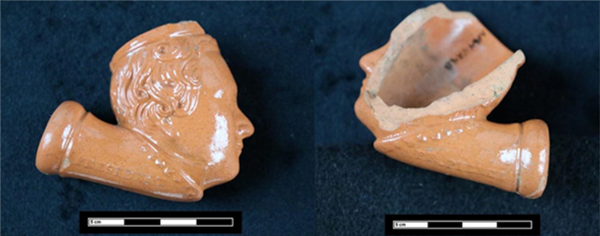 Figure A. The right side of the pipe reads "PRESIDENT," the left side
"FR. PIERCE."
Figure A. The right side of the pipe reads "PRESIDENT," the left side
"FR. PIERCE."
Anthropomorphic pipes, or face pipes, depict the faces of mostly well-known characters or political candidates
(Cande 2019). These pipes came into fashion during the nineteenth century and depicted an array of famous
people from George Washington and Ulysses S. Grant to Emily Bronte. (Thomas Jefferson's Poplar Forest 2016).
The Franklin Pierce pipe was made from red clay with a clear lead glaze. With markings of "FR. PIERCE" on one side
and "PRESIDENT" on another, this design was produced from 1853-1858 (Bell 2004: 52).
Franklin Pierce, a Democrat from New Hampshire, served as a Democratic representative and a senator before winning
the Presidential nomination in 1852 (Figure B). A veteran of the Mexican-American war and support of pro-slavery
states, Pierce won the popular vote against his Whig candidate General Winfield Scott. Pierce served as 14th
President of the United States from 1853-1857 and was the youngest person ever elected to the office.
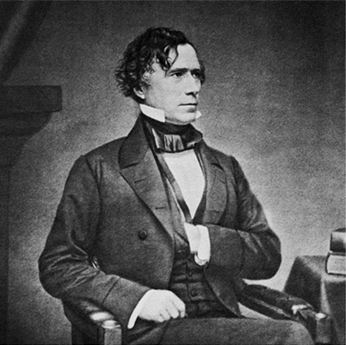 Figure B. Franklin Pierce served as teh 14th president of the United States from 1853-1857
(The White House).
Figure B. Franklin Pierce served as teh 14th president of the United States from 1853-1857
(The White House).
During his time as President, the country saw national tensions only rise as the Kansas-Nebraska Act of 1854 led
to heightened tension between the North and South. This act allowed states to determine whether they were a free
state or a slave state. Kansas became a battleground as citizens flooded the state, trying to influence the
state's decision. These tensions came to a tipping point as violence erupted in a series of violent altercations
between groups, dubbing the area "bleeding Kansas." This series of bloody clashes between abolitionists led by
John Brown and pro-slavery settlers became a precursor to the Civil War (American Battlefield Trust: n.d.,
Figure C). Pierce’s presidency represented the political conflict and turmoil that defined this time in America's history.
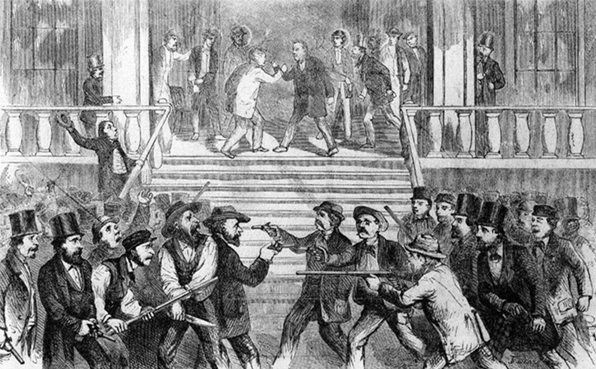 Figure C. Bleeding Kansas Clash between proslavery and antislavery groups in Fort Scott, Kansas
Territory, 1850s (Encyclopedia Brittanica).
Figure C. Bleeding Kansas Clash between proslavery and antislavery groups in Fort Scott, Kansas
Territory, 1850s (Encyclopedia Brittanica).
References
American Battlefield Trust
n.d. "Bleeding Kansas." Civil War History. American Battlefield Trust.
https://www.battlefields.org/learn/articles/bleeding-kansas.
Accessed March 24, 2021.
Bell, Max
2004 "Collecting American Face Pipes." Bottles and Extras. Spring 2004.
https://www.fohbc.org/PDF_Files/Bell_ClayPipes.pdf
Accessed March 24, 2021.
Cande, Kathleen
2019 "Franklin Pierce Anthropomorphic Tobacco Pipe." Arkansas
Archeological Survey, University of Arkansas. September 2019. https://archeology.uark.edu/artifacts/pipe/. Accessed March 24, 2021.
Encyclopedia Britannica
2011 "Remembering the American Civil War." Remembering the American Civil
War - Timeline of events Accessed March 24, 2021.
Mullins, Paul R., and Mark S. Warner
1993 Final Archaeological Investigations at the Maynard-Burgess House (18AP64). An
1850-1980 African-American Household in Annapolis Maryland, Volume I.
National Park Service
n.d. "President Pipes at Vancouver Barracks."
https://www.nps.gov/articles/vancouverbarrackspresidentpipes.htm
Accessed March 23, 2021.
Thomas Jefferson’s Poplar Forest 2016
2016 "Blowing Smoke: A Presidential Campaign at Poplar Forest." Archaeology Blog.
https://www.poplarforest.org/blowing-smoke-a-presidential-campaign-at-poplar-forest/. Accessed March 24, 2021.
The White House
n.d. "Franklin Pierce: The 14th President of the United States." The White House.
https://www.whitehouse.gov/about-the-white-house/presidents/franklin-pierce/. Accessed March 23, 2021.