This pithy quote is attributed to American Founding Father and Revolutionary War hero Samuel Adams.
More importantly here, Adams was also involved in the brewing industry as a maltster. Several
generations of his family produced malt—a vital component in beer (Baron 1962:462). Pierced
tiles (Figure 1) were used in the floors of malting houses.
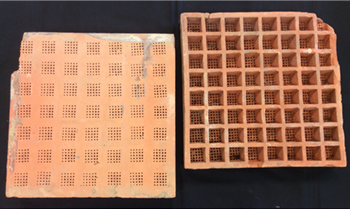 Figure 1. Two of the malting tiles found at the Clagett Brewery site. The tile on the left
shows the malting floor surface side, while the tile on the right shows the underside, with the
deep cell structure.
Figure 1. Two of the malting tiles found at the Clagett Brewery site. The tile on the left
shows the malting floor surface side, while the tile on the right shows the underside, with the
deep cell structure.
Archaeologists working for the Baltimore Center for Urban Archaeology found these tiles during a 1983 excavation
at the site of the former Clagett;s Brewery (Comer et al. 1984). The brewery began producing ale in 1784 and
operated until 1880 under as many as ten owners, including Eli Clagett (Akerson 1990). In addition to
discovering the foundation of the brewery’s malthouse, other artifacts related to the brewery operations
were found, including several dumps of nineteenth-century bottles. More unusual were over three dozen
perforated unglazed ceramic tiles used as flooring for the malting kiln. Manufactured in England by two
companies in operation in the second and third quarters of the nineteenth century (Figure 2), each tile
measures one-foot square and contained 1600 small holes (Bromwich 1984). Hot air passed through these holes
to enter the drying room from the floor below, preventing the sprouted barley from growing so that it
could be used to produce malt (Figure 3).
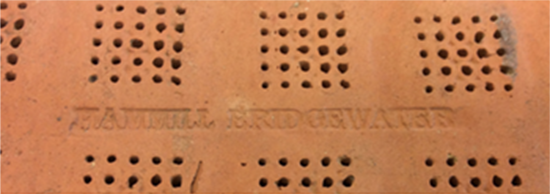 Figure 2. Detail of one of the tiles, showing the stamped mark of the Hammill Company,
in operation in Bridgewater, England, between 1866 and 1883.
Figure 2. Detail of one of the tiles, showing the stamped mark of the Hammill Company,
in operation in Bridgewater, England, between 1866 and 1883.
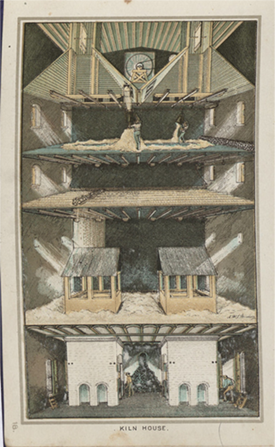 Figure 3. Lithograph from an 1892 publication of the F. A. Poth Brewing Company of
Philadelphia (Mueller 1892). The kilns are shown on the ground floor, with the floors of drying
barley above.
Figure 3. Lithograph from an 1892 publication of the F. A. Poth Brewing Company of
Philadelphia (Mueller 1892). The kilns are shown on the ground floor, with the floors of drying
barley above.
Baltimore, once the second largest city in the United States, has been home to over 115 breweries since the
first brewery began operation there in 1748 (Arnett et al. 1999:274). Beginning in the mid-nineteenth century,
the arrival of immigrants from Germany brought about a wave of breweries producing light German lagers; more
than fifteen breweries are shown on the 1869 Sasche map of Baltimore (Sasche 1869). The brewery industry
remained vibrant in Baltimore until Prohibition.
References
Baron, Stanley Wade
1962 Brewed in America: The History of Beer and Ale in the United
States. Boston: Little, Brown.
Bromwich, David
1984 Letter addressed to Charles Cheek, dated April 5, 1984.
Somerset County Library, Taunton, England. In BCUA files at MAC Lab.
Comer, Elizabeth Anderson, Charles Cheek, and Elizabeth Hartley
1984 The Great Baltimore Brewery Dig: Excavations at an
Eighteenth-Century Industry. Draft report on file at MAC Lab.
Mueller, A.M.J.
1892 Souvenir Album. F.A. Poth Brewing Company, Philadelphia.
Avil Printing Company. http://brookstonbeerbulletin.com
Sasche, E.
1870 E. Sachse, & Co.'s bird's eye view of the city of Baltimore,
1869. Library of Congress Geography and Map Division Washington, D.C.